

(As we’re apt to do for the summers, we tend to hire a few interns. It’s a great way to pass on some of the things we’ve learned, inject a fresh new view into what we do from someone younger, and get a bit of help on a few odds and ends. For this summer, Open Square welcomed a batch of interns, and over a series of articles, they’ll share some of their learnings from their research. This summer, we had the pleasure of having Jacqueline (Sora) Oh. Sora is a rising sophomore at Northeastern University in Boston, majoring in Business. Sora’s an amazingly worldly young person who’s traveled all over as the daughter of a US diplomat. Given her breadth of experiences, we sought to find something equally unique to look at. Ultimately, she settled on exploring a global phenomenon, Formula 1. We hope you enjoy her article below. If you’d like to reach out to Sora for future opportunities, feel free to email her at jacquelinesoraoh@gmail.com.)
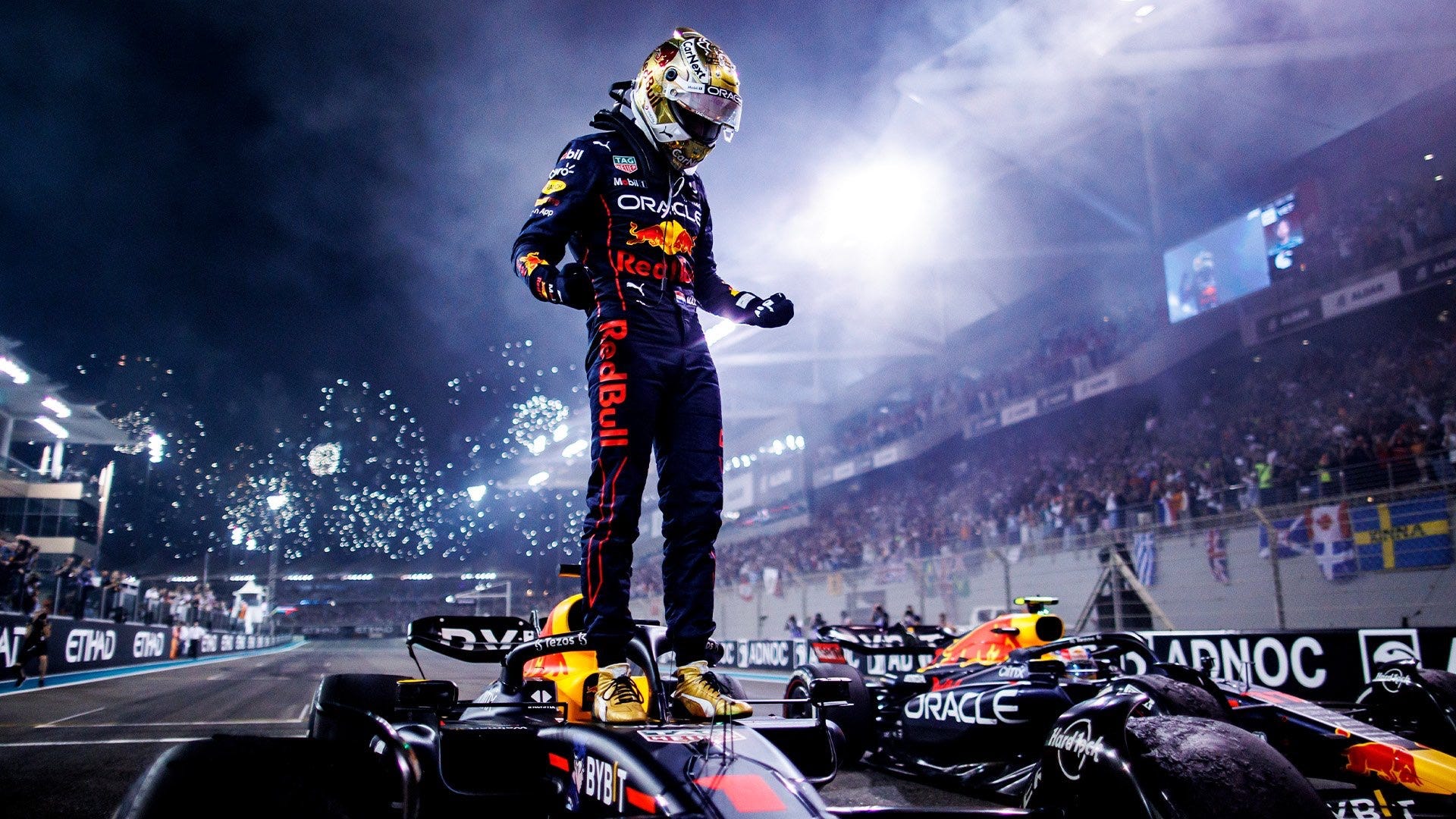
Growing up, I’ve never really cared about cars. Yet somehow, I found myself drawn to a sport in which the entire premise is watching multimillion-dollar cars circle the same track for hours, moving so fast that you can’t even make out the drivers. It wasn’t until I watched Netflix’s “Drive to Survive” that I finally understood the appeal. What drew me in wasn’t the racing, but everything Formula 1 (“Formula 1” or “F1”) is built around it.
Behind the glamour of these races sits a company most fans haven’t heard of: Liberty Media. Having acquired Formula 1 in 2017 for roughly $4.4B, Liberty Media had originally structured its ownership of the sport as a separate class of stock called the Formula One Group, differentiated from its other holdings at the time, SiriusXM, Atlanta Braves, and Liberty Live Group. This “tracking stock” allowed investors to buy a stake of F1 without also buying into Liberty Media’s other businesses. Since then, Liberty Media has split off Atlanta Braves (2023), Sirius XM (2024), and Liberty Live Group (2025), leaving the Formula One Group as its primary remaining business.
The Formula 1 Business
The Formula 1 business can be separated into three distinct pieces: racing, media, and sponsorship. The sport is controlled by the FIA, an international governing body who promotes road safety, but also writes the rulebook for Formula 1. Pursuant to the company’s Form 10K “[t]he FIA owns the F1 Championship and has granted Formula 1 the exclusive commercial rights to the F1 Championship until the end of 2110 under the 100-Year Agreements.” The commercial side of the sport is managed by Liberty Media, which since 2017 holds the exclusive commercial rights with respect to the F1 Championship, an annual, approximately 9-month long, motor race-based competition in which teams compete for the Constructor’s Championship and drivers compete for the Drivers’ Championship.
Liberty Media oversees the sport’s business operations including media rights negotiations, sponsorship agreements, and race scheduling. The competition itself consists of ten teams including Ferrari, Mercedes, Red Bull, and McLaren. Each team operates independently, and designs, builds, and races their own cars (“Formula 1 Teams”). Iconic teams such as Ferrari and Mercedes shaped the early years of F1 by constantly pushing the limits of engineering and performance. As the sport evolved, new technologies such as turbocharged engines and improved aerodynamics transformed the way cars were designed and raced. By the 2010s, F1 introduced its turbo-hybrid power units, entering a new era designed to prioritize efficiency and sustainability without sacrificing speed or competition.
Since 1981, a successive series of agreements (collectively “Concorde Agreements”) have governed the relationship between Formula 1, the FIA, and the Formula 1 Teams. The Concorde Agreement sets the procedures for setting the F1 Championship calendar, the rights of the Formula 1 Teams, and the fixed percentage of prize funds paid to the winners of the Constructor’s Cup and Driver’s Cup. The agreement was recently renewed in 2026. Surrounding this entire ecosystem are sponsors, who invest in the opportunity to associate their brands with the sport’s global exposure, technology, the popularity of its drivers, and prestige.
The Rise of Formula 1
Since its first race at Silverstone in 1950, Formula 1 has grown from a small European sport into a global spectacle. With the rise of digital media and the recent success of Netflix’s Drive to Survive series, F1 has transformed into one of the most watched sports on the planet. With the championship spanning roughly 24 races across in 21 countries each season, the global audience has grown year after year.
In 2023, Formula 1 introduced its Las Vegas Grand Prix, bringing the sport to one of the most iconic roads in the US: the Las Vegas strip. It was reported that Formula 1 had spent more than half-a-billion dollars, all to build and host just 1 of the 24 races on its annual calendar. Just a year later, the race sold out, drawing over 300,000 fans from around the world.
In 2025 alone, the sport had 15 sell out races, while live attendance climbed from 5.5 million spectators in 2024 to 5.8 million in 2025. Demand has grown so intense that tickets for major races now sell out within 20 minutes of release. That momentum shows no signs of slowing down as 18 of the 24 races on F1’s calendar are already contracted with host countries to 2030 and beyond.
The Business and the Stock
The Formula One Group today is a racing sports juggernaut with momentum on its side. Liberty Media has three distinct classes of common stock, two of which are traded on the Nasdaq: FWONA, FWONB, and FWONK.
FWONA carries one vote per share (publicly traded),
FWONB carries ten votes per share (not publicly traded), and
FWONK carries no voting power (publicly traded)
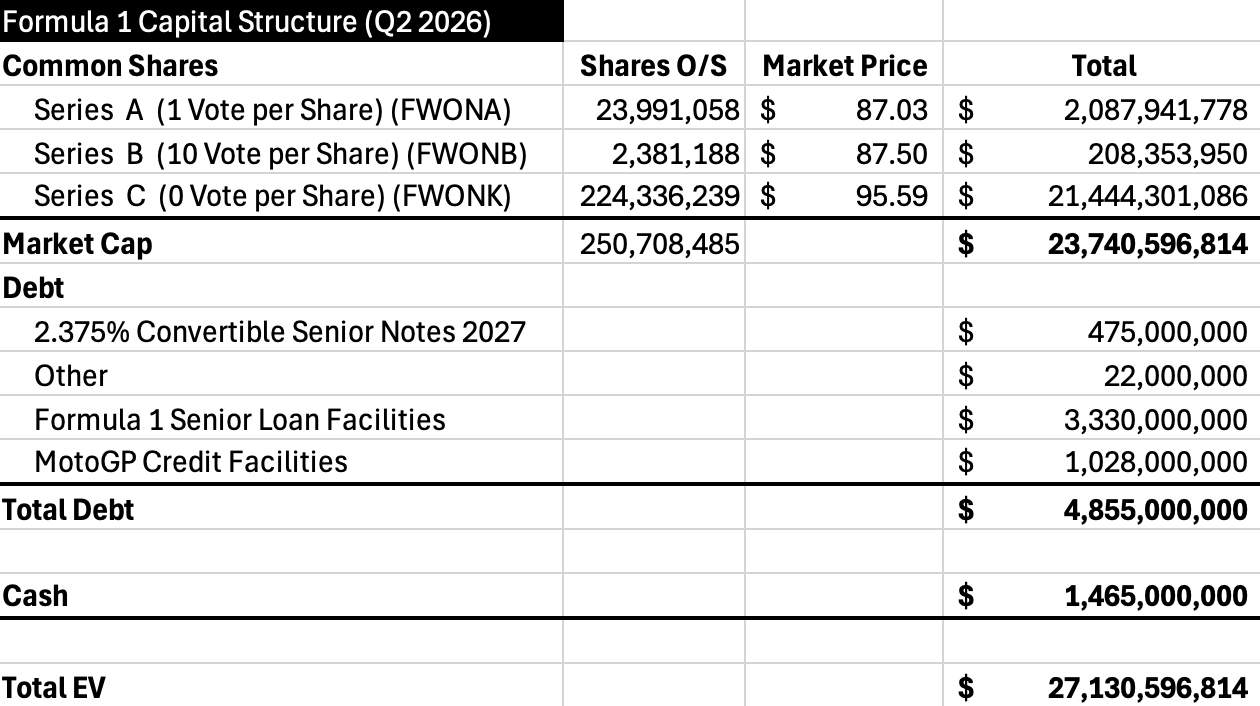
In practice, FWONK is the class most retail investors and financial media actually focus on, since it’s the most liquid and widely held of the three. For simplicity, this report treats FWONK, Liberty Media, and the Formula One Group interchangeably, since they all refer to the same publicly traded stake in F1. Based on the table above, as of September 13th, the Series A and Series C are trading at roughly $87 - $95/per share, giving the company a market capitalization at around $24B.
(OSC - Okay, so walk me through the financials for this $24B company.)
Financials:
When it comes to analyzing Liberty Media’s business model, the company derives its revenues primarily from four sources:
Media rights
Race promotion
Sponsorships
Other/premium hospitality experiences (VIP Paddock Club)
It’s important to note here that Liberty Media acquired 86% of MotoGP (a motorcycle racing series similar to F1) in 2025. While MotoGP brings in additional media rights and sponsorship income, F1 remains by far the largest driver of Liberty Media’s revenue, so the analysis in this report continues to center around F1 and its core revenue streams.
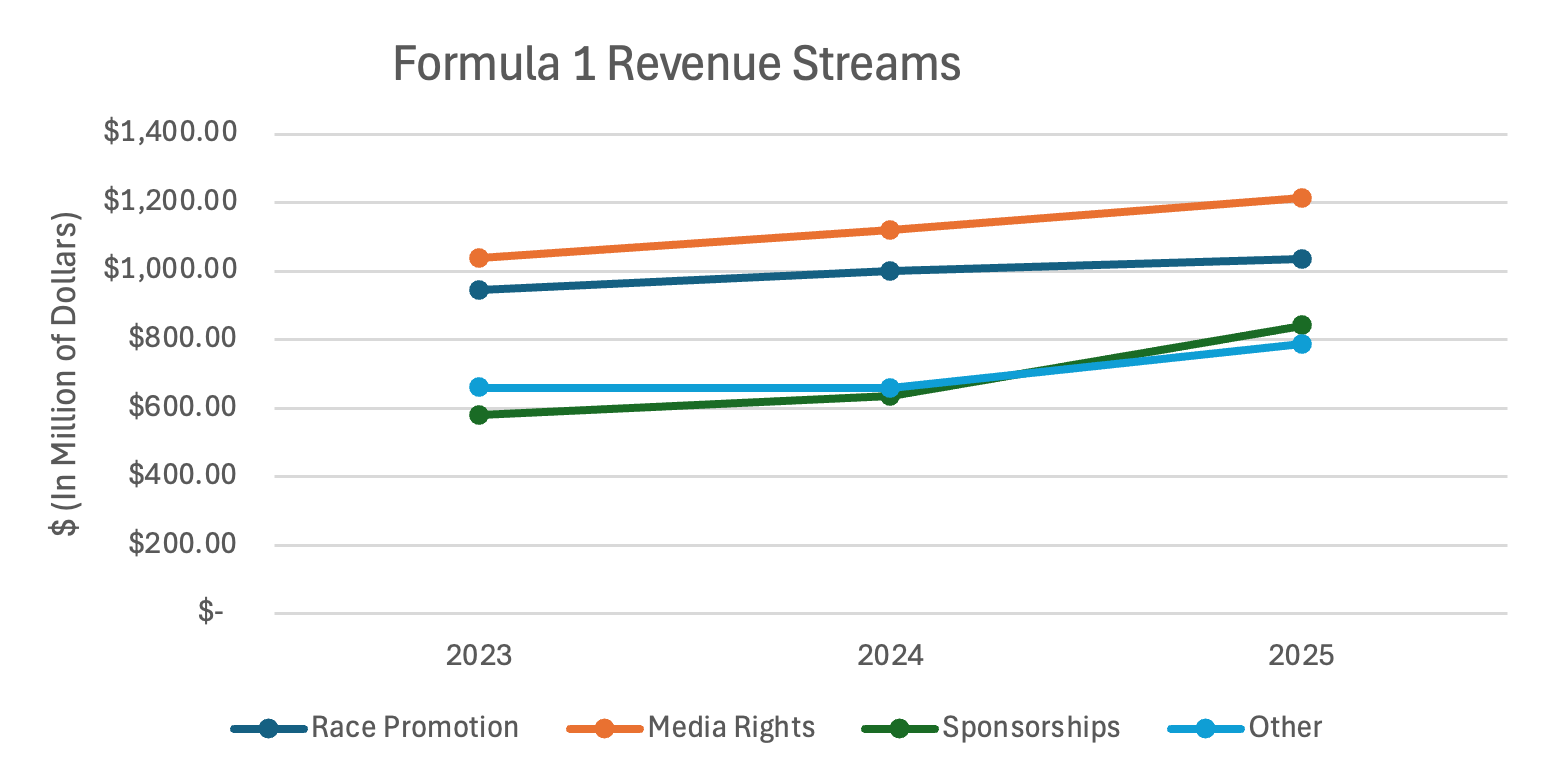
From 2023 to 2025, total revenue grew by roughly 25%, from $3.57B to $4.48B. Revenues in 2025 included the acquisition of MotoGP, which added $0.33B. Strip that out and revenue for 2025 would’ve been closer to $4.15B, so ~20% overall.
Media rights remain the largest single stream, growing from $1.04B to $1.21B over the same period, reflecting the value of F1’s broadcast deals around the world. In contrast, sponsorship revenue stands out as the fastest growing stream, climbing from $0.58B in 2023 to $0.84B in 2025, a jump of over 44% in two years.
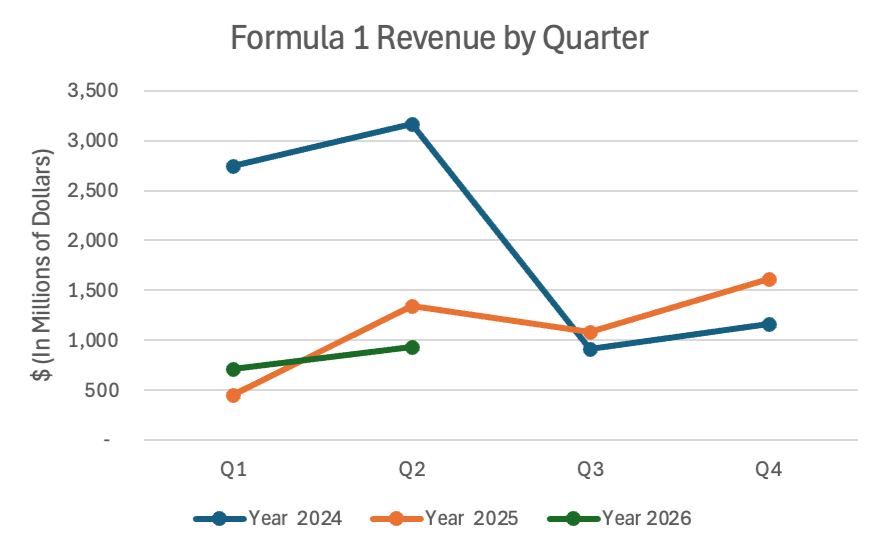
Comparing year-to-date, total revenue for H1 2026 was $1.65B, down approximately 8% from $1.79B in H1 2025. Notably, the sudden downtrend in revenue in Q2 stems from the two canceled races due to the ongoing conflict in the Middle East: Bahrain Grand Prix and the Saudi Arabian Grand Prix. However, the company has already rescheduled the Bahrain Grand Prix for early October in Malaysia, bringing the race season back up to 23 out of 24 originally scheduled races.
Let’s explain each type of revenue stream in detail.
Media Rights. According to Liberty Media’s financials, media rights remains Formula 1’s largest revenue stream, comprising 32.2%, 32.8%, and 31.3% of Formula 1’s total revenue for 2023, 2024, and 2025, respectively. Formula 1’s media revenue comes from three main sources: free-to-air television broadcasts, premium or pay-per-view cable and satellite broadcasts, and subscription revenue from F1’s own streaming services, F1 TV. The broadcasting contracts, known as television rights agreements (“TRA”) typically run from three to five years, and often include annual fee increases. In 2025, Formula 1 held over 50 broadcast agreements worldwide. F1 recently signed an exclusive US broadcast agreement with Apple TV worth ~$750 million, and runs from 2026 to 2030. Additionally, in the United Kingdom and Ireland, Sky Sports signed a $1.35 billion deal this year, for exclusive F1 rights through 2034 under an extended agreement. Although Netflix’s “Drive to Survive” operates on a year-to-year/multi-season renewal basis, another season (Season 9) has been confirmed once again, meaning the series will run through at least early 2027. Though F1 earns very little from Netflix for the series directly, the documentary provides vast marketing benefits for F1 by providing a global platform for the sport, its drivers, and the sponsors.
Race promotion. Race promotion revenue comprised 29.3%, 29.3% and 26.7% of Formula 1’s total revenue for 2023, 2024, and 2025, respectively. F1 grants race promoters, typically circuit owners, automobile clubs, special event organizers, or government bodies, the rights to host, stage, and promote the race weekend, usually under contracts with terms of three to seven years. These deals often raise fees each year, either based on inflation, or a fixed rate of up to 5% during the life of the contract. Promoters earn their own revenue through ticket sales, concessions, local sponsorships, and on-site activations. The notable exception is the Las Vegas Grand Prix, where F1 owns and operates the circuit directly and keeps the ticketing and hospitality revenue.
Several long-term promoters’ contracts reinforce the stability of this revenue stream. Recently, the Mexico Grand Prix was renewed through 2028, and the Miami Grand Prix through 2041 (making it the longest-contracted race on F1’s calendar). Formula 1 has also added a new Spanish Grand Prix in Madrid, replacing its Barcelona circuit under a 10-year deal until 2035. This momentum shows no sign of slowing down as already mentioned above, 18 of the 24 races of F1’s calendar with host countries to 2030 and beyond, a clear indicator of the sport’s long-term commercial stability.
Sponsorships. Being the fastest growing stream, sponsorship revenue grew from 18.0%, 21.7%, and 18.6% of Formula 1’s total revenue for 2023, 2024, and 2025. Over the years, the types of Formula 1 sponsors have evolved through several distinct phases, each reflecting the sport’s commercial value. For most of its history, the sport was sponsored by fuel and oil brands, car parts markers, and tobacco companies. The 1990’s to 2000’s saw the rise of alcohol brands like Martini and Heineken, which sought to associate their products with the luxurious image of F1. By the turn of the century, the rise of tech companies like Oracle, Dell, and CrowdStrike took over. Today, Formula 1 has a massive global audience and provides an ideal platform for luxury brands such as American Express, Crypto.com, Amazon, PwC, and more, all seeking to connect with the sport’s image of glamor, innovation, and exclusivity. Companies are eager to associate their brand with the cutting-edge innovation of F1, whose reputation for engineering precision, performance, data analytics, or demand for excellence mirrors/resonates perfectly with their brand partners.
According to Liberty Media’s 2025 financials, one of its main goals is continuing to grow sponsorship revenue by “creating value for global and regional partners through the optimization of physical, virtual and experiential assets on and off the track.” Recently, the sport has begun to attract high-end goods/luxury makers, and other lifestyle brands. In fact, last year, LVMH replaced Rolex as F1’s Official Timekeeper, under a 10-year global partnership with Formula 1, valued at roughly $1 billion and will feature many of LVMH’s iconic Maisons such as Louis Vuitton, Moët Hennessy and TAG Heuer. Currently, there have been talks of F1 adding Artificial Intelligence, as the company has already received multiple sponsorship offers, however, Liberty Media is seeing how the industry develops in an effort to maximize the long-term opportunity. Overall, this shift reflects how far F1 has come commercially, from a sport once funded by tobacco and alcohol to one now in high demand among some of the biggest luxury giants in the world, this a clear sign of the value these companies now place with being associated with F1’s global reputation.
Other. Beyond its three primary revenue streams, Formula 1 generates additional revenue classified as “Other Revenue.” This includes the ticket sales, mainly from acting as a self-promoter at the Las Vegas Prix, Paddock Club, an exclusive VIP hospitality service, freight and logistic services to the teams, support lower-tier racing series such as F2, F3, and F1 Academy, TV production activities, and licensing and merchandising of the F1 brand.
The sudden growth in “Other Revenue” was primarily driven by the same trend that reflects the rest of the sport’s financials, which is Formula 1’s rising popularity. From 2023 to 2025, revenue in this category has increased from roughly $0.66B to $0.79B. This increase stemmed from higher hospitality demand, particularly the Las Vegas Grand Prix, where the Paddock Club served thousands of guests at ticket prices of $9,500 to $15,000. As stated in Liberty Media’s 2025 Form 10K, one goal is to continue “. . . evolving Formula 1’s hospitality and experienced business to continue providing best-in-class Paddock Club experiences, together with new premium offerings.” Thus, despite being the smallest revenue stream, F1 is actively focusing on reinvesting in every part of the business. Moreover, licensing revenue will increase as more brands, for example, Lego, Disney, Mattel, Hasbro, and Hello Kitty, seek to associate themselves with F1. Lastly, growing freight income is tied to an increasingly production heavy calendar. Overall, F1’s popularity surge isn’t just boosting ticket sales and sponsorship, but lifting every aspect of the business.
Costs:
Producing the races are hugely expensive undertakings, but as the seasons have gone on, the company has become increasingly more efficient. While cost of revenue (COGS) has risen in the past few years, it’s grown at a slower pace than revenue itself meaning F1’s gross profit still increased. In the graphs below, from 2024 to 2025, COGS as a percentage of revenue decreased from 68% to 66%. Gross profit rose from $1.17B in 2024 to $1.51B in 2025, resulting in a growth of nearly 30% while gross margin expanded from 31.9% to 33.7%.

Further down the income statement, we see that operating costs as a percentage of revenue also declined from 24% to 21%, as the growth in operating expenses trailed revenue growth. In total, operating margin improved from 7.9% in 2024 to 12.9% in 2025, showing that revenue growth is translating into stronger profitability. One thing to note is that while the newly acquired MotoGP in 2025 contributed to an ~8% increase in revenue from 2024, it also contributed to a ~8% increase in operating income (i.e., $38M in operating income), and overall the MotoGP amounts were largely immaterial given its scale relative to Formula 1.
(OSC - so how does all this profitability translate, did we see it trickle down to Free Cash Flow (“FCF”)?)
FCF:
Yes, in the past 3.5 years, FCF has grown significantly.
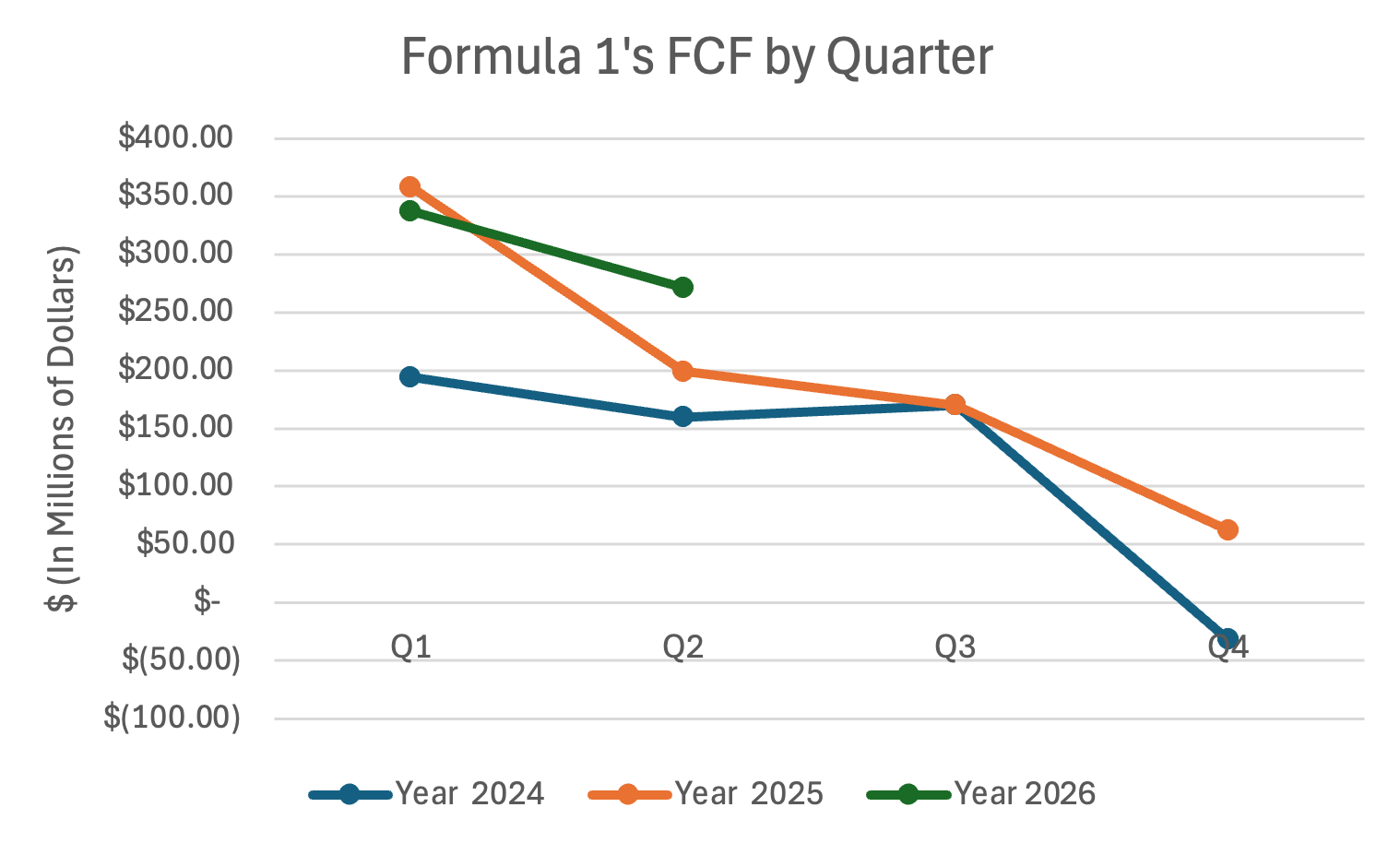
FCF grew from $0.19B in 2023, to $0.49B in 2024, and $0.79B in 2025. If we then take a closer look at year-to-date results for the first half of 2026, FCF in H1 2026 (i.e., $0.61B) was higher than H1 2025 ($0.57B) even though 2 out of the 24 F1 races were canceled because of the turmoil in the Middle East (Bahrain Grand Prix (April 10-12) and the Saudi Arabian Grand Prix (April 17-19)). The Bahrain Grand Prix has been relocated to Malaysia and will occur on October 2-4, which increases the total races in H2 2026, and should lead to an uptick in H2 2026 FCF. Overall, F1 will almost certainly generate higher FCF in 2026 than 2025 despite conducting one fewer race.
(OSC - Interesting, there also appears to be some seasonality to the company’s cash flows, which is unsurprising given when the races are held. Talk to me about Adjusted OIBDA. Seems like the management team likes to throw out that Non-GAAP metric. What’s that about?)
Adjusted OIBDA
Liberty Media’s management stated that it prefers investors to judge the company performance based on their Adjusted OIBDA in which they have added back stock-based compensation, Concorde incentive payments, and impairment and acquisition costs.
(OSC - ah, so costs it doesn’t like, or deems as “one-time” payments.)
Yes, and by using this measure, Formula 1 looks to have a strong upward trajectory in recent years as Adjusted OIBDA grew from $0.77B in 2024 to $1.07B in 2025, a ~38% increase driven mainly by F1’s growth and the MotoGP acquisition.
(OSC - so management is executing even based on their own standards (one would hope that if you throw out your own metric, you can meet it. It’s fair though since we can also see it on the FCF side. So put it all together for us. Is there value here?)
Synthesis
I started this report by admitting I knew very little about cars and in a lot of ways, that’s exactly the point. Arguably, Formula 1’s rise over the past few years hasn’t come from making the actual racing better, but making the commercial appeal and packaging better. Liberty Media has successfully broadened the appeal of the sport from aficionados to casual fans with compelling storylines, driver appeal, and reinforcing the aura of luxury and exclusivity. Through Netflix’s documentary, it’s also re-introduced the sport to the US market, and as the sport’s popularity has risen, the new Las Vegas Grand Prix has been added.
From top media deals to luxury sponsorships to premium hospitality to new circuits around the world, Formula 1’s transformation from a niche motorsport into a global status symbol and entertainment powerhouse is clearly reflected in its financials. As every major revenue stream is rapidly growing and many long-term contracts are already in place, this suggests that this growth isn’t a short-term spike, but a trend here to stay. Margins are expanding alongside revenue, showing that F1 isn’t just getting bigger, but more efficient and more profitable as it grows. While the rate of return (i.e., FCF yield) of ~3.3% (FCF 2025/Market Cap)) (i.e., $0.79B/$23.7B) is anemic, the company has the opportunity to rapidly grow revenues across the four major revenue categories. The stock’s valuation reflects this as well.
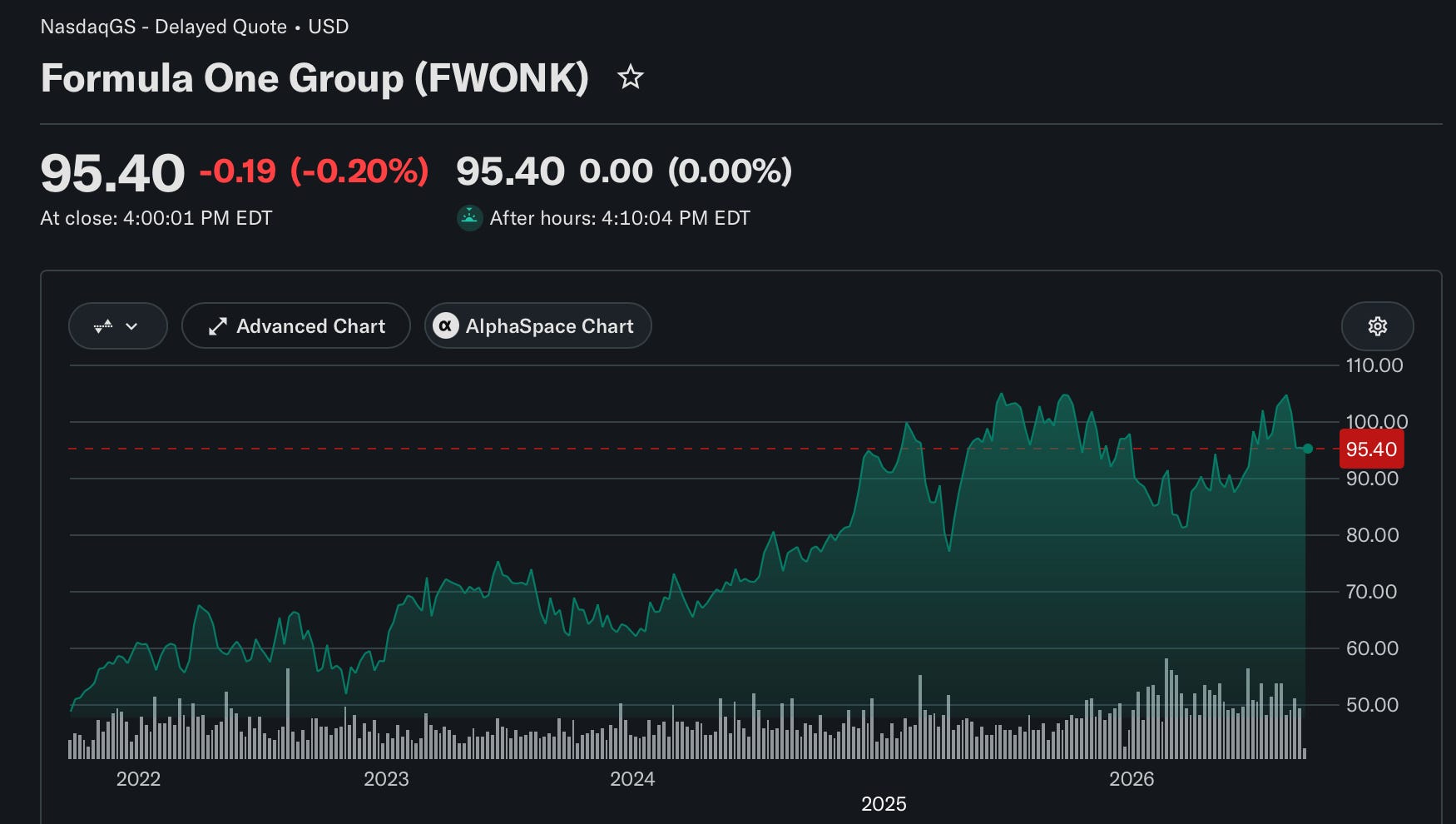
(OSC - you mean it’s expensive.)
Yes.
The low cash flow yield shows that investors aren’t buying F1 for what it currently earns, but what they predict the business will become. Even if we used management’s preferred Adjusted OIBDA, we’re looking at 3.9% (using TTM Adjusted OIBDA / EV (i.e., $1.07B / $27.1B), or a ~25x multiple. If we were to use FCF, we’re looking at a 3% FCF to market cap return, or a nearly 33x FCF to market cap multiple. This shows that investors are already pricing in the future growth.
(OSC - let’s use Wall Street’s figures, let’s just assume their right, and that management’s right. Where would that get us to in the futre?)
As of the latest report, Goldman Sachs projects the company’s revenue from 2026 to 2029 will grow from $4.77B to $5.90B. Adjusted OIBDA should climb from $1.23B to $1.65B over that same period. In turn, FCF is expected to rise over 30% from $0.86B to $1.14B by 2029.
(OSC - interesting, so if you bought it today, and held it to 2029, Adjusted EBITDA would pencil out to around 6.6% (using 2029 Adjusted OIBDA / EV (i.e., $1.65B / $25B (we’re assuming they use FCF to pay down some debt), or a 15x multiple. If you assumed the same 25x multiple as today, the stock would pencil out to be about $160-$165/share.)
Yes, and on a FCF basis you’d get a 4.8% FCF to market cap return (using 2029 FCF of $1.14B / $23.7B), or a 21x multiple. Again if you assume the 33x FCF multiple to market cap today, and you’re looking at a $37.9B company. Divide that by 250.7M shares, and we’d expect a $150/share price in three years.
(OSC- any free upsides? Any free optionality?)
At first glance, the Formula One Group is not cheap, investors are paying a substantial premium on a business that generated a less than $1 billion FCF in 2025. But this headline valuation isn’t entirely representative of what investors are actually buying.
Separate the two businesses right now. As we previously discussed, in 2025, Liberty Media completed its acquisition of approximately 84% of MotoGP for $3.66B (swapping >$2B of cash and undertaking an additional $1B in loans, but adding another racing series to its portfolio). MotoGP’s is essentially a breakeven endeavor for now on an EBITDA basis. It was in 2025, and appears so year-to-date in 2026.
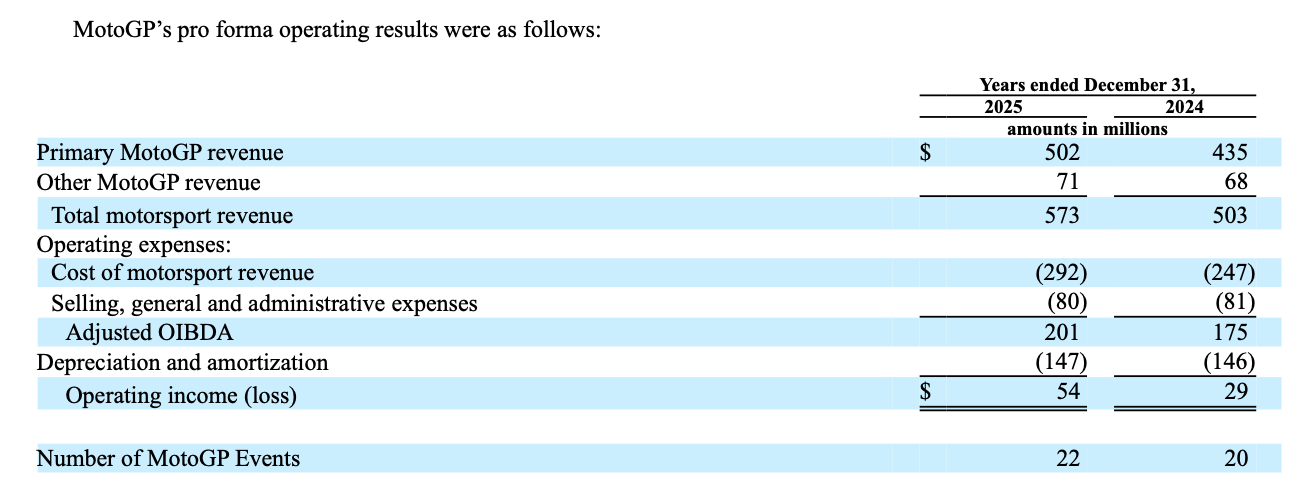
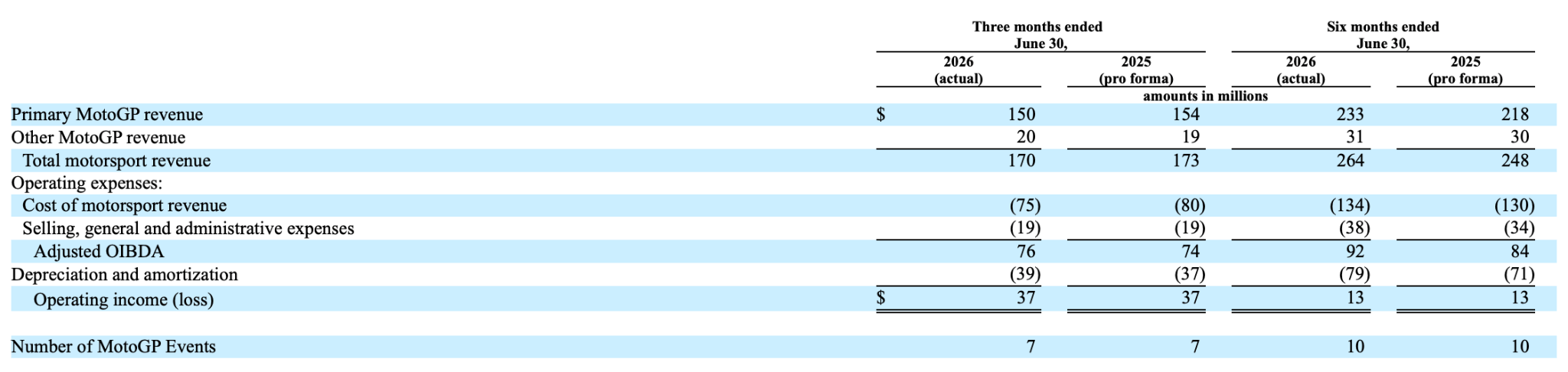
If you assume the value of MotoGP remains $3.66B, then really you’re buying the F1 business at slightly less than $23B in EV. Again strip MotoGP out of Adjusted EBITDA and “F1’s Adjusted EBITDA” falls to $1.0B (vs. $1.07B). In turn, it’s a 4.3% F1 Adjusted EBITDA return vs. the “F1-only EV” of $23B, or a 23x multiple (vs. 25x including MotoGP). Said another way, MotoGP’s inclusion for now acts as a drag on F1’s valuation.
(OSC - so you’re saying MotoGP is breakeven right now, drags down F1’s valuation, but could be worth more later if Liberty Media is able to apply the same F1 playbook?)
Yes, and the MotoGP season runs from March to December also, which is similar to F1’s season, so there’s many cross-marketing opportunities.
(OSC - anything else?)
Sponsorship revenue again is the fastest growing revenue stream, and LVMH’s new $1B campaign with F1 could be a gamechanger.
(OSC - for context, LVMH spent ~$35B in marketing and selling expenses, advertising is estimated to be ~$10B of that figure, so the F1 deal (assuming $100M a year, represents ~1% a year of LVMH’s annual advertising spend).)
That’s right, so there’s much more where that came from. F1 is a flywheel, the more people watch and associate the races with luxury, high-end, exclusive luxury experiences, the higher caliber of brands, and the more advertising dollars it will attract. The sponsorship opportunities can easily surprise to the upside given the low base, and the unique nature of the sport.
(OSC - that’s fair, anything else?)
FWONA. FWONA is the ticker symbol to Liberty Media’s Series A shares. Series A common shares entitle the holder to one vote per share, whereas Series C (“FWONK”) common stock has no voting rights. There are only ~24M FWONA Series A shares, whereas there are 224M FWONK Series C shares, so most investors (or larger investors) prefer the Series C shares given the increased liquidity.
(OSC - okay the average trading volume of FWONA is ~160K shares, or $14M, and FWONK is 2M shares, or $190M, so if you’re an institutional investor, you wouldn’t be able to move in/out of FWONA easily as there’s little liquidity).
That’s right, which is why FWONA, despite having voting rights, is 8% cheaper than FWONK (i.e., $87/share vs. $95/share). You can basically buy FWONA, and get an 8% discount to F1, and if the discount ever closes because traders arbitrage it away, it’s an even greater return.
Putting this all together, by next quarter F1 should be back on its feet with an almost full 23/24 race calendar. However, the bigger point is that Formula 1 has proven they’ve reached a point where the underlying business keeps getting stronger, full calendar or not, through both organic and inorganic growth. Organic growth is the core F1 business doing what it already does well, which is rising media rights fees, expanding sponsorships, and race contracts locked in through 2030 and beyond, overall building itself without needing to reinvent the sport itself. Inorganic growth comes from the MotoGP acquisition, and whatever Liberty Media plans to add next, extending the same playbook that turned Formula 1 from a niche sport into a global commercial franchise. Together, these two engines, one proven, and one with a promising future, make FWONK more than a bet on faster cars. It’s a bet on the management team that keeps finding new ways to monetize the same 24 weekends a year.
If the company can hit on the consensus 2029 forecasts, there’s a high likelihood that the company’s share can appreciate to $150-165/share, and beyond.
(OSC - awesome. We agree. This is a pretty exciting and unique business/opportunity. A product that was once niche has certainly become more mainstream, and it’s a flywheel of an ecosystem. The one hesitation we have, and it’s a large one, is how does this company (and how do luxury brands for that matter), weather a downtrodden economy. With inflation and interest rates vaulting higher, and consumer sentiment down, the wealth effect (i.e., the stock/asset markets) is holding up the economy to a large extent. If that falters, sales and marketing ad dollars will likely take a hit. Sports valuations are high now, as the wealth effect and scarcity of these assets means there’s a lot of dollars chasing a small number of assets, but that can also turn pretty quickly if the market sells off. In sum, we really like this business. There’s multiple ways to win, and there’s a pretty deep moat that no competitor can easily replicate. We’d prefer it at a discounted price given an elevated market. Something to definitely put on our check-list if it ever gets discounted. Great job this summer Sora, and thanks for the great write-up!).
Please hit the “like” button and subscribe below if you enjoyed reading the article, thank you.