

“For the first time since the start of the Iran conflict, we don’t have a baseline view. We simply don’t know how to model the endgame.”
Yeah that’s bad.
If you hadn’t read it, that was JP Morgan’s Natasha Kaneva’s take on the oil market. Here’s the full blurb in their latest oil report.
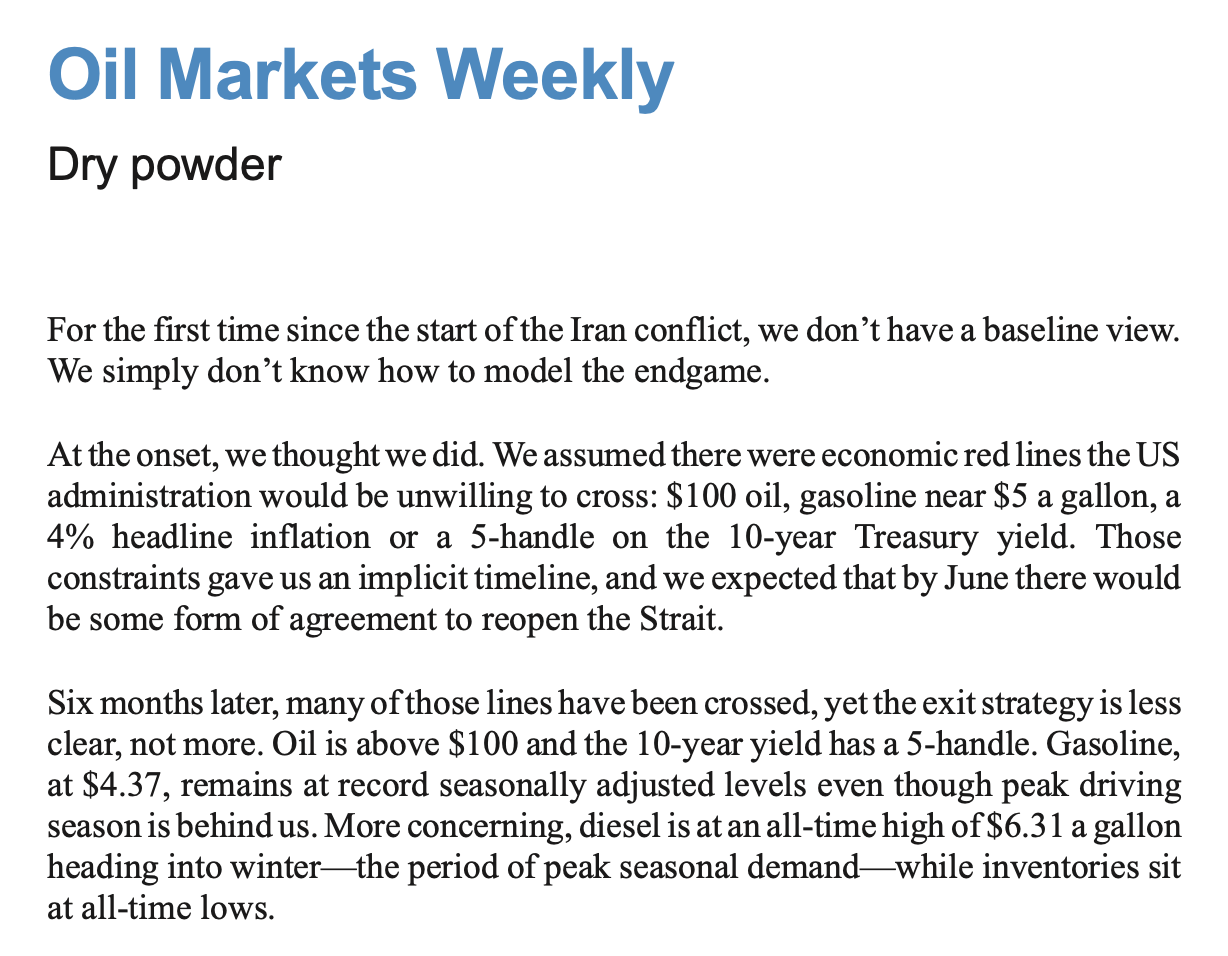
Yeah that is bad.
Well in the sense that if the analysts with one of the most comprehensive data sets and vast resources at their disposal can’t quite put a finger on a hugely important sector, what’s that say about where we’re at in the world. Mind you this is an analytical team in a research department in a huge, yuge and large bank. A team who’s incentivized to provide a view and drum up business (i.e., trading/investment/transaction fees).
Take a position, hype the market, drum up some investor interests, create some financial instruments, and sell said financial instruments for a tidy fee. Yet, when you throw your hands in the air and just shoulder shrug . . . what’s there to do? What position is there to take? Bullish or bearish? Call or put, long or short?
That’s where we’re at today.
No one knows.
No one knows because no one’s ever dealt with drone warfare before.
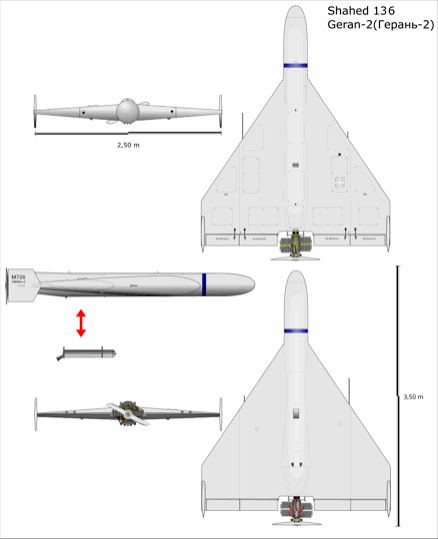
Battlefield technology goes through stages. Stages where the advantages shift from the defense to the offense, and back again. Just think back to the days of World War I, the advent of the machine gun, which made infantry charges obsolete. Trench warfare then became the norm as offensive gains proved costly when streams of bullets cut through the ranks. Offensive advances ground to a halt.
Unsurprisingly, offensive technology improved. Armor and engine advancements soon turned the fledgling tanks of WW I into highly maneuverable armored vehicles by the 1930s. Technological arms development led to the creation of new doctrines, and soon gave rise to the use of combined arms and armored warfare (e.g., Germany’s Blitzkrieg strategy). Quickly, even the feared French Maginot Line was bypassed, and armor coupled with air power became the dominant strategy. Offense reigned supreme. Arguably, this has lasted for decades, as tanks, infantry fighting vehicles, and fighter development raced ahead of defensive weaponry.
That is, until 2022.
As Russia quickly learned with its Ukrainian invasion, new weapons would shift the advantage back to defense. Plentiful and cheap drones and ballistic missiles became the defender’s key weapons. A few drones can quickly cripple immobilize an advancing army, while keeping defender’s at a safe distance. It’s what we’re seeing today in Russia/Ukraine, and it’s what we’re seeing in the Middle East (e.g., Red Sea and the Strait of Hormuz). Drones and ballistic missiles aren’t powerful enough alone to allow their users to gain territory, but they’re certainly strong enough to allow the defense to hold territories. Whether it’s the Donbas region, or the SoH, the costs the defense can impose on invaders is simply too much (i.e., economically, militarily, and in lives). So the advantage shifts to the defense, and that’s what we’re seeing today.
This isn’t temporary. It’ll be for awhile. Even an impoverished and poorly trained army can employ the tech. Even better that they do because their lives are deemed plentiful, and sadly “expendable.” Contrast that with the West, where economic prosperity ratchets up our value of life, and cheap drones suddenly lays bare the cold tradeoff in this type of asymmetrical warfare. Add onto the fact that our defensive weapons are too costly and too few to employ to counter the saturation attacks that are becoming increasingly sophisticated, and you can see how we’ve lost the upper hand.
So that’s where we’re at. It’s why the analysts can’t find a path out. You’d need to understand the military’s limitations at this stage. Despite the rhetoric and the bombast, despite the proclamations, we’re at a stage where we can’t win (i.e., be in a position to unilaterally impose our diplomatic/military will on the region). While we might not necessarily lose, we don’t have the capability in the near-term to “win.”
Winning means dislodging the Iranians from their control over the SoH. Winning means returning to the pre-war days where the status quo was free, open, and safe transit free from harassing attacks, or the friction of administrative control/management. Winning means a ground war.
Absent that, Iran controls the SoH, and with it the Middle East, which empowers BRICS, the political and economic coalition of emerging economies. BRICS (i.e., Brazil, Russia, India China and South Africa), is really guided by the dominant players, Russia and China, and China no doubt sees Iran’s control of the SoH as a corollary to its control of the Taiwan Strait. More importantly, letting the US dig out of a situation of its own making distracts from its military, diplomatic, political and economic attentions elsewhere (i.e., those directed against Chinese interests). Undoubtedly that’s why Russia also encourages and supports Iranian ambitions, which helpfully weakens their ability to support Ukraine.
The Houthis
Lest you forget, the Houthi militia group in Yemen as of last week effectively controls the Bab el-Mandeb Strait in the Red Sea. As Iran’s proxies, the Houthis along with Iran, have essentially blocked Saudi exports through that area. Couple that with the attacks on Saudi’s East/West Yanbu pipeline, and the Saudis have been forced to shift exports back East, and rely even more on the Southern Oman lane in the SoH, which is hardly ideal as it again exposes their cargo to Iranian targeting.
Is any of this sustainable? We don’t think so. Iran won’t relent here, and as the economic carnage unfolds, it plays into Iranian hands. The US is unlikely to escalate as the midterm approaches, and the US military posture doesn’t appear to be changing for the time being. After the midterms is a different case, but that’s still 1.5 months away. There’s certainly been talks, and most recently chatter that the Iranians can reopen the SoH within 7 days if the US lifts its economic blockade, repatriates seized Iranian assets, and ceases all military conflicts in the region. That’s workable, but it also means returning to the MOU signed in June, which again stipulates that Iran controls the SoH, something the US agreed to, but ultimately found untenable. So this makes us wonder, what’s really changed?
Let’s Get Physical
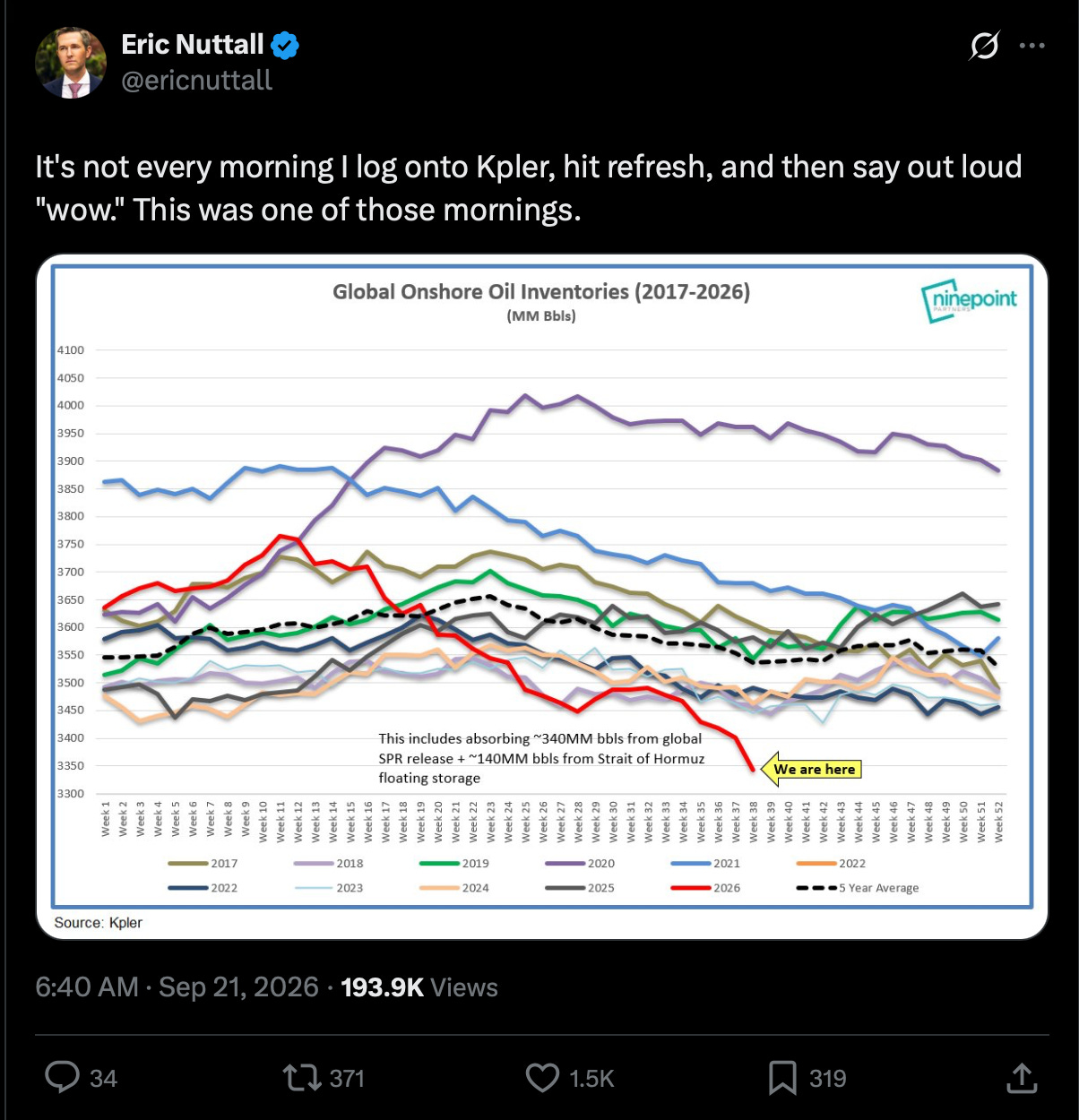
Oil is currently ~$90/barrel in the paper market, and $120/barrel in the physical market, and there are few negotiating points that lend itself to optimism that a quick and lasting solution is imminent. Product prices when judged by the crackspread has breeched $200 as globally Russian and Middle East refinery outages linger. Product prices don’t appear to show any signs of slowing as inventories have emptied and we’re having to destroy demand. This is what that looks like. Since the economy runs on products, and diesel in particular, that’s the main issue. We’re forced to slow demand, and that means we’re forcing ourselves into a recession . . . a global one.
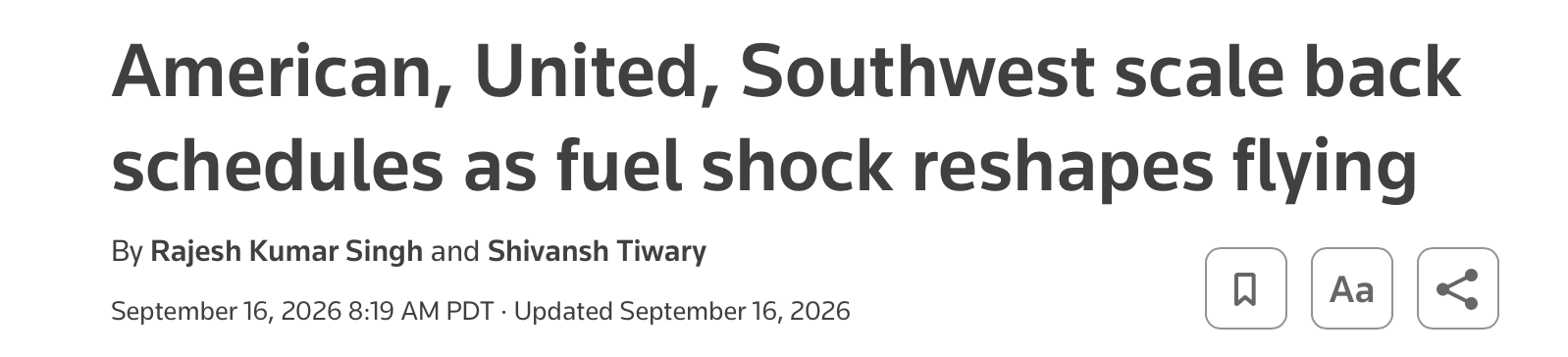
Global demand is weakening here as trucking and airline traffic start to contract. The closes real time indicator, airlines, have already started issuing their warnings.
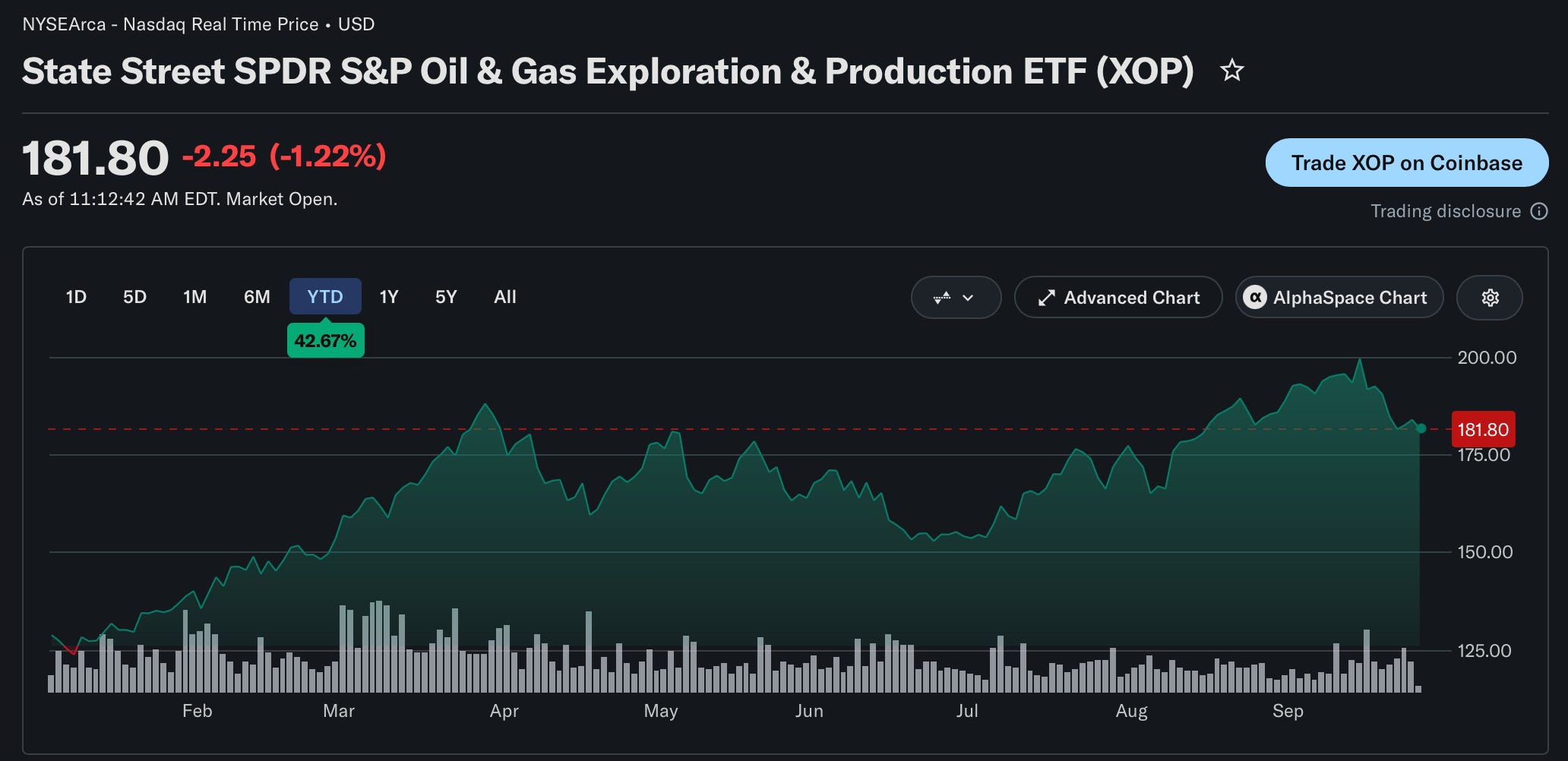
Oil equities though have started to stall out. The market just doesn’t want to give producers credit for high “short-term” oil prices given the steep backwardation, and the chance of recession.
Despite analysts like JP Morgan saying the current situation can’t be modeled, Wall Street is definitely modeling it based on the curve. So cap everything out around $75/barrel, even though oil prices are well north of that. This too will fade, so says the market.
It may be right though, because the last time oil prices really threw a wrench to the economy was 2008. Crude prices topped out at $145/barrel, or about $215/barrel today. Tack on the equivalent crackspread and we’re around $245-250/barrel. Product prices are high (~$200/barrel), but aren’t quite there yet, it’s the crude that’s lagging, but we sure are close.
Now vs. Tomorrow - Do the Midterms Matter?
So will Iran relent? (Here’s NY Times’ take yesterday).
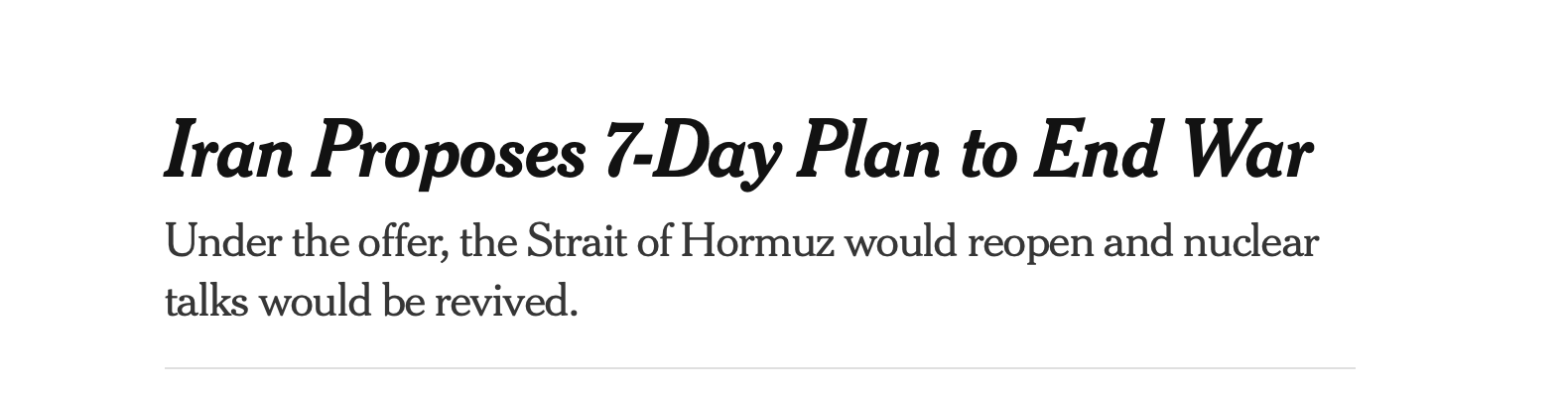
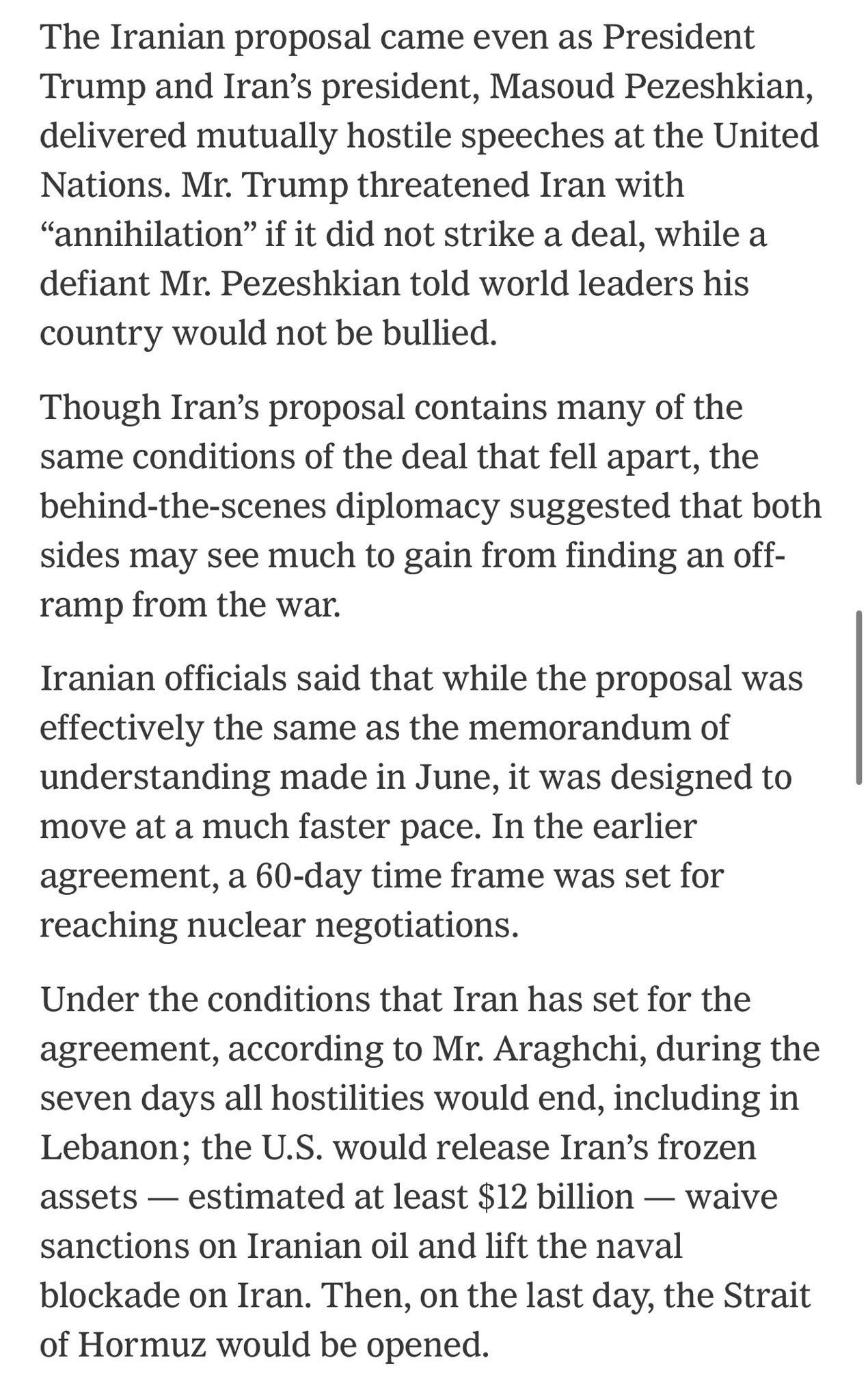
In the short run? Maybe, but will it matter? Unlikely. A reprieve to their economic pressures (i.e, the release of Iranian assets) just prolongs their negotiating position. It brings immediate economic relief, but that’ll gird them for an even longer fight post-election. In the longer-term, what’s irreconcilable is still irreconcilable, both parties can’t control the strait, and under the prior MOU, that was ceded to Iran. How can the US go back to that understanding?
Which is why we think a stalemate has occurred. Neither party can advance their diplomatic positions militarily, but one party (the US) needs to in order to advance their position diplomatically. So we wait. We wait as the two continue to circle each other, waiting for the other to weaken.
Meanwhile these are just a few of the things that have happened these two weeks:
Iraq (via Iranian proxies) attacked and disabled the Saudi East/West pipeline that had rerouted barrels from the SoH to Yanbu and the East;
Damage to the pipeline, which will take weeks to repair, forces Saudis to cancel shipments to European refineries for a month;
Saudis begin rerouting Eastern exports back to the West and out through the Strait of Hormuz;
Houthis captured the West Coast of Yemen, and now control the Bab el-Mandeb Strait, dealing a severe blow to the Saudi supported government;
Houthis launched attacks agains Riyadh, Yanbu, and other cities;
Iran continues to attack tankers in the SoH, specifically those sailing in the southern Oman lane that’s under US protection;
Ukraine continues to attack Russian refineries; and
US contemplates releasing more oil from its Strategic Petroleum Reserves and floats the idea of a diesel export ban, which lands like a lead balloon.
All is well.
We’ll give Eric Nuttall the last word here . . . wow.
Please hit the “like” button and subscribe below if you enjoyed reading the article, thank you.