

$10B.
That was fast.
$10B was the debt target OXY had set out after its Q1 conference call. It was the target level the company had planned to hit as it methodically whittled down its debts. Fortunately, with higher oil prices, that goal was achieved only six months later.
Frankly, the past quarter was a surprisingly strong one. Third-party gas pipeline constraints and maintenance activities curtailed production in the Gulf of America. The disruption caused us to lower our Q3 production and free cash flow (“FCF”) figures. Hence we assumed the company generated ~$2B in FCF. Fortunately, stronger international and Permian production bridged the difference, and total production landed much closer to the average of the last two quarters at 1,427 Mboe/d vs. 1,426 and 1,433 in Q1 and Q2, respectively. In turn, FCF exceeded our expectations. Though positive, when we step back, we’re left with this thought . . . OXY’s days as an independent company may be limited.
Let’s get into it.
The third quarter was great, so we can quickly review it. Overall, OXY generated ~$2.8B in FCF (excluding working capital). After paying the common and preferred dividend, the company was able to repay $1.8B in debt, thereby achieving its $10B debt target quicker than we’d anticipated.
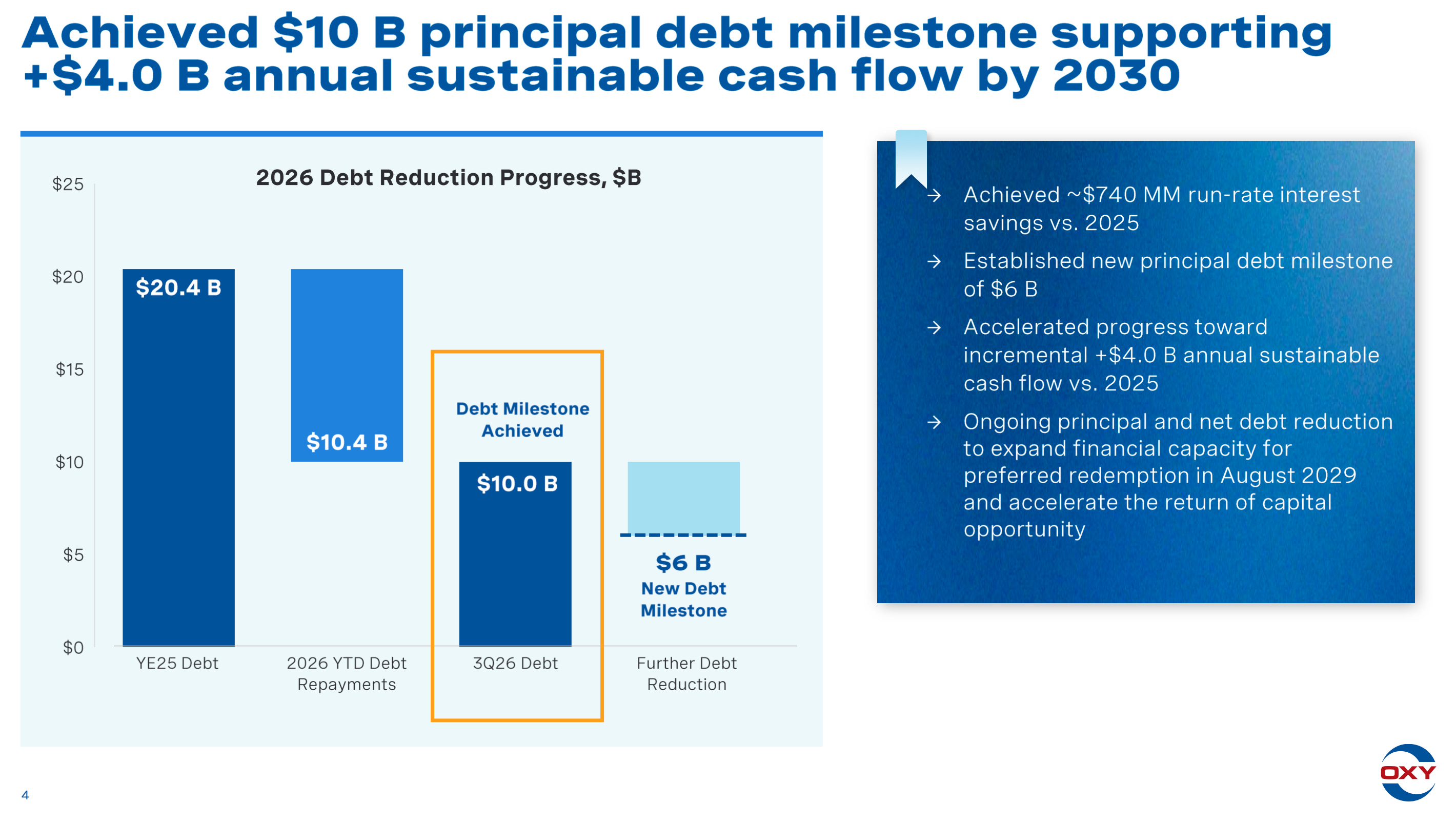
OXY then turned around and set a new debt target of $6B (i.e., another $4B reduction from current levels). Despite the recent volatility in oil prices, prices in Q4-to-date have averaged ~$98/barrel. This is slightly higher than last quarter’s $85/barrel, and even if oil prices average $85/barrel for the remaining 6 weeks, oil will still average ~$90/barrel for the quarter. OXY has also forecasted slightly higher production (1,450 Mboe/d at midpoint), which means if oil prices hold, there’s a good chance OXY will again be able to repay another ~$2B of debt, allowing OXY to exit 2026 with ~$8B of net debt. The current oil curve also shows that Q1 oil prices are averaging low-mid $80s, and if that holds, then OXY should be able to hit its $6B goal by the end of Q1 2027.
Looking Ahead to 2027
So what will 2027 FCF figures look like? Well as always let’s level set. Forget today’s oil prices.
Let’s use $65/barrel oil, which is what the company’s using under its “+$4B in Annual Sustainable Cash Flow Expected by 2030” plan.
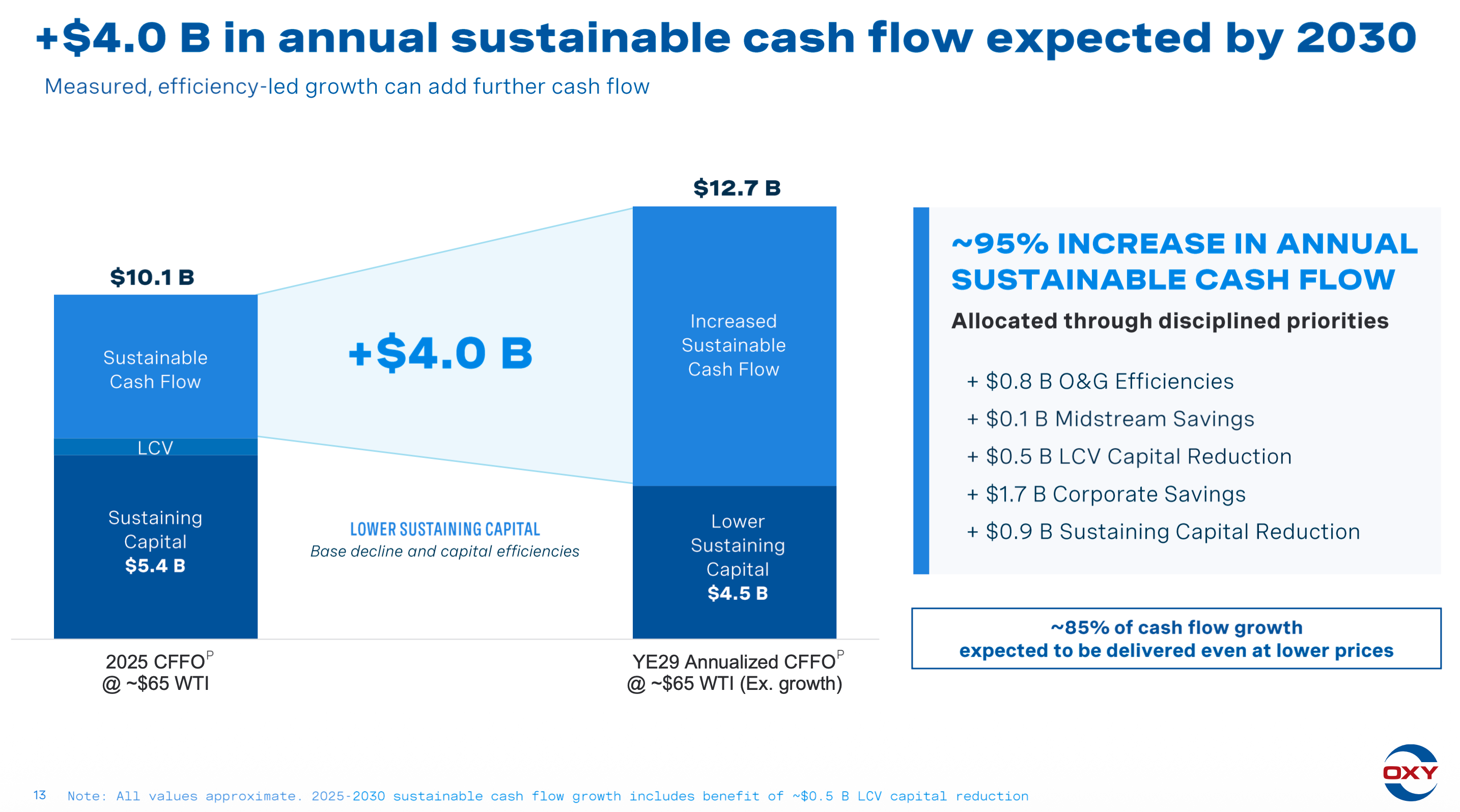
In a $65/barrel WTI environment, OXY generated ~$4.4B of FCF in 2025. In 2026, their plan was to improve that by an additional $1.2B. So call it $5.6B in FCF. This was assuming debt would fall to $10B.

In the Q2 conference call, OXY shared that it anticipated an additional $700-$800M of savings in 2027, which should come from two parts, $400M of lower midstream costs as Stratos LCV capital spend ends and lower interest expense (i.e., $340M which is attributable to ~$5B of lower debt).
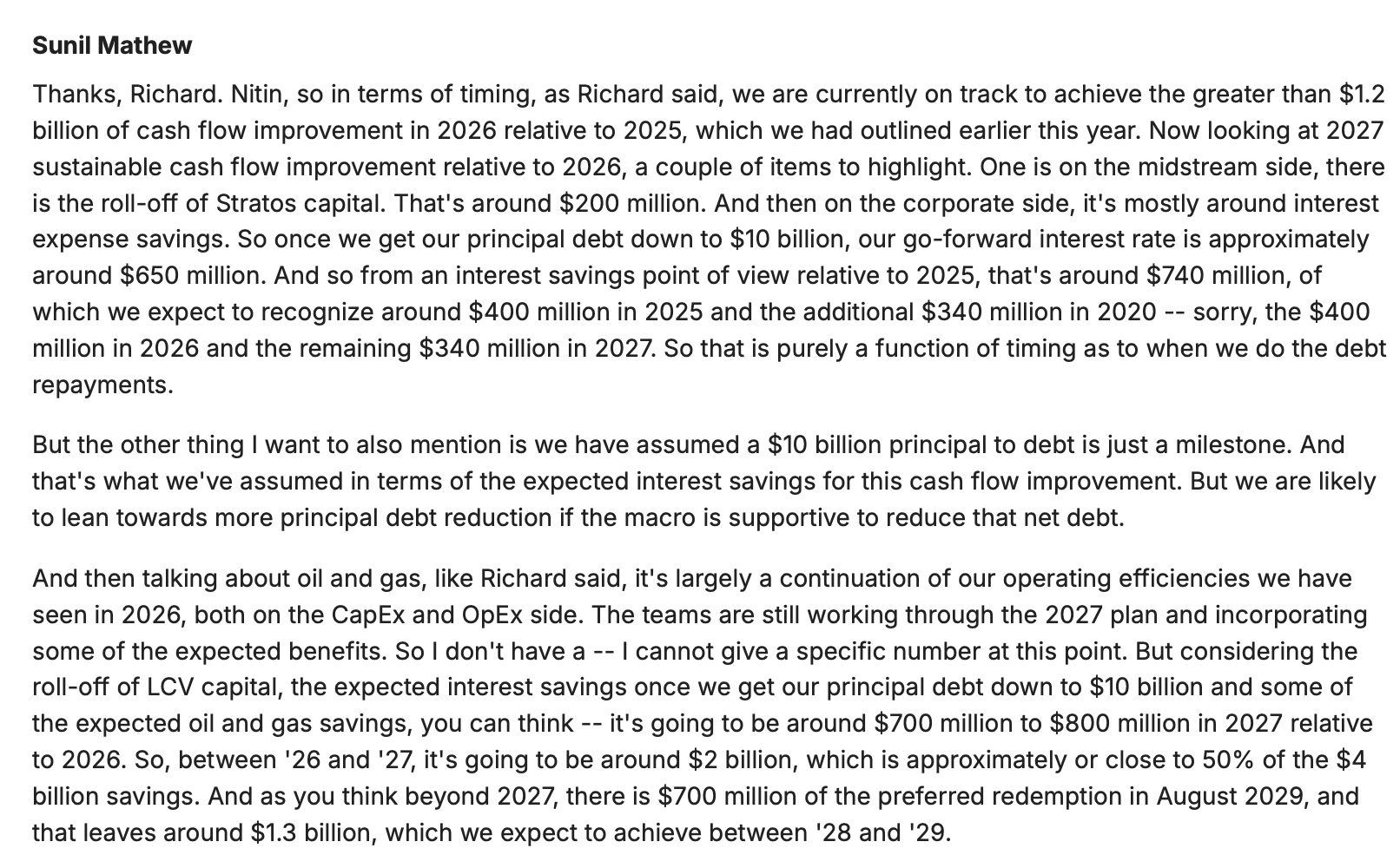
So that 2026 $5.6B baseline figure jumps to $6.3-6.4B in FCF in 2027, again at $65 WTI and assuming the same capex.
It’s likely more though because to reiterate higher oil prices are accelerating things. The above assumes that OXY exits the year at $10B of net debt, but that bogey was already struck by Q3. So if we actually exit the year at ~$8B, we’re looking at additional interest savings of ~$125M. So FCF for 2027 should be closer to $6.4-6.5B. Here’s the figures again, just tack on $125M to 2027.
So what’s the market thinking?
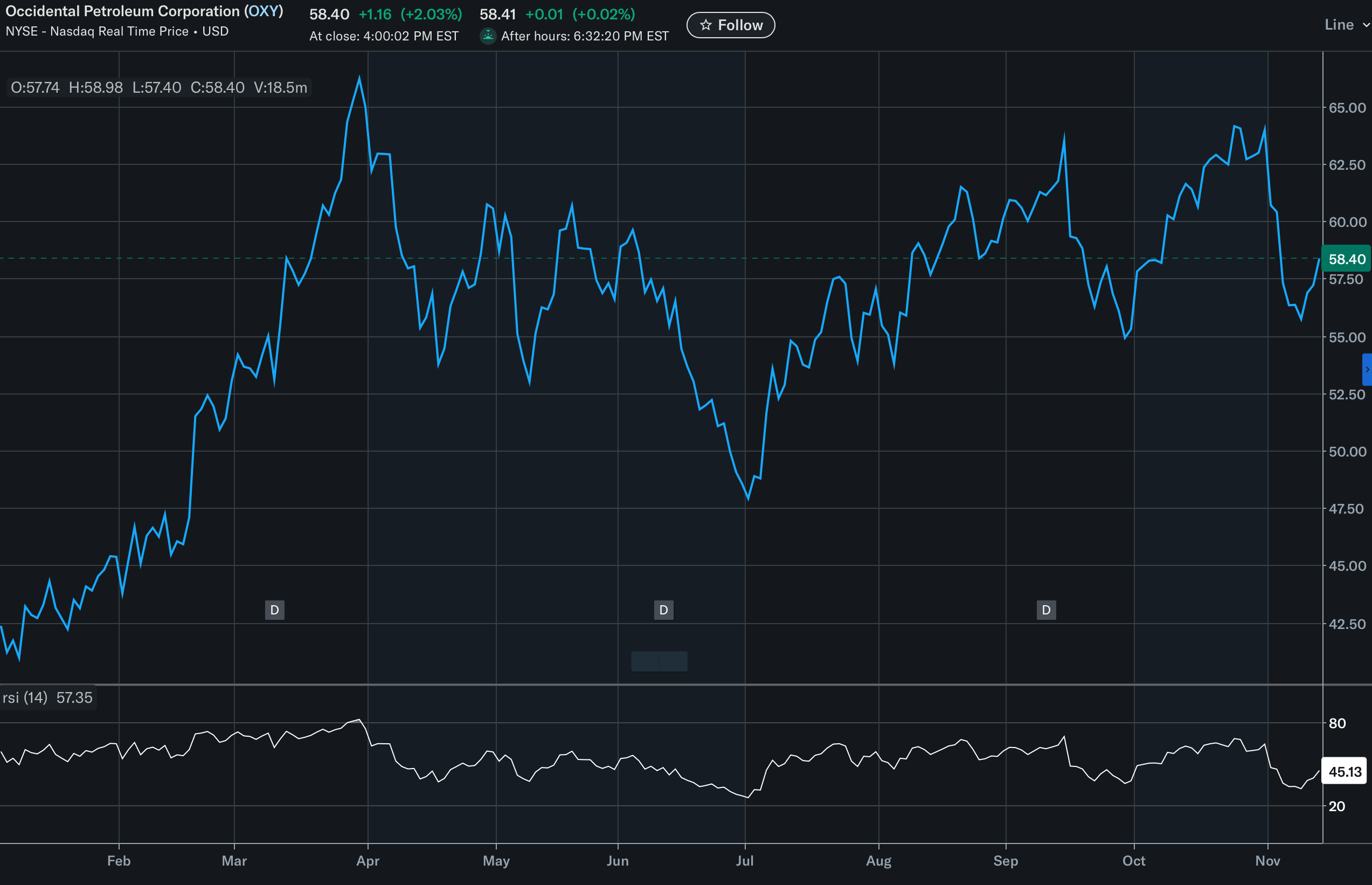
Yawn.
Well on a twelve month forward basis, it’s basically pricing this company at 10x FCF. Just think about this for a minute. $6.5B in FCF, but take out $700M for Berkshire’s preferred. What do you get? $5.8B in FCF, for a $58B market cap company.
Even more pointedly, that figure could soon be its enterprise value. OXY will likely end 2026 with debt of ~$8B, or $4B net debt. By the end of H1 2027, we believe OXY will be cash positive, and if oil prices stay anywhere with a 7 or 8 handle, it could be entirely net debt free and have enough cash by YE ‘27 to materially retire the preferred shares when they come due.
What’s a bit stunning is that the baseline scenario is predicated on a $65/barrel WTI world, and given that we likely just drew oil inventories down by ~1B barrels coupled with geopolitical uncertainty, we definitely think oil prices should average higher than $65/barrel (which it did in 2025).
OXY As a Target
Alternatively, there’s an opportunity here for a strategic buyer to step-in. Why now though? Well five reasons.
Five things have transformed OXY in the past year.
First, the OXYChem transaction simplified and streamlined the company, and as a pure-play oil and gas producer, the operations and assets are much easier to integrate into a large company.
Second, the CEO just changed. Vicki Hollub’s retirement ushered in Richard Jackson’s tenure. The new team has yet to announce any major transformative acquisitions that tie-up the balance sheet. Most of the management team’s activities have been geared towards increasing organic FCF generation. Institutional/management inertia have yet to set in, nor has the team made any irreversible capital allocations commitments, so it’s a clean slate.
Third, the aggressive drive to deleverage means the company becomes ripe for a takeover as a larger acquirer can re-lever the balance sheet, and effectively conduct a leveraged buy-out.
Fourth, OXY’s plan to increase cash flows are independent of oil prices, and are the byproducts of streamlining capital/operational activities and debt repayments. Thus, if an acquirer were to make a bid, it’d step-into a rising stream of cash flows with little macro risks. At a minimum, the savings appear to be readily achievable given the company’s accomplishments thus far. All of this means that the FCF outlook brightens further and with more certainty in the coming years.
Lastly, the higher cash flow has yet to be reflected in the company’s stock price. So even tacking on the necessary deal premium to entice existing shareholders to tender, the overall transaction will likely be accretive to any acquirer.
OXY’s shares have only increased from the low-$50s in February (pre-war) to the high-$50s (today), despite repaying an additional $5B of debt (by year-end). If the reduction in debt justifies a commensurate rise in the equity, then there you have it. Still, it means the market is considering little else, when in reality, FCF increases really starts to gain traction here on out.
We’re at a point-in-time where OXY’s share price has barely nudged higher in the past year, but its earnings potential and FCF will inflect further in the coming years independent of oil prices. Said another way the company’s value today is discounting and dismissing the growth in value tomorrow.
Back of the Envelope
Let’s run through a hypothetical scenario assuming that an acquirer buys OXY for $75B using $45B in equity and $30B in debt. If an acquirer were to buy OXY at say $75/share, or $75B in Market Cap (i.e., at a 30% premium), it would effectively purchase a company that generates $8B of FCF annually at $65 oil from 2029 and onwards. Factor in additional synergies by cutting redundant G&A and capturing opex/capex savings (i.e., ~$1-2B), and we’re looking at nearly $10B of FCF.
What if you looked only at 2028 cash? Well the math also works. So assume a 2028 close (it takes most of 2027 to work through HSR (antitrust) review). By 2028, under OXY’s current plan (and assuming $65 oil), you’re looking at a “Revised FCF” of $6.9B. Tack on $1-2B in synergies, and the FCF increases to $8-9B. If the company takes on $30B of debt at a 6.5% blended interest rate to fund the acquisition, it’ll shave off $2B from FCF for interest expense (it’s a bit less since you get a tax deduction for it, but for the sake of simplicity, we’ll assume it full boat). Net/net, you’re back at ~$7B of FCF in exchange for $45B in equity, or a 15% FCF yield. In 2029, once the combined company repays the Berkshire preferred shares and realizes additional savings, again FCF rises back to $8B (i.e., $10B of FCF less $2B of interest expense).
There are certainly ways to reduce the debt load (i.e., convince Berkshire to convert their preferred shares into common shares, and/or have them exercise their warrants, which will bring in cash), but those would entail the bankers and buyer to work on the trimmings. The turkey’s the centerpiece here, and that’s the exorbitant cash flow at $65 oil.
Assume slightly higher prices, say $75 WTI moving forward, and it translates to $2-3B of additional FCF, which really starts to move the debt repayment needle. It doesn’t take long to pay off $30M of debt if you’re seeing $12-13B of FCF annually.
So yeah, this company is cheap. It’s actually too cheap if it wants to stay independent. It’s only cheap for a limited time though. As debt’s reduced and FCF climbs, the share price will naturally rise to account for it. An acquirer can simply capture most of this upside quicker, and effectively swap the current discount as the deal premium, and still come out with an accretive transaction.
If we’re right though, there’ll soon be hunters looking to take this turkey down.
Happy hunting.
Please hit the “like” button and subscribe below if you enjoyed reading the article, thank you.