

(As we’re apt to do for the summers, we tend to hire a few interns. It’s a great way to pass on some of the things we’ve learned, inject a fresh new view into what we do from someone younger, and get a bit of help on a few odds and end. For this summer, Open Square welcomes four interns, and over a series of articles, they’ll share some of their learnings from their research. This summer, we had the pleasure of having Carter Chi. Carter, class valedictorian of his high school, today is a rising junior at Middlebury College and is majoring in Economics. He plays shortstop for the school’s team and is looking forward to a career in professional baseball and finance. Given his sports background, he decided to take a look at Planet Fitness (“PLNT”) to see if there’s some hidden value. We hope you enjoy his article below. If you’d like to reach out to Carter for future opportunities, feel free to email him at cchi@middlebury.edu.).
PLNT
It shows up everywhere, with bold yellow and purple graphics welcoming patrons to an inclusive atmosphere; it’s all by design.

Planet Fitness (NYSE: PLNT) has become to gyms what Dunkin’ is to coffee. PLNT has built its entire identity around the “High Value, Low Price” model. Their gyms offer a judgment-free branding aimed squarely at the intimidated beginner crowd rather than the peptide-shooting bodybuilders, all for an entry price of $15/month. It’s a value proposition of win on volume, not on markup.

By the end of Q2 2026, the PLNT ecosystem has grown to 2,930 clubs (i.e., 2,636 franchisee-owned clubs and 294 corporate-owned clubs), and roughly 21.5 million members. The vast majority of new locations are franchisee-owned, including 21 of the 23 stores opened last quarter. That’s not coincidental, as PLNT intentionally stays “asset-light” by letting entrepreneurs/franchisees put up the capital and take on the real estate risk for each new club. Franchisees own or directly lease each PLNT franchise location from third parties. In contrast, PLNT has no other leases except for its headquarters and one corporate-owned club. Instead, PLNT collects a toll on everything that happens by collecting revenue on monthly and annual membership dues, equipment placements, and royalties.
Today, PLNT has ~77 million shares outstanding, and with a current share price of ~$48/share, it sports a market cap of $3.6B. As of Q2 2026, the company had $2.3B of net cash (excluding $75M of restricted cash), and an enterprise value of ~$5.9B. Since October of 2025, the shares have underperformed the market dramatically.
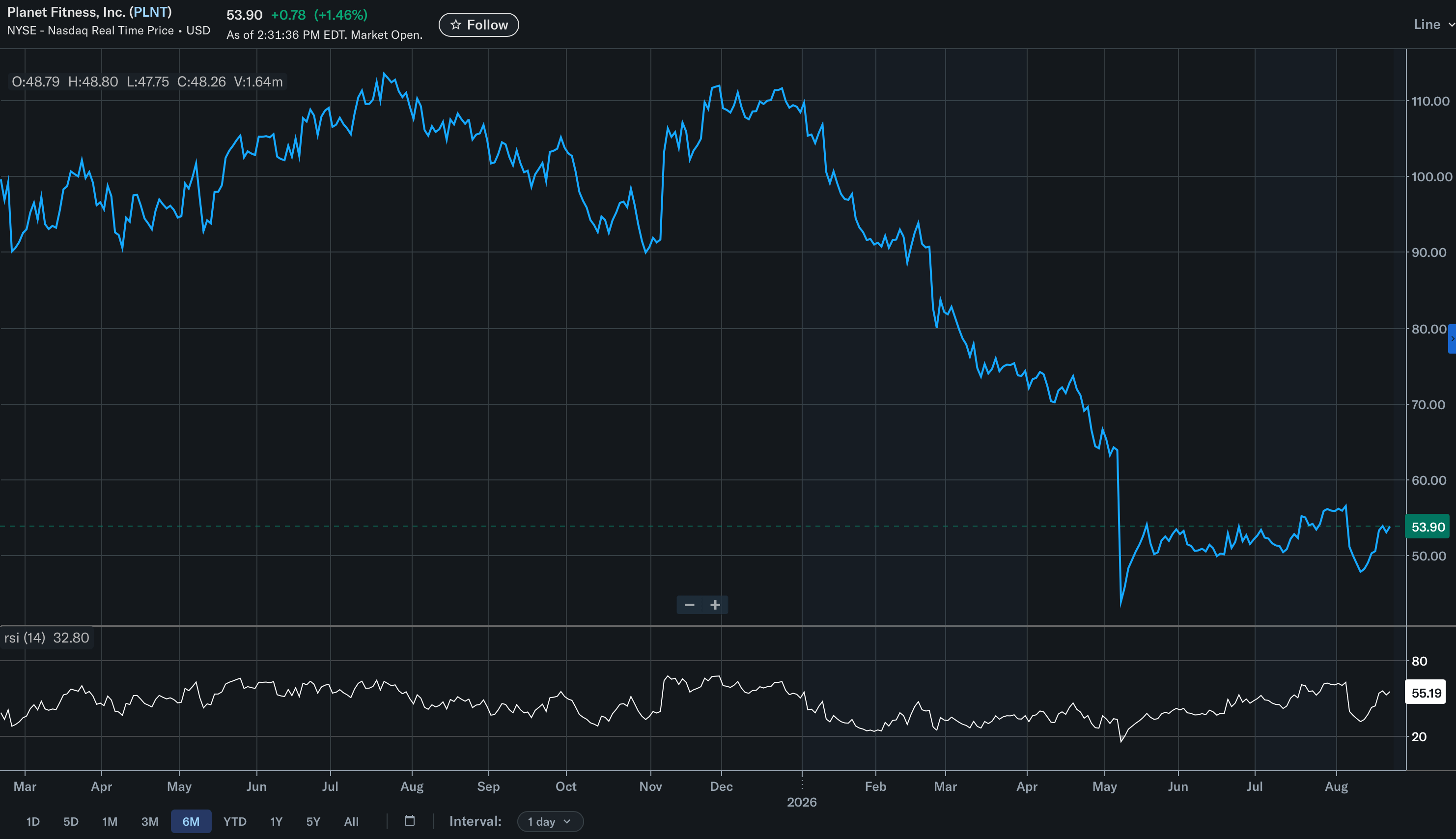
PLNT shares have fallen from $114/share to the lows you see today after management walked back its own multi-year growth targets in May. Year-to-date, PLNT shares have declined nearly 60% after withdrawing its multi-year guidance in May.
How the Machine Actually Works
Still, it’s an asset-light franchise model, so we’re always keen to take a look. More than 90% of the company’s revenues are recurring monthly dues, which generate royalties that keep showing up whether or not a single new member walks in the door. It’s one of the reasons investors have historically paid-up for the stock: a growing, predictable, subscription-like cash flow with relatively low capital intensity, since PLNT itself isn’t the one signing 10-year leases and buying squat racks for every new location.
Despite this favorable business model, PLNT’s shares are well off their highs after a few management stumbles. The deeper concern is whether the market’s 60% haircut of PLNT’s stock fits the size of what has actually changed. Two forces are entangled here: a marketing change has resulted in a real slowdown in attracting new members, and in turn, the growth in revenue growth and profitability have slowed. For investors, the question is whether the decline is a temporary stumble, or a permanent fall.
Let’s walk through the financials to see if the haircut is justified.
Financials
PLNT separates its revenue across four segments, and each one tells a different part of the story:
Franchise: Franchise royalties are the largest contributors to PLNT’s margins and represent fees collected from the thousands of independently-owned clubs running under the PLNT banner. The franchise royalty averaged 6.7% in 2025. In 2023 and 2024, the royalty averaged 6.5% and 6.6%, respectively.
National Advertising Fund: PLNT collects roughly 3% of gross membership dues from franchisees and corporate-owned clubs (historically 2%), and pooling the dollars into a fund earmarked for marketing and advertising spend. The fund is effectively a pass-through, as PLNT spends what it collects, netting to roughly zero.
Corporate-owned Clubs: this is revenue from the roughly 12% of the fitness clubs that the company operates. The clubs generate membership dues directly.
Equipment: PLNT requires franchisees to buy cardio and strength equipment through the company, and to replace them ~5 to 9 years. Every treadmill a franchisee buys is revenue for the parent.
In 2025, PLNT reported total revenue of $1.3B, up 12.1% year-over-year. Of that, ~$0.47B (35.3%) came from the Franchise segment (i.e., $0.38B in franchise royalties and fees, plus $0.09B for the National Advertising Fund revenue, again something PLNT collects, but then spends dollar-for-dollar on marketing), $0.55B (41.2%) from Corporate-owned Clubs, and $0.31B (23.4%) from Equipment sales to franchisees.
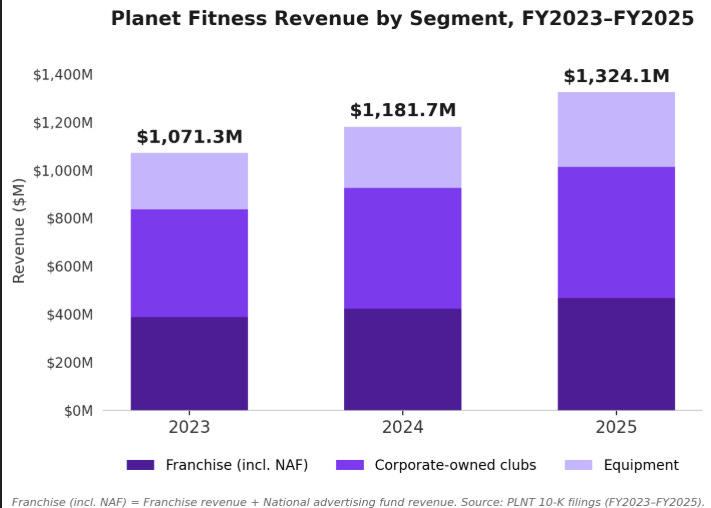
In the past three years, total revenue has compounded ~11.2% a year while total opex compounded ~7.9%. That increasing spread shows up directly in higher operating margins, which expanded roughly 200bps from 2023 to 2024 and another ~240bps in 2025, for an increase of 434bps cumulative.
Said another way, PLNT has become increasingly more profitable over the past few years. As of 2025, PLNT’s operating profit margin was 29.8%, vs. 27.4% and 25.5% for 2024 and 2023, respectively.
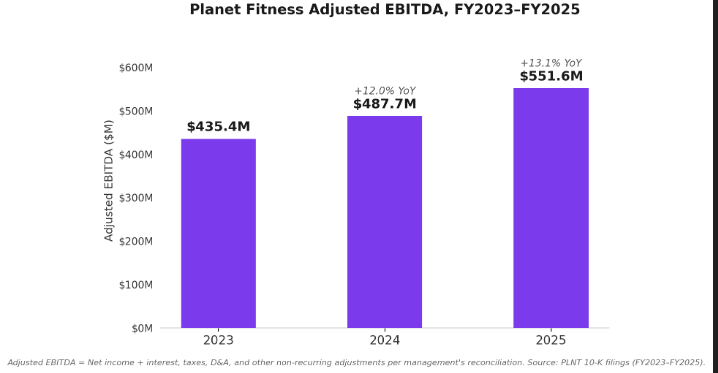
Like most management teams, PLNT’s executives call out Adjusted EBITDA as their preferred metric. We’ll indulge them and also exclude things like stock option expense, one-time legal expenses, insurance recoveries, etc. Adjusted EBITDA tells a similar story: $0.55B in 2025, up from $0.49B in 2024 and $0.44B in 2023.
As you’d expect, the Franchise segment is more profitable than Corporate-owned Clubs. Even though the Corporate-owned Clubs segment contributes the most to PLNT’s total revenue, it’s also the lowest-margin. Its Segment Adjusted EBITDA margin was 37.8% in 2025, versus 71.9% for the royalty-rich Franchise segment. As a result, Franchise is the segment that actually matters most to profitability. Equipment, while smallest at 23.4% of revenue and 14.8% of segment profit, is the fastest-growing and most volatile line, up 21.1% in 2025 (vs. 10.6% for Franchise and 8.7% for Corporate-owned Clubs), but this segment is largely dependent on the speed of new clubs being built out.
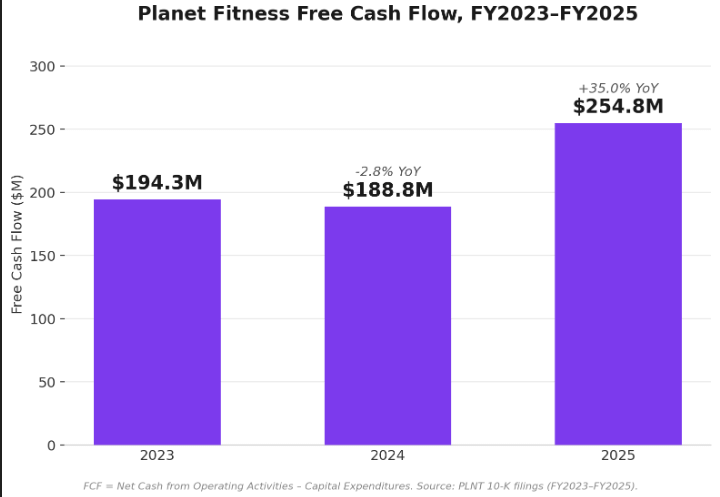
Strip out the accounting noise, and the number that should matter to most investors is FCF (i.e., operating cash flow after capex). This is the cash PLNT has left over to buy back stock, buy other assets/conduct M&A, pay down debt, or return to shareholders. FCF has grown 35% from $0.19B in 2024 to $0.26B in 2025.
A Blown Rep, or a Blown Set? Sorting Timing From Structural
Every gym-goer knows the difference between a blown set and a blown-out shoulder. One means you rest, adjust your form, and you’re back under the bar next week. The other means months of rehab and a real question about whether you can ever lift the same weight again.
That’s the exact question PLNT investors are wrestling with right now.
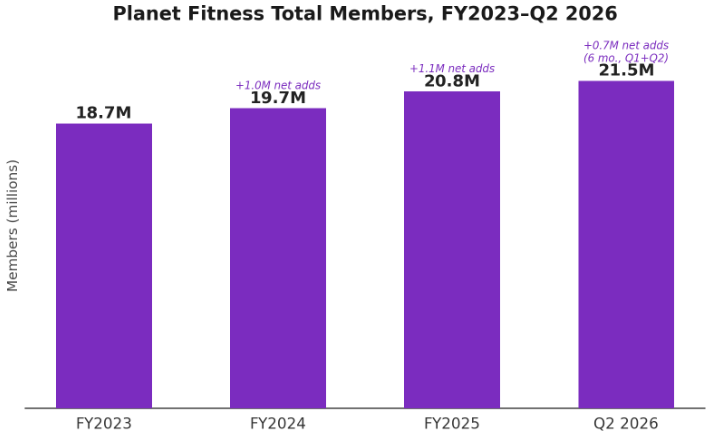
Today PLNT has 21.5M members as of Q2 2026. Although membership has grown by ~15% over the past three years (18.7M in FY2023 → 21.5M in Q2 2026), we can see that by Q2 2026, sequential growth in memberships has effectively stalled.
Former interim-CFO Tom Fitzgerald, on the Q1 2026 earnings call, said directly: “We added about 1 million net members in Q1 last year. And this year, it was about 700,000”, down from Q1 2025, despite more clubs being open year-over-year.
PLNT has two membership options: Classic Card at $15/month and premium Black Card at $25/month. Of the 21.5M members, ~68% hold Black Cards. Black Card membership penetration has grown ~4.1 percentage points in roughly the past year and a half (63.9% at FY2024 → 68% at Q2 2026), but that rate of growth is also slowing down.
Based on the 2025 Investor Day and 2025 Form 10K reports, management had proposed a 3-year plan designed to grow revenue by low double digits and adjusted EBITDA in the mid-teens percentage. However, this growth algorithm was formally withdrawn in the Q1 2026 earnings call due to shortfalls in net membership growth and the pause in the Black Card price increase rollout.
As recently as the 2025 Q4 call, barely a quarter before the blowup, former CFO Jay Stasz reiterated the three-year growth algorithm and told investors the company expected to “get back to those targets” in the out-years. A few months later, on the Q1 2026 call, that same algorithm was withdrawn entirely, with CEO Colleen Keating citing a net member growth shortfall that had an “outsized impact on the year.” Management damaged its credibility here, as it told the market one thing in February and a materially different thing in May. (OSC - likely explains the CFO getting ousted soon after)
So was the shortfall caused by seasonality, or something structural? Let’s start with the case for a “blown set,” a timing issue. Seasonally, PLNT adds the most members in Q1 (i.e., holiday gift giving and New Year’s resolutions). Combine winter storms that dented January joins, along with a short-lived uptick in cancellations tied to the rollout of “cancel anytime” online member management, and you have a business absorbing a few one-time bruises rather than a business that’s broken. If January’s storms and the cancel-anytime friction were truly one-time bruises though, Q2 should have told a healing story.
Management’s own diagnosis in Q2, however, wasn’t seasonal. Newly appointed CFO Sudhanshu Priyadarshi called out in Q2 2026 earnings “the slowdown in net new joins” directly, and pivoted the company’s stated priority toward “expanding the member base, complemented by rate growth rather than the other way around.”
That’s not the language of a business dusting off a bruise, but a case for the “blown shoulder,” something structural. Management conceded its campaigns weren’t reaching the core “gymtimidated” beginner audience, the exact demographic the entire high-volume, low-price thesis is built to attract.
Marketing Issue?
On the Q1 2026 earnings call, CEO Colleen Keating attributed the recent softness to the company’s marketing, which “largely resonated with a more fitness-minded consumer, yet had less resonance with the fitness beginner or more casual gym goer,” along with broader macroeconomic pressure on consumers.
The 2025 marketing campaign was supposed to prove PLNT could deliver real fitness results without abandoning its judgment-free positioning. Instead, in her words on the Q2 2026 earnings call, the marketing plan “overtorqued” as the cast in the ads skewed toward visibly muscular, athletic-looking bodies. The company built a campaign that visually spoke to people who didn’t need PLNT’s core value proposition, and let it run for a full year before recognizing the mismatch.
Keating referred to the current cast as “the fit getting fitter” rather than the relatable, average, and/or beginner-looking members the brand has historically used to signal approachability. The fix, as management has described, is a return to the brand’s original casting and tonal playbook, not a new strategy.
. . . or Something Else?
The failure though may not be the ad, but the sustainability of the engine itself.
For PLNT, increasing revenue breaks down to two levers: “rate” (i.e., increasing prices on members), and “volume”" (i.e., increasing the number of members). The split between them tells you whether growth is coming from charging people more, or from signing more members. Ideally the rate-to-volume ratio would be 75/25: 75% of increased revenue would come from migrating existing members from the Classic Card to the Black Card, and 25% of increased revenue would be achieved by increasing membership overall. This ratio of rate-to-volume has taken a step down from the first quarter. Rate-to-volume split ran roughly 90/10 against a management-guided target of 75/25 (i.e., 90% of revenue increases came from migrating members to the more expensive Black Card, and 10% from member adds). By the second quarter, there was no volume growth left to speak of. Management disclosed that rate accounted for more than 100% of the growth in revenue.
Mentioned earlier, Black Card penetration, historically the company’s most dependable path to organic revenue growth, has slowed. While Black Card penetration itself is still rising, up 240 basis points year-over-year in Q1 and 210 basis points year-over-year in Q2, it is decelerating from the 340-basis-point annual gains the company was posting earlier in 2025, which explains why price alone can’t keep carrying the top line growth much longer. The cheapest, easiest dollar of incremental revenue per member is already spoken for. So while company grew revenue entirely by charging existing members more, it lost ground on the metric the entire business model depends on.
Weigh the two cases against each other, and the “blown shoulder” argument appears stronger. A single bad quarter doesn’t explain a management team reiterating a three-year algorithm in February and abandoning it in May. That’s not a business absorbing a bruise; that’s a business model that broke. Winter storms and a marketing overcorrection are real, but they’re the kind of headwinds a well-calibrated growth algorithm should have margins of safety for. The fact that they didn’t is telling. From here, growth has to come the hard way: adding more members and clubs.
The Rehab Plan: what management says gets them back in the game
Management’s plan to rebuild the business, and by extension the stock, rests on fixing the marketing engine, defending and growing the member base, and only then touching price again.
Management’s own diagnosis of the Q1 2026 stumble was that the marketing campaign had inefficiencies with the National Advertising Fund. The fix underway is hiring a new ad agency and introducing a refreshed campaign slated for full rollout before year-end, timed deliberately to be ready for the January 2027 join season. Franchisees are funding a bigger share of this by shifting contribution dollars from Local Advertising Fund (7% to 6% of revenue) to National Advertising Fund (2% to 3%) starting in 2026, which centralizes spending and, in theory, buys more precision per marketing dollar. The rationale behind it is that it will increase media-buying scale and save on agency fees. CEO Colleen Keating stated in the Q3 2025 earnings call, “For 2026, the franchisees voted to increase the contributions to our NAFs from 2% to 3% and decrease contributions to local marketing from 7% to 6%. This 1% shift will allow us to increase the size of our NAFs in 2026, and we believe that the shift will unlock new marketing opportunities for our brand while resulting in marketing efficiencies.”
This is a cost-efficiency case, not a targeting one. Cheaper, more efficient distribution of the wrong message doesn’t fix the message. Until a new marketing campaign actually built around the “gymtimidated” beginner is in full swing, the ad fund shift is evidence of process change, not evidence of a fix. Perhaps management has begun to realize this as the CEO shared in Q2 . . .
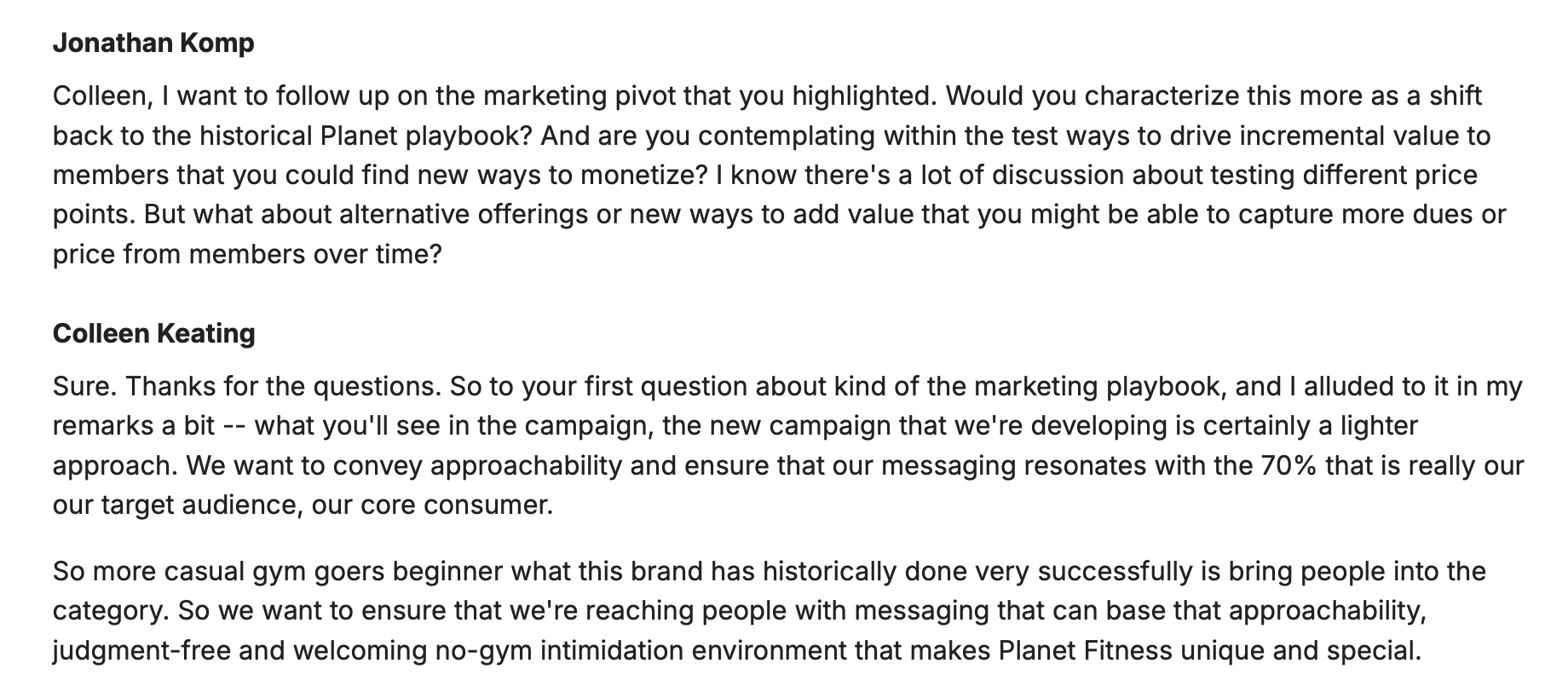
The advertising campaign that focused on trying to attract more “higher value” Black Card members went too far, and shifted PLNT away from its “gym for all” ethos.
In addition, recent price increases created challenges to attracting new members. Changing pricing has already proven costly as the earlier Classic Card increase from $10/month to $15/month coincided with softening membership growth. Management is now trying to reverse this by decreasing Classic Card membership back to $10/month via promotions/discounts to stem the loss of members. Recently, PLNT had also planned to increase Black Card prices from $25 to $29/month, but paused the full roll-out.
In short, the logic behind pausing price increases is straightforward, focus on increasing the number of members. First, hold off on migrating members to the Black Card until new member growth actually recovers, then take the Black Card increase once volume is back to carrying its share of the load again. Second, reduce the price of admission for new members by lowering the Classic Card price.
To aid with membership additions, management is also continuing the High School Summer Pass program that offers free membership to high schoolers during the summer. PLNT’s now converting north of 8% of its several-million teen participants into paying members, adding a potential future pool of Black Card updates.
Conclusions
Even if we set aside the question of management’s credibility after they withdrew guidance so quickly, in our opinion the growth ceiling here is low. In 2025, the company generated $0.25B in FCF, and with a market cap near $3.6B today; that represents a nearly 7% FCF-to-market-cap margin. For 2026, we project FCF to be fairly close to $0.26B, but more importantly, we see little room for future growth unless PLNT’s management team can execute. The two levers for increasing revenue (i.e., rate and volume) are already challenged. Membership growth has stagnated, and Black Card penetration has limited room left to run as price increases on both Black Cards or Classic Cards have already shown they cost membership volumes. This is a business that’s had difficulty increasing prices without bleeding members, and has likely already converted most of the easy upgrades.
The case for putting new money into PLNT today doesn’t clear the bar. While the fundamentals aren’t broken: FCF is still growing (though anemically), the franchise toll-booth model still throws off recurring cash, and management has a credible-sounding turn-around plan on paper, there’s still great uncertainty until there’s concrete evidence that the marketing reset is actually working. We need to see the company add net members in numbers similar to prior years once the new marketing campaign launches ahead of the 2027 “join” season.
Before that, this is a pass, but not necessarily a short. The business isn’t deteriorating; it’s just unproven in this latest pivot. We project 2026 revenues to reach $1.45B, $1.54B in 2027, and $1.62B in 2028, which is mid-to-high single-digit growth, not the low-double-digit pace management once promised. Even this, however, will be impossible if the company fails to add new members.
The one date worth putting on the calendar is the 2027 Q1 earnings call, when the results of this year’s marketing fix either shows up in the join numbers, or doesn’t. The hiring of a new CEO plus a refocus on increasing membership gives us renewed confidence, but membership growth must be present before investing. Membership influxes should be up year-over-year in Q1 2027 and carry over to Q2, 2027 as proof that PLNT is making positive steps to fixe their revenue engine. Anything less and the stock may take another leg lower.
OSC (EDITOR’S NOTE): We’d agree with this conclusion, and would probably add the risks of deteriorating consumer confidence and the increasing strain of consumers in this “K shaped” economy. We can see it in the spending data. Walmart’s recent report, which led to a fall in the stock, reinforced our current view that the lower income strata is particularly challenged in today’s current high-inflation economy.
As PLNT noted in its 2025 Form 10K “Generation Z represents our fastest growing demographic, contributing to our memberbase that is approximately 51% male, and includes households of all income levels. Approximately 22% of our clubs are located in areas that the U.S. government deems “low income,” providing access to improve health and wellness in underserved communities.” Unfortunately, these are the very demographics that are experiencing pricing pressure, and if nearly a quarter of your clubs are located in low income locales AND you’re having difficulty increasing prices by only $5/month (e.g., the Classic Card from $10/month to $15/month), while the economy is still “relatively” strong, what will happen if the economy weakens from here? Ultimately, we agree with Carter’s conclusion that investors should take a beat and wait to see if PLNT’s marketing shift can reverse its recent trajectory.
Please hit the “like” button and subscribe below if you enjoyed reading the article, thank you.
Good little writeup, did feel like it was a bit too heavy on the AI use though
Excellent read and break down.