

(As we’re apt to do for the summers, we tend to hire a few interns. It’s a great way to pass on some of the things we’ve learned, inject a fresh new view into what we do from someone younger, and get a bit of help on a few odds and end. For this summer, Open Square welcomed four interns, and over a series of articles, they’ll share some of their learnings from their research. This summer, we had the pleasure of having Maya Iyengar. Maya is a rising sophomore at the University of California, Berkeley majoring in Business at the Haas School of Business. Go Bears! Like her sister (who works for Google DeepMind), she’s developed a keen interest in AI, and decided to spend her summer looking into the SAAS space where software meets AI. In particular, one company drew her attention, ServiceNow, and post-SAAS sell-off she decided to take a look. We hope you enjoy her article below. If you’d like to reach out to Maya for future opportunities, feel free to email her at maya_iyengar@berkeley.edu).
NOW
ServiceNow (“NOW”), the Santa Clara-based AI platform, has spent the last two decades turning itself into the default operating system for enterprise workflows. Founded in 2004, it has quickly become one of the largest pure enterprise software-as-a-service (“SAAS”) companies in the world.
NOW offers a suite of products, and the core of these solutions is the Now Platform, a cloud system that pulls an organization’s workflows and data that may be scattered across email, spreadsheets, and other tools, into one unified workflow.
At the current share price of approximately $138/share with 1.03 billion public shares, the company has a market capitalization of nearly $138B. NOW also carries roughly $2.9B in net debt (i.e., $7.5B in debt offset by ~$4.6B in cash and marketable securities), which results in an enterprise value near $135B.
So what do you get for $138/share, and how does the platform work? Let’s take a tour.
The Software
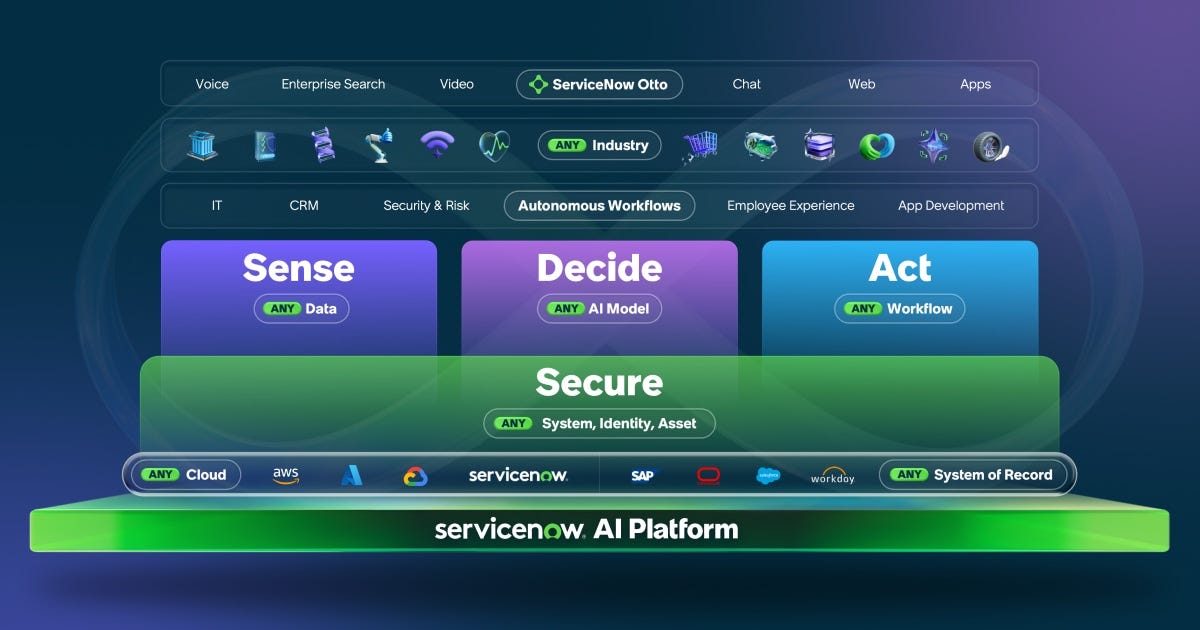
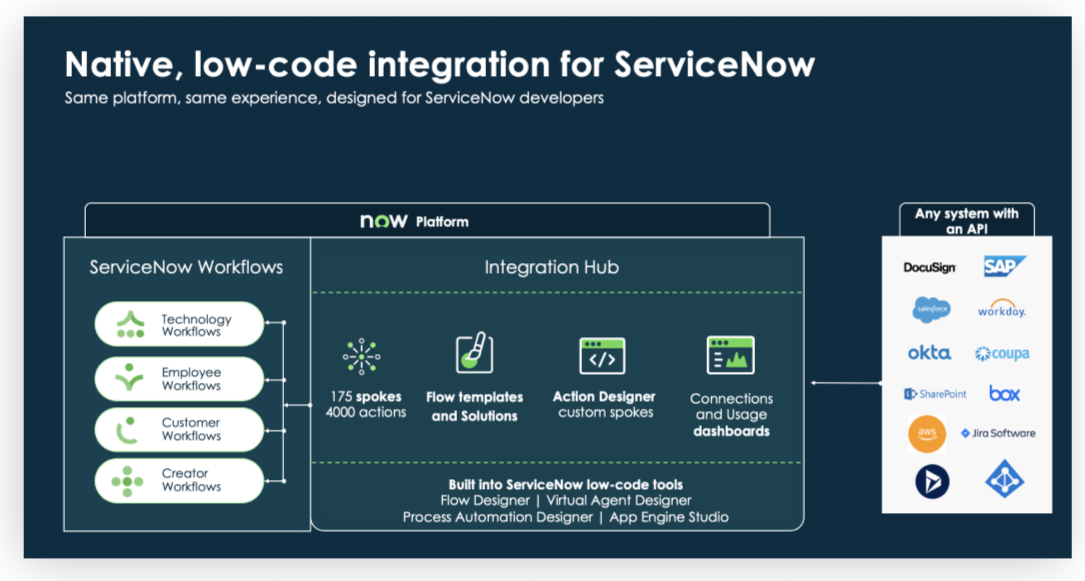
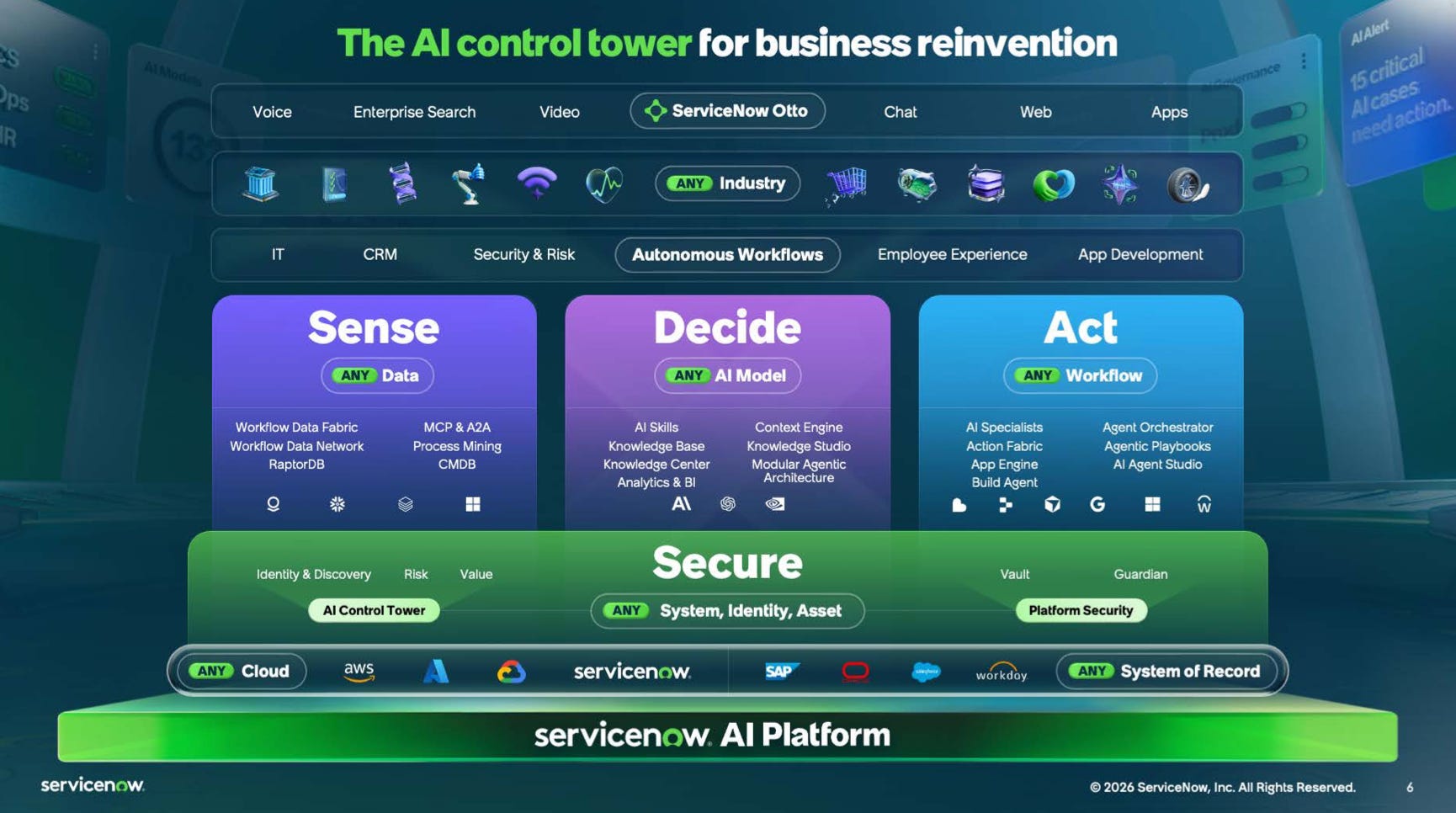
NOW is essentially a modern workflow automation platform that plugs into IT workflows, customer workflows, and employee workflows all in one spot. Under every application sits a shared database and a workflow builder (Flow Designer) and the IntegrationHub, which uses hundreds of prebuilt connectors to pull data from Salesforce, SAP, Workday, and the major clouds. On top of this foundation is Now Assist, NOW’s generative-AI layer, which uses LLMs including Anthropic’s Claude to summarize cases and draft responses. In this way, NOW effectively orchestrates the entire customer lifecycle, and in NOW parlance, an “AI Control Tower” for business reinvention.
The company sells its products and services directly and indirectly to enterprises across a wide variety of industries through subscription agreements. In addition to subscription offerings, certain AI and data solutions include a consumption-based pricing component that governs when customer usage exceeds the fixed number of service credits available under the customer’s subscription agreement.
Before diving into the financials, there are two pretty important metrics SAAS businesses such as NOW focus on: Remaining Performance Obligations (“RPO”) and Annual Contract Value (“ACV”).
RPO represents a forward-looking financial metric defined as the total value of contracted non-cancelable customer contracts that have not yet been delivered. RPO includes two main revenue streams: deferred revenue and unbilled revenue. You can view RPO as both a “backlog” and “leading indicator” of revenue.
ACV, on the other hand, measures the yearly average revenue generated from a single customer contract. Think of this as a smoothed-out metric, so it allows you to compare the average annual revenue even if you’ve signed customers to short-term or long-term contracts. Said another way, RPO represents the backlog and future revenue, and ACV shows whether each contract in that backlog is increasingly more valuable (ideally we’ll want both to inflect).
NOW’s Targets
In NOW’s most recent Financial Analyst Day, held on May 4, 2026, the company set a 5-year target of achieving $30B in revenue by FY 2030 with a “Rule of 60+” (i.e., subscription revenue growth rate + free cash flow margin exceeds 60%). More specifically, the company is also attempting to grow its AI ACV to 30% of ACV in order to better highlight the progress it’s made in incorporating AI agentic models into its overall platform. NOW’s “AI” refers to the company’s Agentic AI capabilities, AI Control Tower, and integrated MOvements functionality, which are available at premium prices.
In 2026, the company anticipates generating $1.5B in AI ACV.
So let’s step back and look at their financials, and how all of these goals measure up.
First, starting with the top line: revenue.
NOW reports revenue in two broad categories:
1. Subscription Revenue, and
2. Professional Services & Other
The company reported $13.3B in revenue in FY 2025. 97% of the revenue came from Subscriptions, which totaled $12.9B in FY 2025. Professional services, which are related primarily to the implementation, configuration, and training of NOW’s products, made up 3% of revenue, approximately $0.4B. NOW has grown revenues by 21% and 22% in 2025 and 2024, respectively. For the first half of 2026, revenues are on track to grow 21% (2026 H1 vs. 2025 H1). If NOW were to successfully achieve its $30B bogey in FY 2030, that would represent a nearly 18% CAGR from FY 2025’s $12.9B. Sounds great on paper, but is that truly achievable?
Let’s dive deeper into the financials (note all chart information is from company provided information (e.g., Form 10Ks, Form 10Qs, and IR presentations).
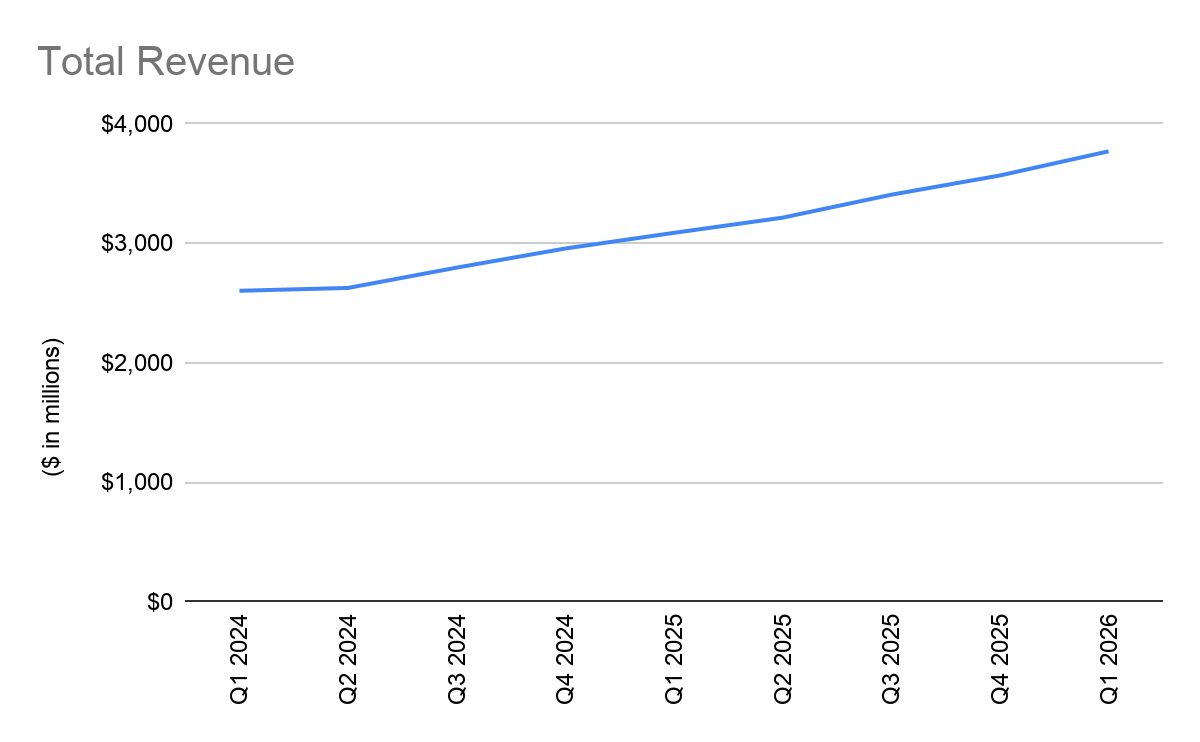
Given the Subscription revenue-based model, gross profit margins are fairly high. The company does lose money on the minimal professional services fee it generates, but it’s immaterial and facilitates the installation of the company’s products. Overall GPM sits around 78% in 2025, down slightly from the 79% in 2024.
Heading further down the income statement, we land on operating expenses. In FY 2025, total opex ran $8.5B, or 63.8% of revenue, down from 66.8% in 2024 and 70.1% in 2023. That significant 6-point drop within two years is a great sign of operating leverage in the business, meaning that revenue is growing faster than the cost to attract it.
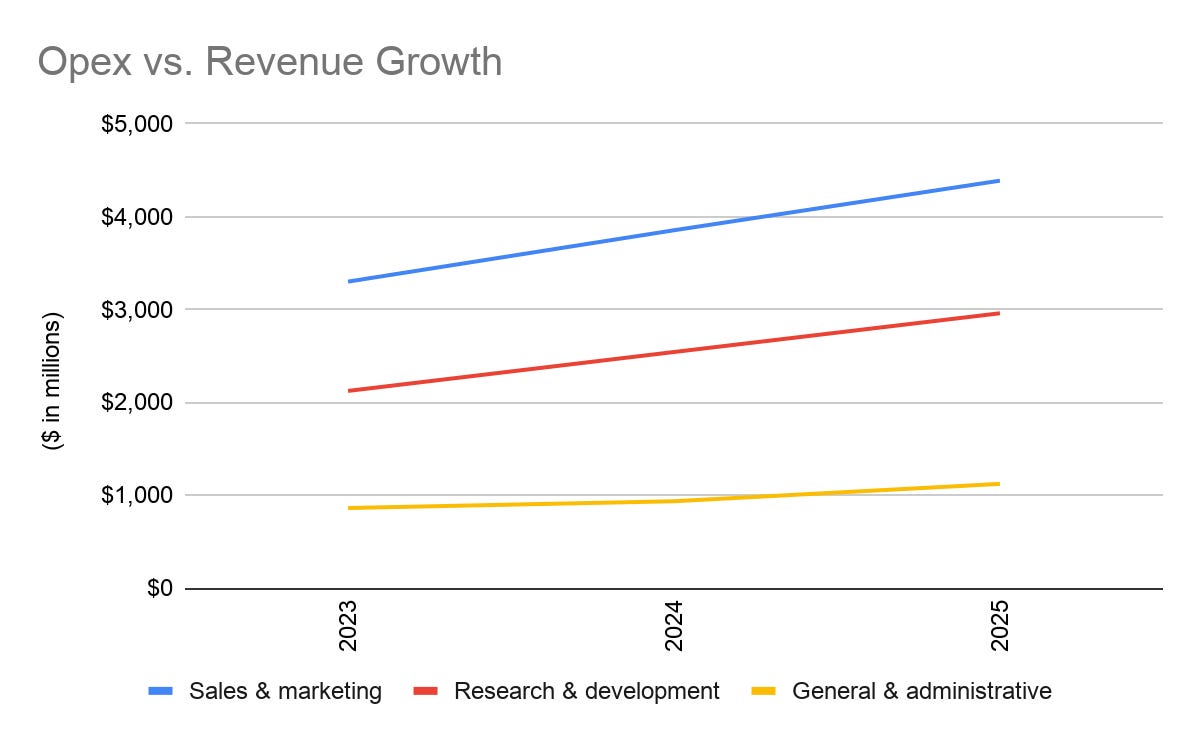
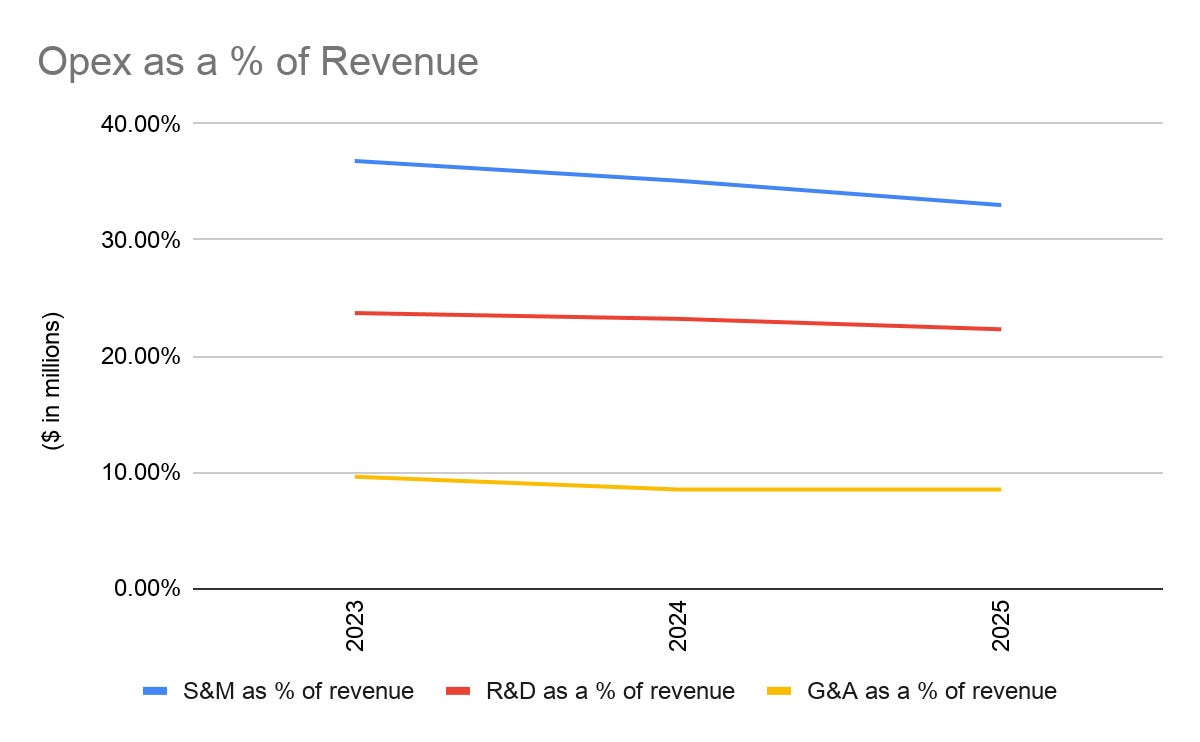
Sales & marketing takes the lion’s share of expenses at $4.4B, and it’s also the main cause of that 6-point drop in total opex as a percentage of revenue. As of Q2 2026, Revenue is growing 21% year over year and is increasing at a faster rate than operating expenses. Sales and marketing alone dropped from ~37% of revenue in 2023 to ~33% in 2025, signifying that sales productivity improved. R&D has held roughly flat near 22–23% of revenue (~$3.0B), while G&A shifted down to ~8.5% from 9.6% in FY2023. In other words, every major line item in costs is shrinking as a share of revenue, and the largest one (i.e., S&M) is shrinking the fastest.
The payoff lands on the next line down. EBIT in FY2025 comes in around $1.8B, up from $1.4B in 2024. This jump in EBIT represents a widening gap between revenue and operating expenses growth, and as the business scales further, it’s the number to watch.
The increasing operating leverage is also translating to an improving cash flow statement.
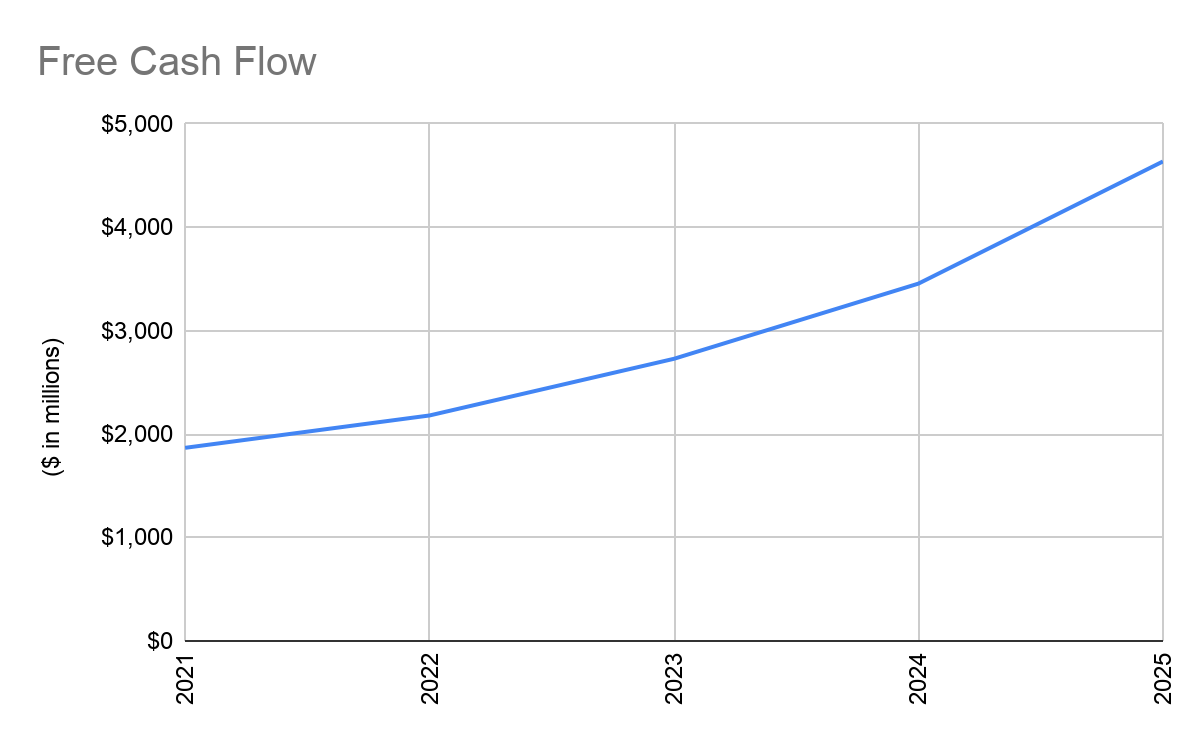
Operating cash flow landed ~$5.4B in FY 2025, and has been steadily rising these past few years. The largest add-backs? You guessed it: depreciation/amortization, which runs ~$0.7B, and stock-based compensation (“SBC”) at ~$2.0B. For a +$100B company, SBC is high, but unsurprising given it’s in the SAAS sector. After factoring in capital expenditures (i.e., purchase of PPE $0.9B, we can see that NOW generated FCF of ~$4.6B, fairly close to NOW’s own metrics of Non-GAAP FCF.
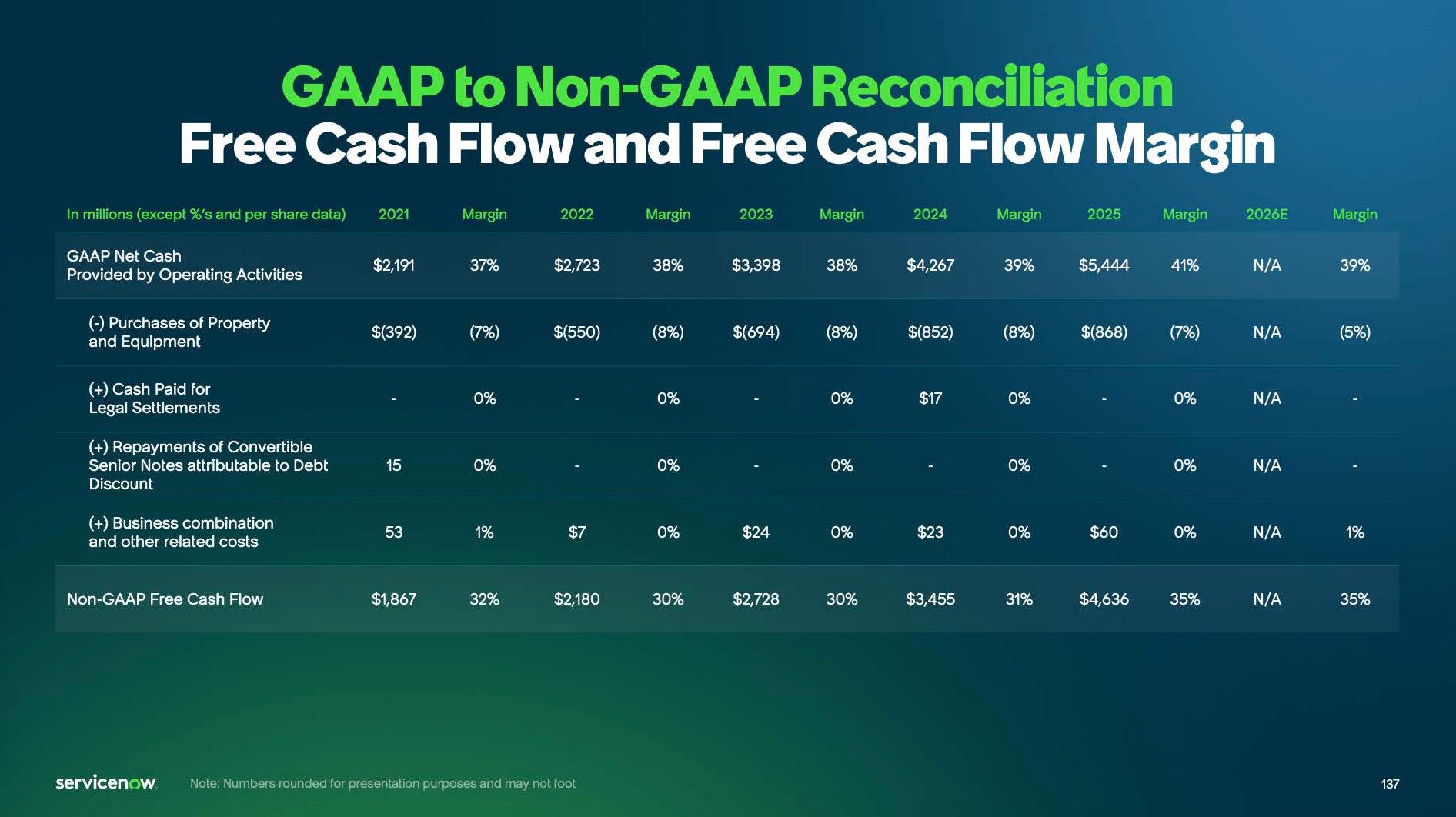
Before we get excited, there are two things to note. First, while the $4.6B in “FCF” appears to be decent relative to NOW’s market cap, we’re not sure why they’d elect to exclude the recent acquisition of Moveworks (worth ~$2.9B ($1.5B in stock and $0.9B in cash)) that closed in December 2025, which if accounted for drops FCF to nearly $3.7B. Perhaps because it’s a “one-timer?” Oh wait, they also purchased Veza (~$1.2B) and Pyramid, and Armis (~$7.75B) in 2026 . . . yeah.
(OSC - The company provides that the acquisitions were needed to build out NOW’s product portfolios. Each of the purchases broadens and deepens NOW’s offerings: Veza (expands AI security and risk portfolio), Pyramid (AI business language and natural language data querying), and Armis (bridges a gap between asset visibility and automated risk management).)
Second, even if FCF was $4.6B as NOW claims, what about SBC? NOW’s share count has been fairly flat these past few years, but NOW has had to repurchase ~$1.8B of common shares in 2025 to keep that share count flat. Said another way, share repurchases are needed to offset the dilutive impact of employee stock compensation, so at the very least FCF should be reduced for this expense.
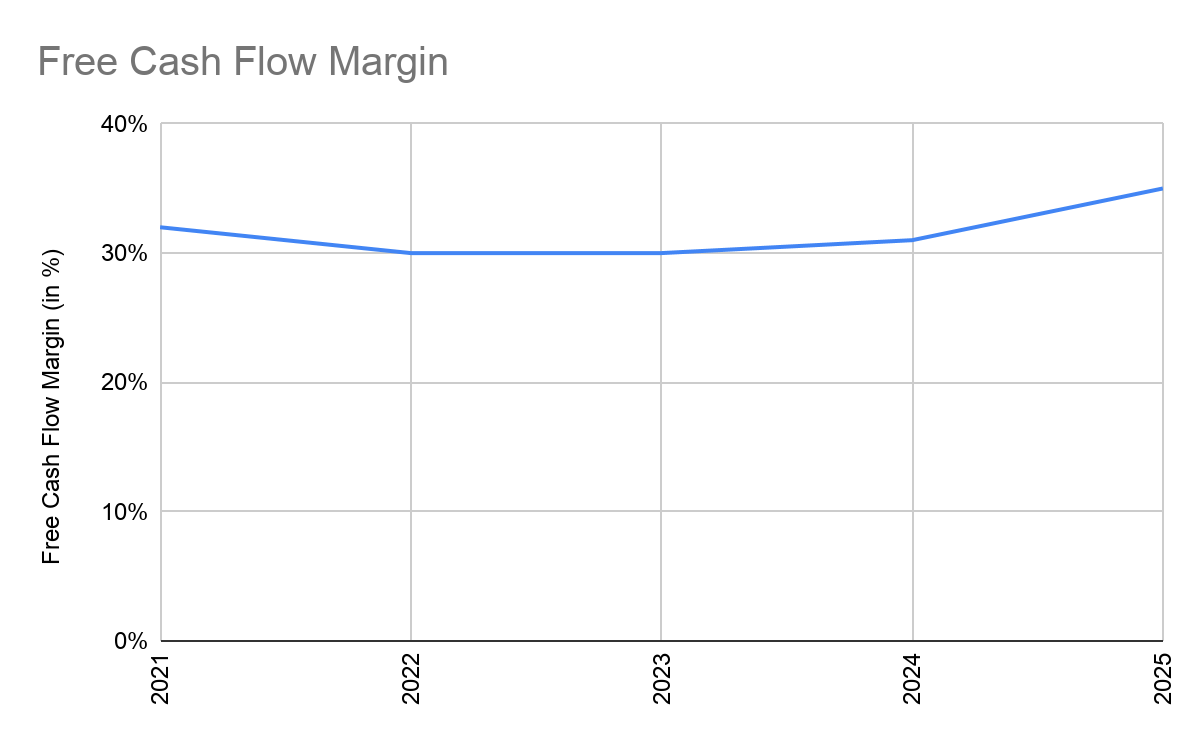
Nonetheless, continuing with and comparing our $4.6B FCF against the total revenue gives us a ~35% FCF margin, which is an excellent rate, and leaves the door open to either reinvest or return it to the shareholders.
(OSC - This sounds fine so far, but what’s the risks here Maya? Why the sell-off in the space and in this company specifically? What’re you seeing?)
Synthesis
There are a few risks in our minds that should be addressed: vibe coding and the business model.
Vibe Coding
First, vibe coding is all the new hype these days, and refers to building software from natural-language prompts instead of hand-written code. And this prospect is one of the most direct threats to a platform business like NOW, because it lowers the barriers in skill and time to build the very workflow apps in-house that NOW charges for. Popularity in this sector is expanding rapidly: the AI-coding market is growing at roughly a 38% CAGR, with 92% of developers using AI coding tools daily, and over 40% of new production code being AI-generated. Raw vibe-coding output creates the “Shadow IT” problem, which occurs when business units become frustrated waiting for software they believe will make them more effective. This causes them to create an interim solution, therefore skipping the procurement process.
From design and scaling issues to security and compliance concerns, vibe coding as a whole falls short in many areas. As a result, NOW has started positioning itself as a governance and orchestration layer for enterprises, which sits underneath AI coding tools that developers may be using to complement business needs. Its Build Agent tool translates natural-language prompts directly into production-ready enterprise applications. NOW has also extended Build Agent’s governance and context directly into Cursor, Windsurf, Claude Code, and GitHub Copilot, so developers can build from any environment while still operating inside NOW’s governance layer. And even beyond their AI offerings, NOW also has a key differentiator: the two decades of accumulated enterprise workflow data. This gives its AI agents built-in business context that other, more generic, coding assistants won’t have.
We’re seeing this trend across industry, with other enterprise software companies too. Salesforce (CRM), for example, has a similar ideology with their “build anywhere, deploy here” pitch in relation to their Agentforce suite. Same with Microsoft (MSFT) and their Copilot Studio and Power Platform. All of these companies are racing to become the primary governance layer of record, and NOW is competing on the size of its existing enterprise footprint rather than fully building out its own unique technology.
Changing Business Model
Second, the business model is shifting. Can NOW maintain its revenue growth? Even if it dodges getting “vibe-coded” away, will customers still flock to NOW’s offerings? NOW’s growth has historically been a function of users of their software, and AI is exactly the technology that lets NOW’s own customers do more work with fewer people. If growth were still purely tied to headcount, the future of their revenue would be an expected downturn.
Management’s shift to non-seat-based pricing is their direct answer to this risk associated with their prior revenue model. By acquiring half of net-new business through token consumption, infrastructure, and connectors instead of headcount, NOW is deliberately isolating its growth from the headcount reductions that its systems enable at its customers. In theory, this means revenue can keep growing, even if customers are shrinking their employee base, because pricing is now tied to the amount of work being done, rather than the number of logins that are required. This also means NOW’s offerings have to enhance productivity and deliver real benefits.
(OSC - Whether the widespread adoption of AI and LLM models in businesses is effective remains an option question, but admittedly it’s early days. In its recent State of AI survey (November 2025), McKinsey consulting found that nearly 80% of companies are now using AI in at least one business function, but >80% of companies still report no material contribution to earnings from their AI initiatives.)
So if you’re pricing on higher usage, you better hope it drives higher usage. During a Financial Analyst Day in Q2 2026, NOW categorized their pricing model as “Predictability + Flexibility,” essentially presenting their model as a blend of subscription-based pricing with usage-based meters. They also reported that this new pricing model has already made up nearly 50% of net new annual contract value (NNACV). If customers see value in NOW’s AI offerings, we should see that turn-up in higher RPOs and AI ACV.
RPO & AI ACV
So far things appear on track as RPO continues to increase.
(OSC - note that Maya has used the non-GAAP RPO figures, which the company uses. It adjusts growth rates, etc., for constant currency to eliminate the volatility of F/X fluctuations).
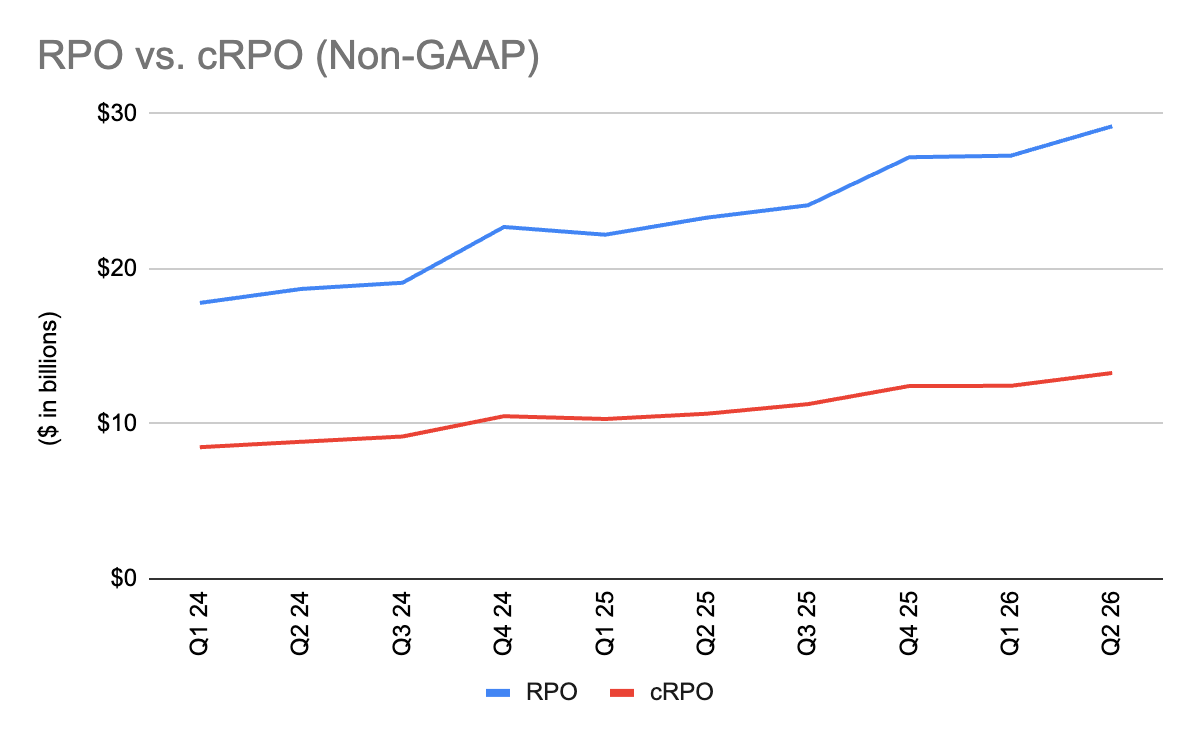
NOW breaks down RPO into two main categories: current RPO (cRPO), the portion of RPO expected to convert into real revenue within a year or less, and non-current RPO, any portion that is expected to convert after a year.
As of Q2 2026, total RPO reached $29B, with cRPO at $13.2B and non-current RPO expanded to $15.8B, up from $13B in FY 2025. This increase in non-current RPO could be attributed to longer contract durations, and decreases NOW’s long-term revenue risk.
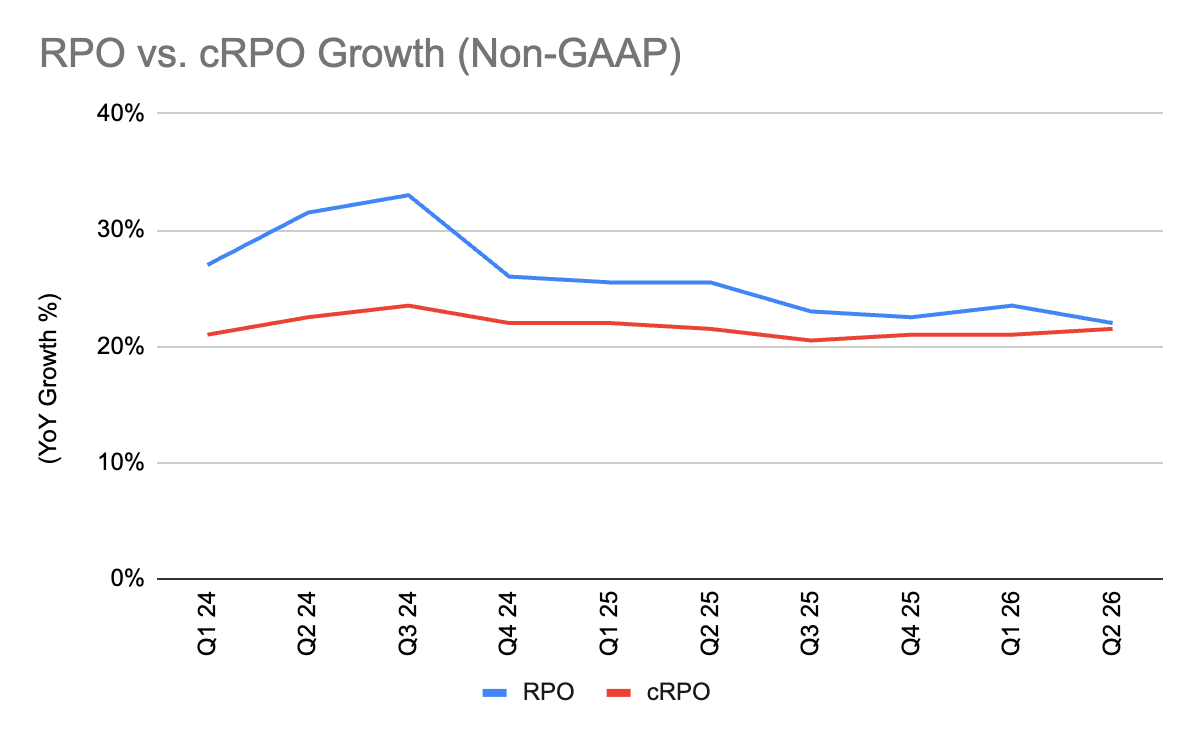
However, the growth rate on RPO has slowed from its 2025 peak, which will be something to watch in Q3 and Q4 of 2026.
(OSC - Nonetheless, again if we view RPO as both a backlog and leading indicator of revenue, the fact that it’s growing faster than revenue is a healthy sign).
So RPO tells us that contracts are being signed, but what about the value of those contracts? Are customers paying more for the software (i.e., they find more value). For AI ACV, we’re seeing continuing growth. AI ACV landed at over $600M at the end of FY 2025, and as of Q1 and Q2 2026, the number grew to $750M and >$1B, respectively.
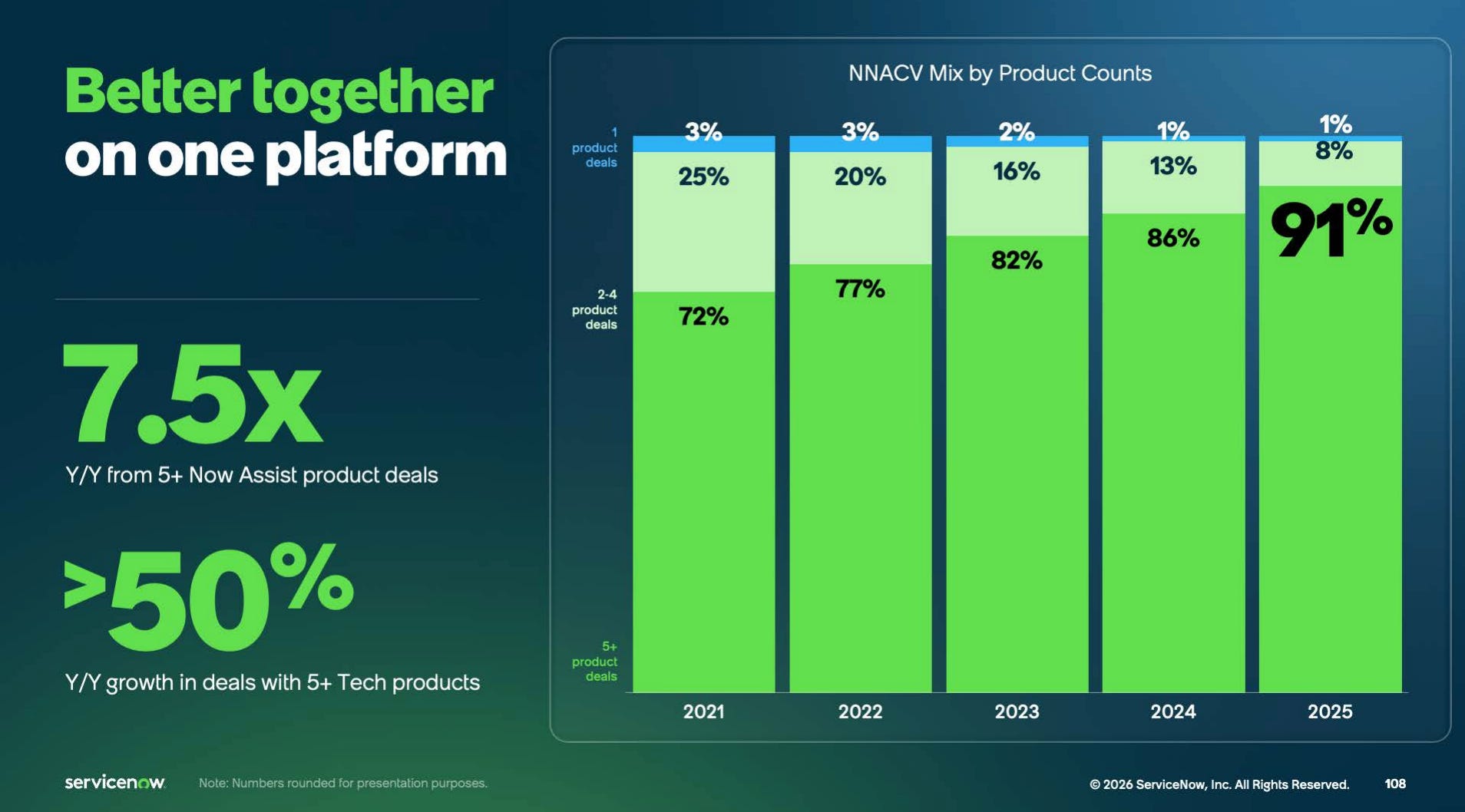
As you can see from the chart above, deal size is also growing. A deal with 5+ products is worth substantially more ACV than a single-product deal, and as the mix shifts toward 91% of deals having 5+ products, the average new deal size (ACV per deal) is rising sharply. This is also in agreement with the growth metrics presented, such as the 7.5x Y/Y growth rate. And with NOW’s extremely high retention rate, this growth in ACV only highlights greater net revenue retention potential.
From a business standpoint, this also signifies that ServiceNow’s platform strategy is working. The “Better together” narrative seems to be true, as customers are increasingly adopting the full platform, with 5+ products in their suite through one contract, rather than purchasing a single piece of the pie. Simultaneously, first-time agentic AI buyers grew 45% year over year, signaling that NOW’s customer base is expanding, rather than growing within existing customer accounts.
Gina Mastantuono, NOW’s CFO, commented on this shift, saying that “customers aren’t paying us for tokens, they’re paying for resolutions.” This builds off of the 50% NNACV being non-seat-based, but is also the source of seat erosion. However, seat erosion and ACV growth aren’t offsetting the positive effects of AI adoption. Rather, they signify that value within NOW’s business model is transitioning from headcount-based licensing to outcome-based contracts.
(OSC - this makes sense to us. NOW is charging customers a mix of token-based, assist-based pricing (i.e., AI and platform charged based on the assistance it provides and the cost of consumption) vs. outcome-based (i.e., AI system delivers a specific business outcome (e.g., Salesforce)), so if customers don’t find a use, they wouldn’t be using it, and you should see that in RPO and AI ACV. AI usage typically uplifts the price by 20-30%).
Putting it all together, the current $1B in AI ACV, 40%+ net new AI ACV growth, reported 9x growth in agentic AI production customers over 9 months, and half of new business being non-seat-based, NOW seems to be on the right trajectory to meet its FY 2026 targets, which brings us to the bigger question here.
Buy, hold, or sell?
NOW’s stock has fallen over 22% in the past 52 weeks. However, the decline was less a “NOW-specific” event and more a broader enterprise-software selloff that also hit other large companies in the industry such as Salesforce, Workday, and Oracle.
At today’s price, NOW starts you at around a 3.5% yield (the 3.5% of FCF the business generates against its market cap, or the flip side of paying 28x FCF). Looking at the 3.5% return, the problem is quite straightforward: investing NOW is essentially accepting a worse FCF yield than a total index fund would deliver, which means you’re paying a premium for a stock in hopes of greater future returns. By investing in NOW, you are essentially accepting a lower yield in exchange for growth, and the +20% compounding on the top line (revenue) will lead to greater compounding on the bottom line (FCF).
Over the past four years, NOW has grown revenue at approximately 22% a year and FCF at 26% a year, so there’s a track record of executing. If we make the assumption that NOW’s historical FCF margin remains stable, and the company achieves its $30B revenue targets by 2030, NOW could potentially generate $10B in FCF by 2030. Assuming NOW’s FCF multiple stays roughly the same, or even dip slightly (i.e., 25x, or 4% FCF to share price) and the number of shares outstanding remains stable at ~1B, the stock may reach $250/share. Given the explosive growth of NOW’s offerings and its foray into AI, this doesn’t seem impossible, or implausible.
The honest verdict is that NOW is a high-quality business at a very demanding price. The business growth, up until now, has shown great promise, and the recent pricing pivot has also answered fears of seat erosion. Overall, the stock represents quality at a fair price, not necessarily a great bargain, or a value trap.
(OSC - We agree here. On balance, it’s a promising company in a fast growing space. Given that the stock has run-up nearly 30% in the last month when Maya started this project, we’d also agree that it’s best to wait for a pull-back. Much of the space took another step higher post-CRM’s earnings release yesterday, so the momentum is carrying through as it’s breached both the 50 and 200 day moving averages. In addition, the RSI is also elevated at this stage.
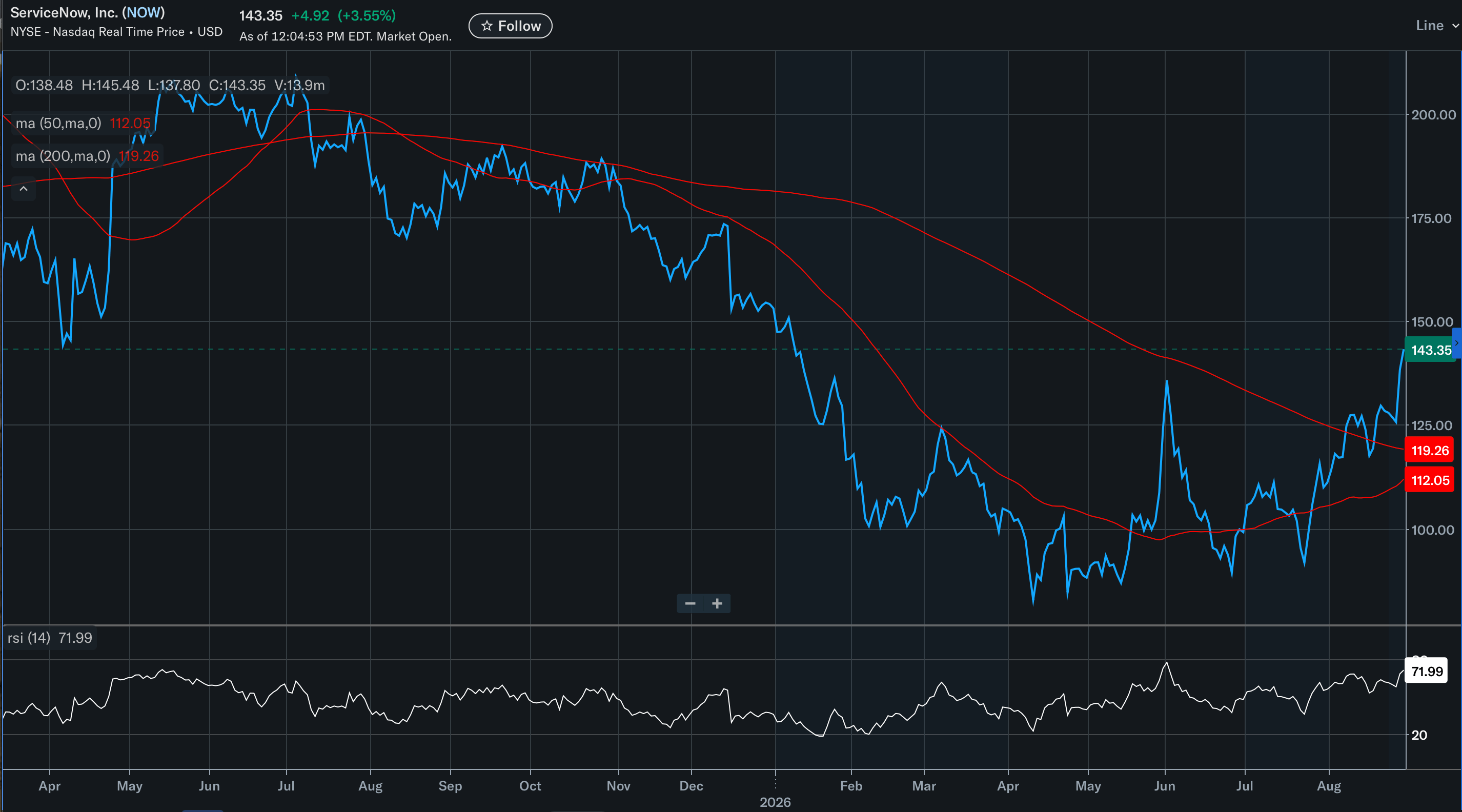
Still, there’s a fair chance this company hits its targets just given where the AI space is headed, and once these features are embedded in corporate IT budgets, they’re hard to remove. We’ll likely take a position as well in the common shares (again after waiting for a slight pull-back. Given the froth in this space, and the elevated market as a whole, it’s better to stay patient with any excess capital. The AI space is still in the growth phase, and there’ll be many opportunities to participate in companies that will monetize it all, so there’s no rush in taking these positions. This harkens back to Buffett’s “swinging at good pitches.” This one’s decent, but stay disciplined at the plate. Great job this summer Maya, and thanks for the great write-up!).
Please hit the “like” button and subscribe below if you enjoyed reading the article, thank you.