

The trap is sprung.
After a month of conflict, we can all assuredly agreed that the Iranian excursion was at best . . . ill advised, and at worst . . . well . . .

So we wait for the weekend as special forces (Tier 1 operators), a Marine Expeditionary Unit (“MEU”), the 82nd Airborne, land based fighters and bombers, and coalition forces assemble to capture some of Iran’s islands in an attempt to unblock the straight.
Will they succeed? Absolutely.
Tactically that is.
The tactical/military superiority of the US armed forces can’t be denied. They’ll almost certainly take whatever land, air strip, port, or oil infrastructure they set out for, and with minimal casualties. Of that we’re fairly certain given the poor training and degraded Iranian capabilities.
What we’re uncertain of though is whether a quick strike and victory, necessarily gives the US sufficient leverage in its negotiations. Negotiations that are seemingly getting more desperate by the day.
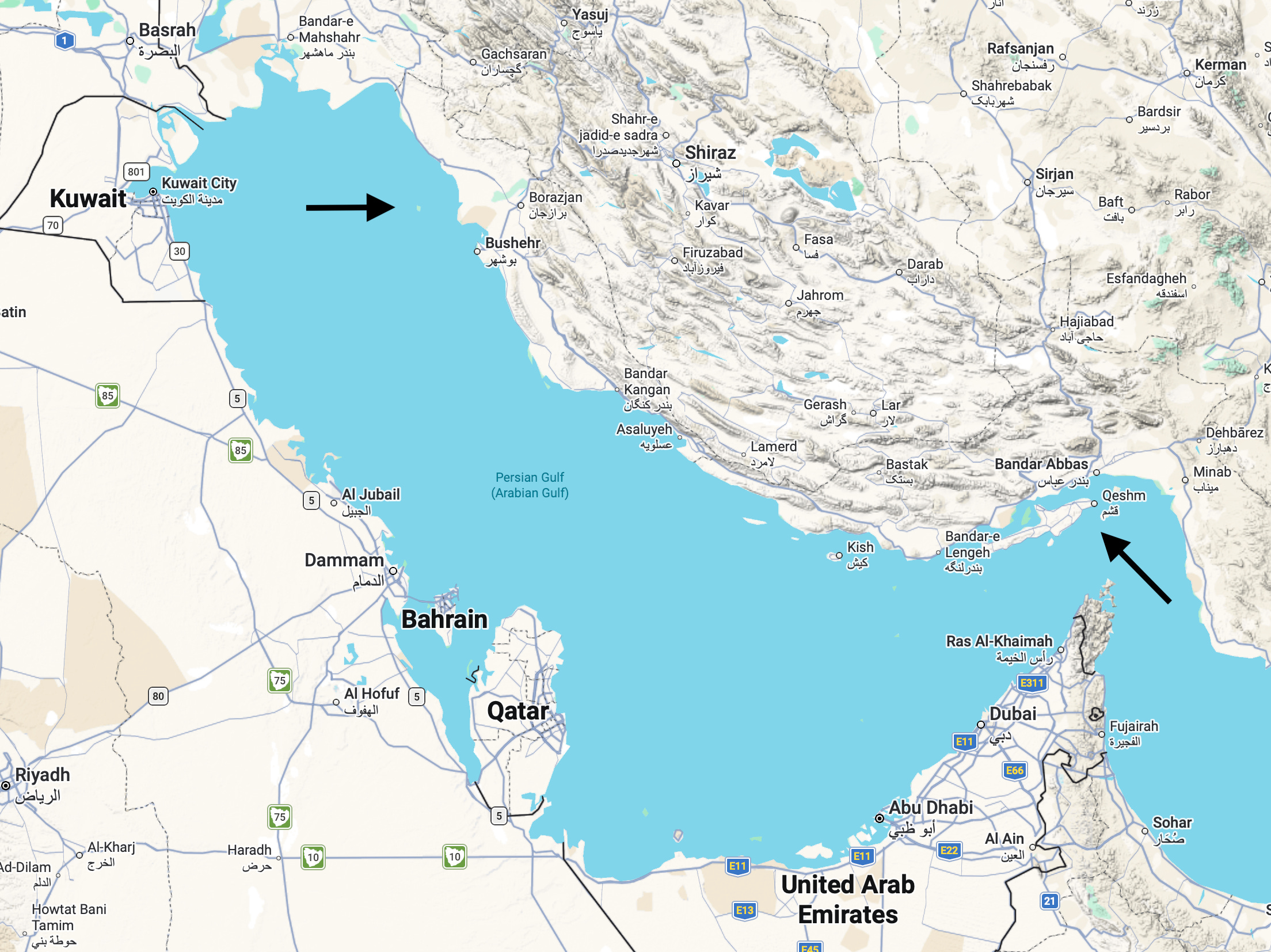
Among the few options floated include taking Iran’s strategically located islands in the Persian Gulf.


First, the US could take Kharg, Iran’s oil export terminal on the top left hand corner of the map above. Second, it could take Qeshm on the bottom right. Kharg, a major export terminal would be beneficial as it would shut-down the main spigot for Iran’s oil exports. Iran can divert its supplies, but not as easily, and not in full. Yet if the US was already willing to unsanction Iranian oil for fear of harming the oil market, it’d be inconsistent to then capture Kharg, and jeopardize flows there. Still, in trying to gain leverage, capturing Kharg would be the way to go. It’s much further in the Persian Gulf though, so would require a longer logistical tail to hold, which increases the military risk. Kuwait or Saudi Arabia’s assistance could help as they could resupply the troops from there. Still though, would the US be willing to completely shut-off flows when oil is already impacted? We’ll see.
Alternatively, the US could capture Qeshm. Currently, Iran is demanding that the US recognizes its right to control the strait (one of a list of 5 demands), and it’s using the waterway between Qeshm and the mainland as a toll gate. Capturing Qeshm would deny the Iranian’s the ability to use the facilities there. Issue with Qeshm? As you can see, it’s much larger. It would also likely mean ground operations in Bandar Abbas, and that means you’ve landed boots on Iranian mainland soil, which will take the entire war up the escalatory ladder.
Would it Matter Anyways?
Regardless of what the US does, what doesn’t immediately disappear is the asymmetrical threat posed by the Iranian drones and mines. If so inclined (and able), Iran can send enough drones to overwhelm the naval escorts when they cross the strait and/or at least pester the commercial tankers. Even if the escorts were successful, the disruption, logistical burdens, and insurance/economic costs likely means only 20% of the original traffic can be restored. Here’s Vice Admiral Kevin Donegan of the US Navy (in an interview with Goldman Sachs).
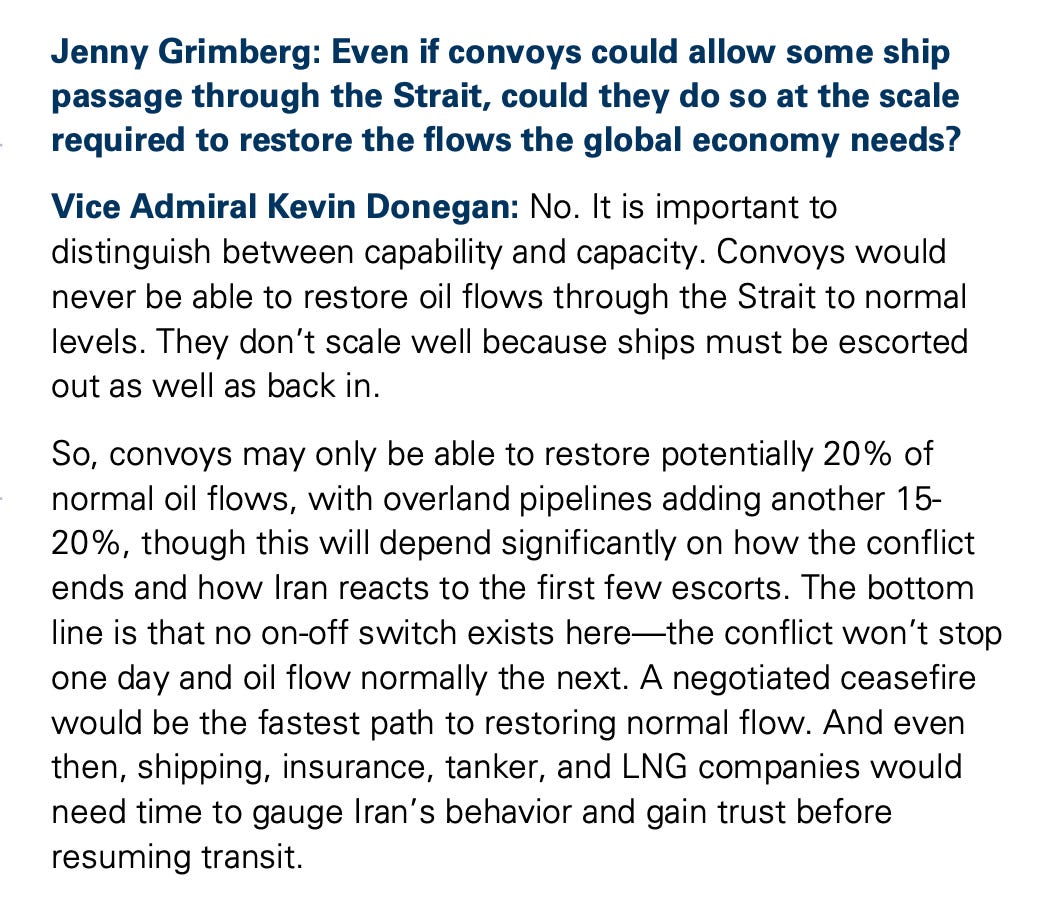
20% of normal flows? That’ll hardly make a dent in the supply outage.
Besides, we’re skeptical that sending boots on the ground means the Iranians will quickly capitulate as they only need to drag the war out for another few weeks. If Iran can keep the strait closed, or materially disrupted for 2-3 more weeks, we believe the global economy will come crashing down, deterring future aggression from the West.
So would they be willing to sacrifice a tactical loss for a strategic victory? Yes.
Today, we continue to have nearly 10-11M bpd of production shut-ins. Exports through the Strait of Hormuz are down by nearly 15M bpd, and SPR releases are just beginning. Despite accounts on Twitter sharing that some vessels have passed, it’s a far cry from the norm. Vessels traversing the strait are the exception and not the rule.
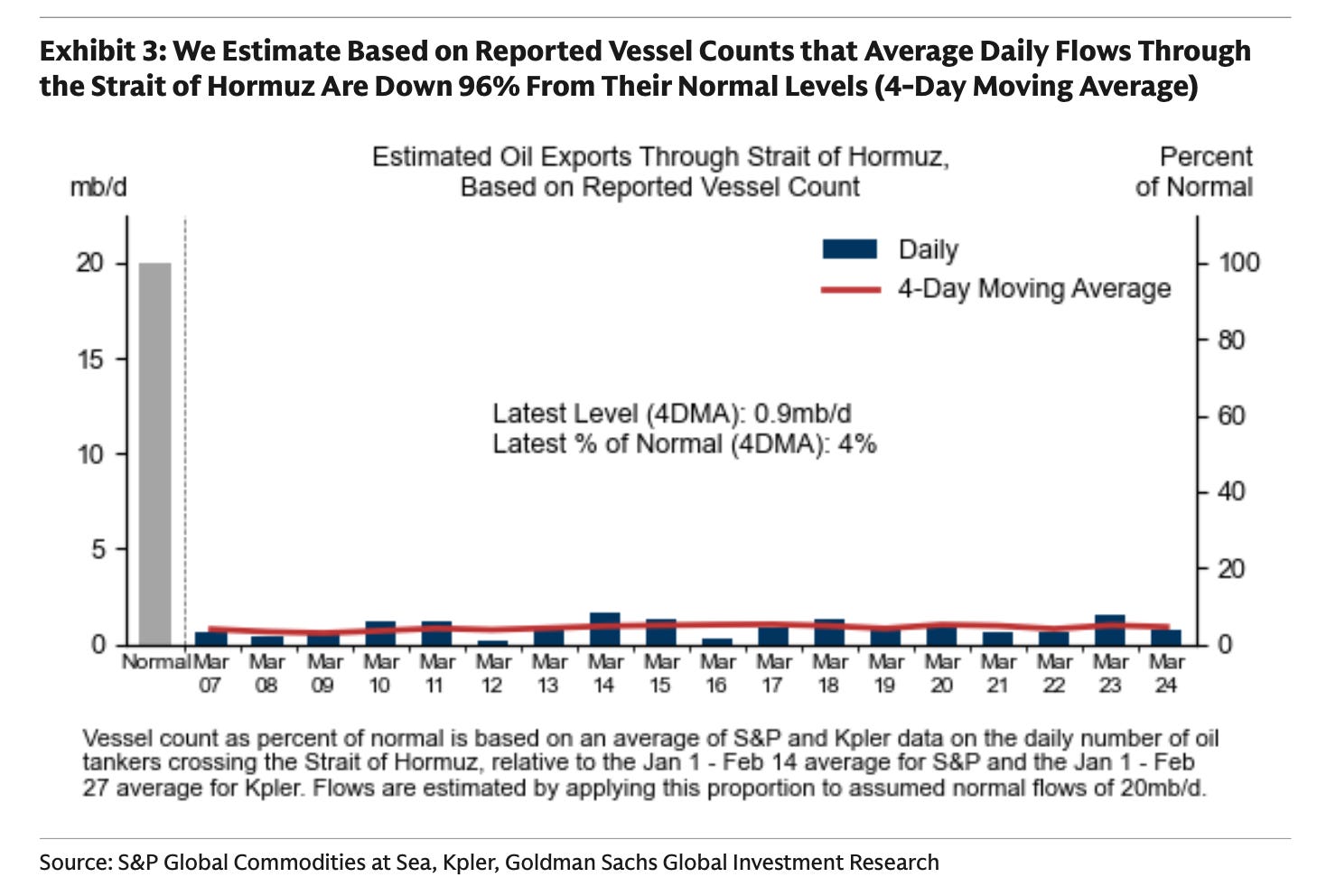
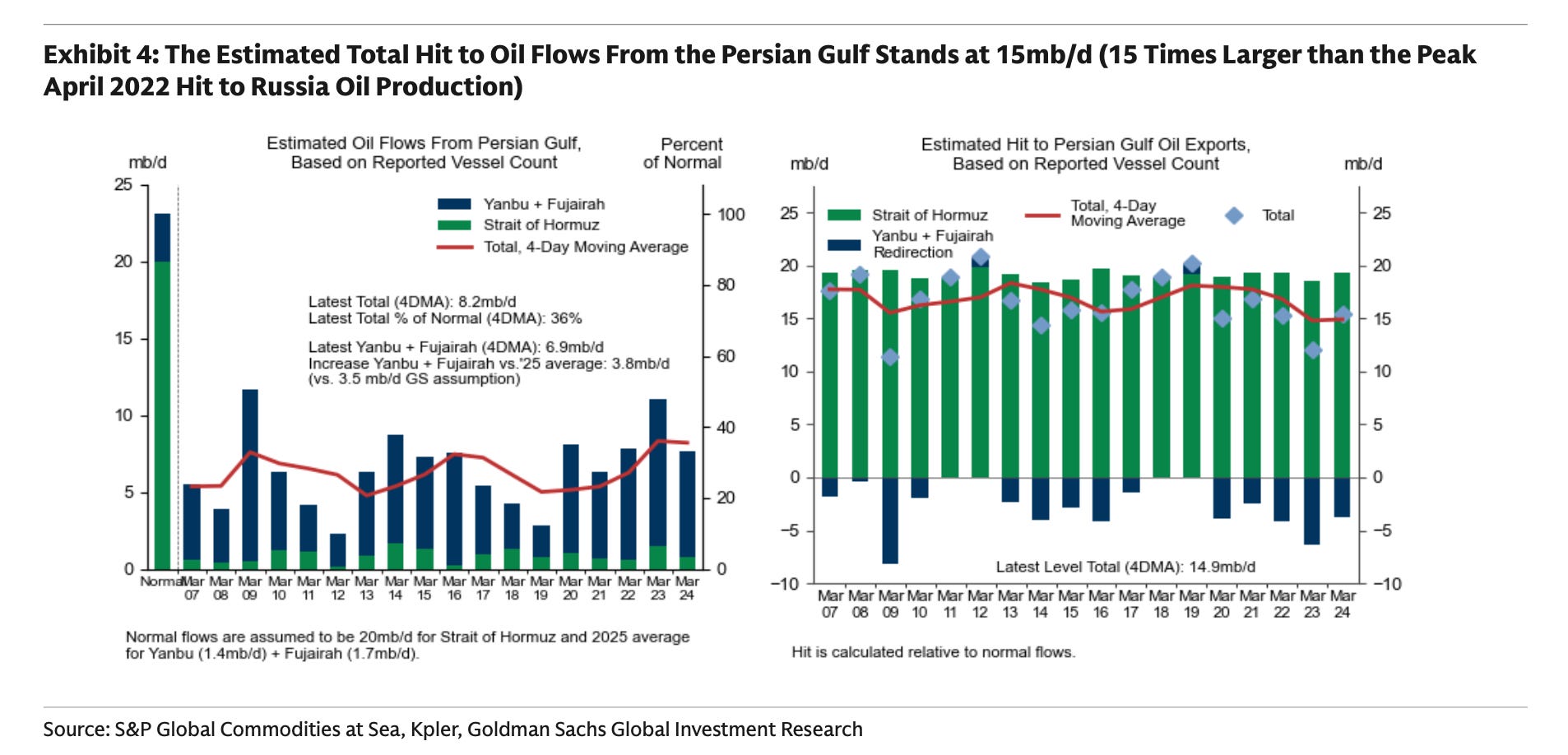
More importantly, production shut-ins are topping 11M bpd, and will take weeks if not months to fully come back if the war were to end today. You think we can last? Asia is already in full emergency mode:
Philippines - have declared a national energy emergency program, 4 day work weeks, and directives to limit travel and reduce power usage
Thailand - mandatory work from home for civil servants, strict air conditioning settings to save energy and subsidizing product prices;
Pakistan - 4 day work week for government offices, closed schools and cut fuel allowances
India - restricted LPG usage to ensure supply to households
Sri Lanka - limited fuel purchases and made Wednesdays a holiday for fuel consumption.
Japan - suspended public reporting of product inventories and intervening in the paper market to suppress prices. Restricting exports of petroleum products.
South Korea - implemented petroleum price caps and public energy savings program.
Australia - introduced export curbs on refined products (the country imports roughly 80-90% of its petroleum products). Relaxed fuel specifications.
Note that this is this week only, and countries are beginning to buckle. Even if the war were to end today, it would still take weeks to restore product flows and transport crude and products to the impacted countries. By next week, Europe will begin to feel the pain as the tankers that would normally show-up don’t.
This slow-rolling outage will accelerate in the coming two weeks, and by our estimates, if a resolution and immediate resumption of supplies doesn’t occur, we’ll have lost so much inventories (i.e., ~450M barrels) that inventory reserves will be depleted and prices will begin to moon. Any longer, and the scarring will be severe. Energy Aspects estimates if the outage lasts until the end of April, we’ll collectively lose 920M barrels of liquids. That my friends is nearly unfathomable.
Complacency
As of Thursday’s close, the SPY and QQQ are down only 5.6% and 6.4% year-to-date, respectively. Trump’s back and forth about striking and not striking energy targets in 5 day, and now 10 days, has flip flopped the market. After each TACO though, the market rallies are getting weaker, and oil prices have fallen less. It’s a dangerous indicator that the TACO-ing is becoming less effective. The paper market can be fooled, but the physical market is starting to discipline as the molecules just aren’t there.
Unfortunately, unlike the US’ unilateral tariffs, it takes two to TACO this time, and will Iran bite this time? Only to give up all of its strategic advantage just when the leverage will soon swing decisively in their favor? Only to negotiate with a Trump Administration that has already burned it twice (i.e., attacking during negotiations)?
We’re doubtful.
The nuclear option outside of developing a nuclear weapon was always to weaponize the Strait of Hormuz. It was simply unthinkable because of the global consequences. Who would decide on such a pyrrhic strategy? Apparently, someone facing an existential crisis.
They’ve finally done so, and that missile has been fired directly at the global economy. So fool them once, shame on us. Fool them twice? . . . they’ll let it burn.

(Disclaimer, we hold plenty of energy equities, USO/BNO, and shorts on select tech companies. Due your own due diligence, but for the love of all that’s good . . . be careful out there in the coming days.)