

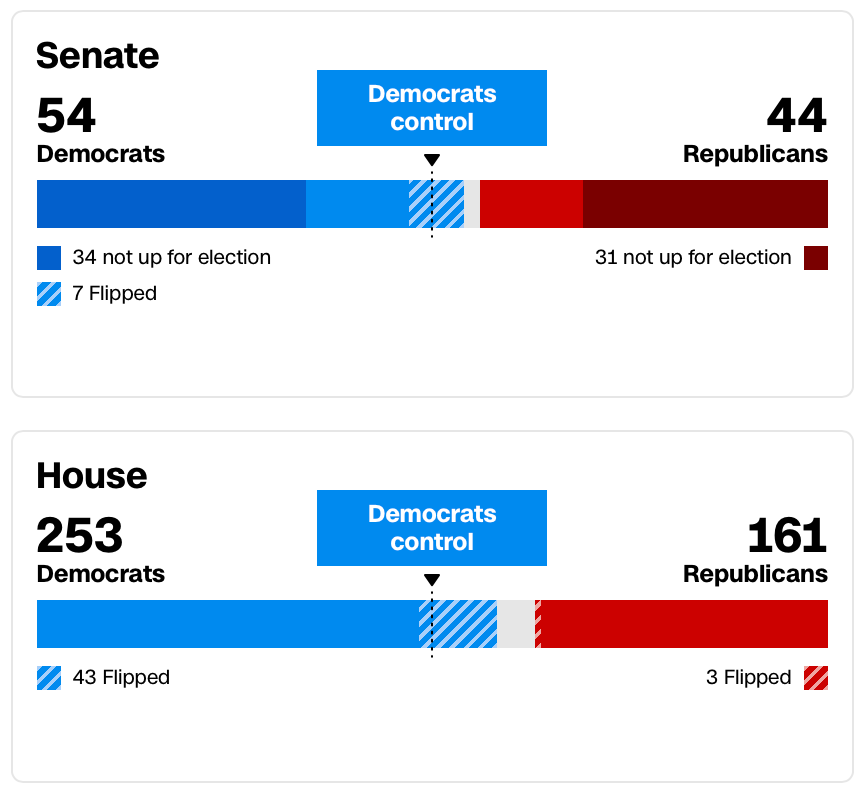
We expected a Blue-nami last night, and as expected it happened.
The post-mortems are plentiful so no need to rehash them here. Suffice it to say, the midterms were a referendum on Trump and the Republican party’s failure to address the war in Iran, high inflation/costs, corruption, and overzealous immigration enforcement.
A Blue-nami indeed.
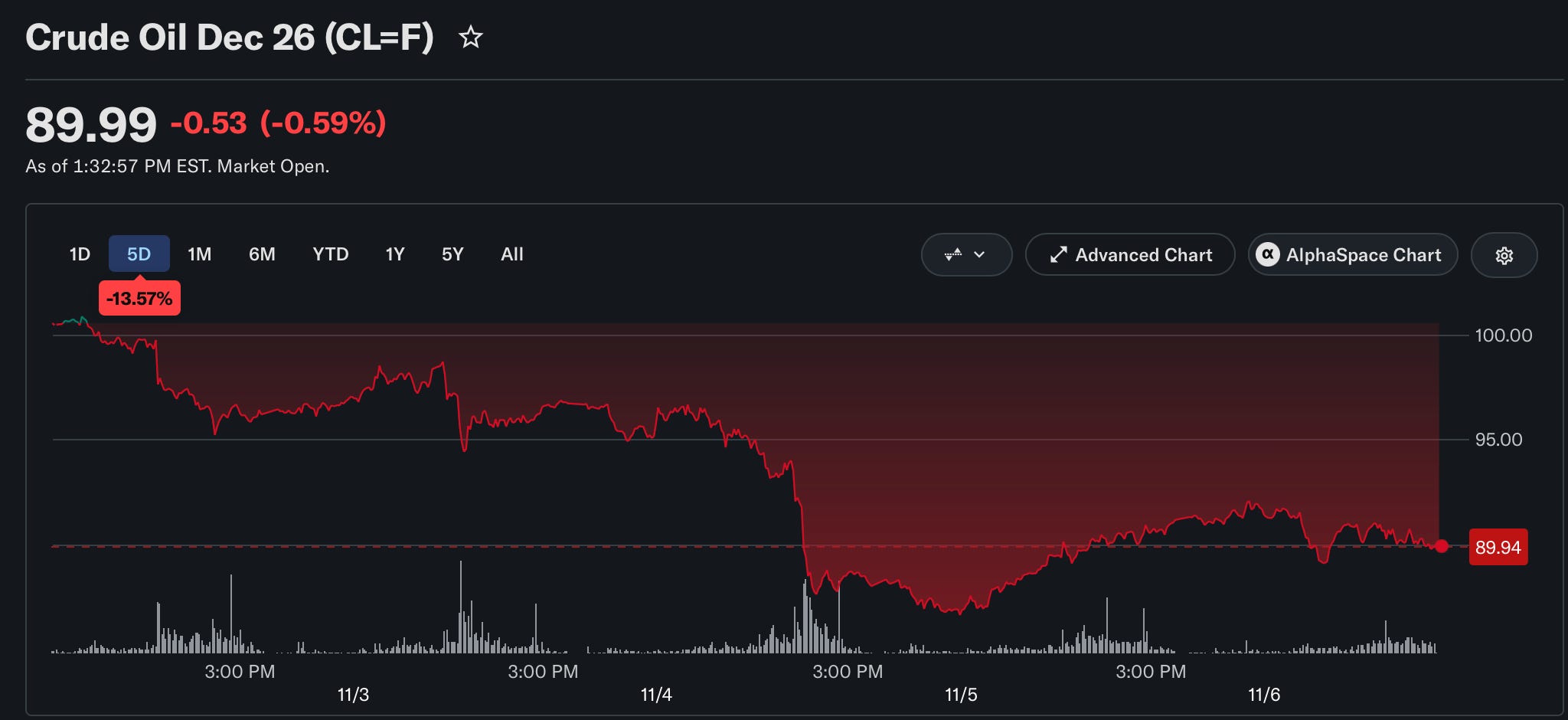
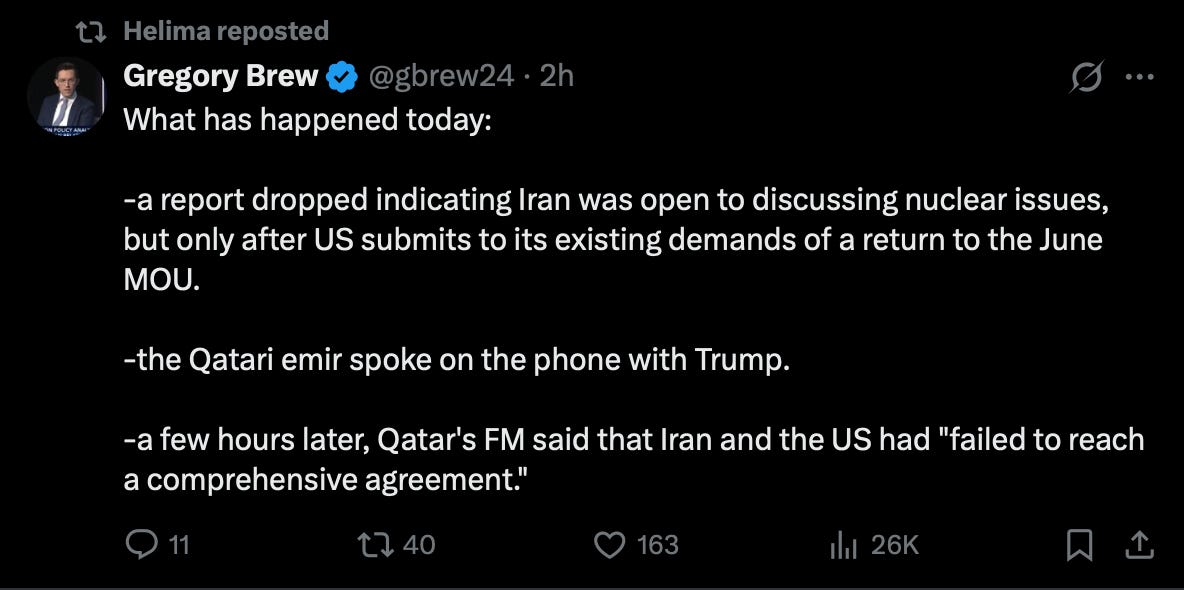
Right before the Blue-nami happened, on Monday, a flurry of tweets and news articles printed as we headed into decision day. The Peace is Coming, the Peace is Coming, the headlines trumpeted. Negotiations with Iran were apparently going swimmingly, and a new MOU 2.0, or peace accord was coming shortly as Iran and the US moved closer together, bridging the gap between the two sides’ red lines. Oil unsurprisingly sold off on the news.
Then on Tuesday, the tsunami struck. By Wednesday, oil prices fell further as everyone, including the Vice President, cited the war as the main reason for the Republican’s losses, and the market interpreted that as the US was ending the war. Well in fulness, either Trump does, or the Democrats will when they’re seated on January 3rd and proceed to cut funding for the endeavor. Though we’re still missing ~4M bpd out of the Persian Gulf, the Blue-wave also washed away the ~$25/barrel political premium we had in the oil market. For the week oil prices had declined by nearly 20%, falling ~$20/barrel and WTI sits today at ~$90/barrel and Brent at ~$98/barrel. Both are a far cry from the $105/113 we saw at the end of last week.
So this leaves us with, what, 60 days give or take? Doesn’t the election mean we have a 60 day timeframe in which to bring this war to an end on terms favorable to us? The IRGC though has already begun crowing. It exacted a hefty political toll for the US’ misadventure, and sent a stark warning to future political leaders that unilateral attacks on Iran can prove hazardous to a president’s political health.
It’s against this backdrop that we’re negotiating. The Iranian’s have held firm to their 7 lines, and from that position they haven’t strayed. They’re asking for firm commitments, lifting of the blockade and sanctions, reparations, control of the Strait of Hormuz (“SoH”), and withdrawal of US forces from the region.
Most of these are untenable, but then again time is on their side. The IRGC, enriched by their own self-dealing and illicit trades, are largely deaf to the rumblings of the masses, and after all, it only needs to wait 60 days before the Democrats end the war for them. Against this backdrop, how likely will the Iranians be to offer generous concessions? How likely will they take a step-back and capitulate on anything? Yeah we thought so.
So it leaves us with the US. What’re our options?
US Withdraws - leaving control of the Strait of Hormuz to the Iranians. Yeah that’s a non-starter. Abdicate power to China/Russia, leave GCC allies in a lurch, handicap energy security in the future, and risk the sanctity of the petrodollar as the reserve currency? Not a chance. This is an unviable and un-serious option.
US Attacks - with the USS Theodore Roosevelt carrier strike group steaming its way to the Middle East, it’ll bring about a full complement of three aircraft carriers in the region by the middle of November. This would be an optimal time given the force structure in place. Climbing this next rung of the escalatory ladder means the US will have to hit the Iranians hard. Energy, power, civilian infrastructure, along with targeted leadership strikes. If the US does this, it’ll have to fully commit if it wants to nudge the Iranians back to the dining table because any half-measured attack will leave it in the same place as today, but with depleted ammunition stocks.
US Waits - it continues with the economic siege, with no end in sight. Every day that passes is another day US forces get stretched even further, and the economic costs become . . . costlier. In a battle of wills, the one who’s survival is on the line will typically win. Our pain threshold is measured economically, whereas for the Iranians the pain is irrelevant, it’s survival. This also has a clock on it given the incoming tsunami of Dems. Waiting means introducing the risk of a funding shortfall if the Democrats refuse to fund the war. Seiges are costly, and having no budget has a deleterious affect on sieges.
US Agrees to a MOU 2.0 - this COULD happen. Qatari/Pakistani negotiations could prove fruitful, but how likely is this at this juncture? Iran continues to insist that both parties would need to revert to the 7 redlines agreed to in the initial MOU in June, the same ones that the US had initially agreed to, but then balked at fulfilling. Would it do so again, and simultaneously agree to table any nuclear discussion to later? Not a chance. It didn’t work before, and we don’t think it’ll work today. Now you could have some version of a deal. So instead of “ceding” control of the SoH, the US could agree that the SoH will reopened, but managed henceforth by Iran and the GCC. Heck pick a lane, Iranian’s get the outbound, and Oman gets the inbound. You could even institute a toll, which Iran will use for funding security measures, and maintenance of the strait. It’s protection money, it’s racketeering, disguised as “maritime safety.” The US needs to save face though, so Iran will offer up nuclear inspections again. A JCPOA 2.0. The “best” JCPOA 2.0 there could be. Next-up? Payments. A slug of frozen cash is thawed and funneled to the Iranians. Reparations come from the toll, and once the embargo and blockades are lifted, Iran can trade again.
Is that 4th option even palatable? Would Trump willingly agree to something like that to move on? Possibly, but it would negatively cement his legacy for this entire debacle. That is unless he can sell the agreement as a win. Yet, why would the Iranian’s allow him to do so? They certainly denied him any victory right before the midterms, and they know he’s facing a 60 day clock now (i.e., in 60 days, Iran becomes the de facto hegemon of the Middle East).
How certain are we of any of this? To be honest, it’s even money . . . 6-5, pick’em. On balance though, backing down when he faces mounting pressures doesn’t seem to be in Trump’s wheelhouse. Historically, tactical retreats haven’t been in his playbook, and he often doubles-down on issues to force the issue. So if you can’t wait them out and you can’t retreat, then you’re left with swallowing an MOU you rejected 4 months ago, or pressing your point militarily.
As you can guess, we think the kinetic option is still the most likely path forward. The US needs to nudge the other party to make further concessions, and nothing nudges more than the concussion wave from a bomb blast.
Iran will almost certainly retaliate (as opposed to a performative display). This isn’t 2025 when both sides can carry out pre-informed attacks hoping the other won’t invite serious retaliation. There’re no performative males this go around.
Unfortunately, Iran’s in a much stronger place today militarily (if not economically, and has already promised a severe counterstrike across various GCC countries. Nonetheless, if Iran persists on holding firm to its 7 red lines, there’s few options left . . . and fewer still that are palatable.
So as we dive into the coming weeks, as US forces are repositioned, we think oil will recapture its “geopolitical premium.” Although much of the next steps are unclear, what’s clearly obvious is, the risk isn’t zero.
Please hit the “like” button and subscribe below if you enjoyed reading the article, thank you.