

October 18, 2026
Eight months and counting. By the time this letter reaches you, we’ll be closer to nine. Nine whole months. Nine months of continuous uncertainty and volatility. Nine months of mutual distrust and intractable positions. Nine months of chaos.
We’re at a point in time where we’re back to where we started, sanctioning Iran. Since bombs and missiles didn’t work, the US has schemed up Operation Outcast, doubling-down on Iranian sanctions. Sound familiar? We’re serious this time though. We’re cutting off all Iranian oil exports in a strategy designed to wear down the IRGC. Time and determination are what we’ll need for Operation Outcast to gain traction. Unfortunately, time and energy are the two very things in short supply today. Despite the market’s ebullience, curtailed commodity flows out of the Middle East are wreaking havoc on global prices, and in turn, inflation. It’s not limited to oil, but products, fertilizer, and other commodities no longer freely transiting the Strait of Hormuz (“SoH”). Eventually their absence reprices the markets, and inevitably those costs will be factored into interest rates and bonds. That’s when things get serious. The equity markets can play with AI and ignore the real world costs of the conflict at its own folly, but bond investors are the market’s true disciplinarians. Debts dominate, and if inflationary pressures persist and erode the time value of an investor’s principal, you can bet that bond investors will demand higher rates to compensate. If so, the equity market will hate it.
For energy, physical prices are screaming these days, and they’re shouting . . . this has to go higher. Although the administration is doing all that it can to manipulate prices lower (i.e., anywhere from jawboning about imminent peace deals to outright shorting futures/contracts), we’re living in a pressure cooker where the more inventories draw, the more prices need to rise. In Q2, China’s willingness to reduce crude imports and draw from inventories soothed the markets, but it’s back, not fully yet, but it’s been increasing imports while raising export quotas on products. Even with its vast reserves, there is a pain threshold it’s willing to tolerate. Whether it was shrinking inventories, and/or deep losses experienced by Chinese refiners (who weren’t allowed to export products), that limit has been reached.
Everywhere along the supply chain we’re seeing higher prices as the repercussions of a losing war reveals itself. Whether it’s tankers carrying cargo or crude, diesel prices, or fertilizer costs, the waves of higher expenses are hitting all at once, and they’ll linger as global buffers have been drawn. In this commodity cycle we’ll pay doubly, first to restock, and second to insure adequate stock going forward.
We worry. How does this situation resolve itself? How does a lame-duck president concerned primarily with self-enrichment and self-aggrandizement deal with a legacy defining event that has few pathways to victory? More pointedly, if the GRIFT has BECOME the game, does it even matter what kind of agreement is made? In a few years, that’ll be my successor’s problem . . . so long as I and my brethren get ours. Leave the petrodollar, the Middle East instability, the fractured alliances and the empowered adversaries to others, and blame them for the failure. We’ll get ours while the going is good. Keep “stacking it” as they say because nothing protects more than billions; nothing muffles the protests like a wall of money. We’ll need the ramparts thick when the masses come with the pitchforks and prosecutions. Stack it high so we keep the beggars at bay when the prices rise, because rise they should, and rise they will.
Oil Demand & Oil Supplies
The third quarter. What’s the word we’re looking for? Tense. At the end of the second quarter, US and Iran agreed to a temporary ceasefire. A 60 day period to negotiate a final peace treaty, but one predicated on 14 points. Fourteen points that apparently the US administration had never intended to follow in the first place. After an initial cooling period during which energy prices calmed as the deal makers spoke well of each other, their intractable and irreconcilable positions resurfaced in Q3. As Iran exercised control over the SoH (as agreed to in the MOU), the US attempted to circumvent the restrictions by opening an alternate route in Southern Oman. Iranian missiles and drones subsequently flew as ships tried to traverse the corridor. The US then retaliated and oil spiked. How can they come to an agreement when neither party is willing, or able to cede control of the SoH? A choked off strait means higher energy prices and inflation, and that’ll drive higher rates, and those have taken off since the war started.
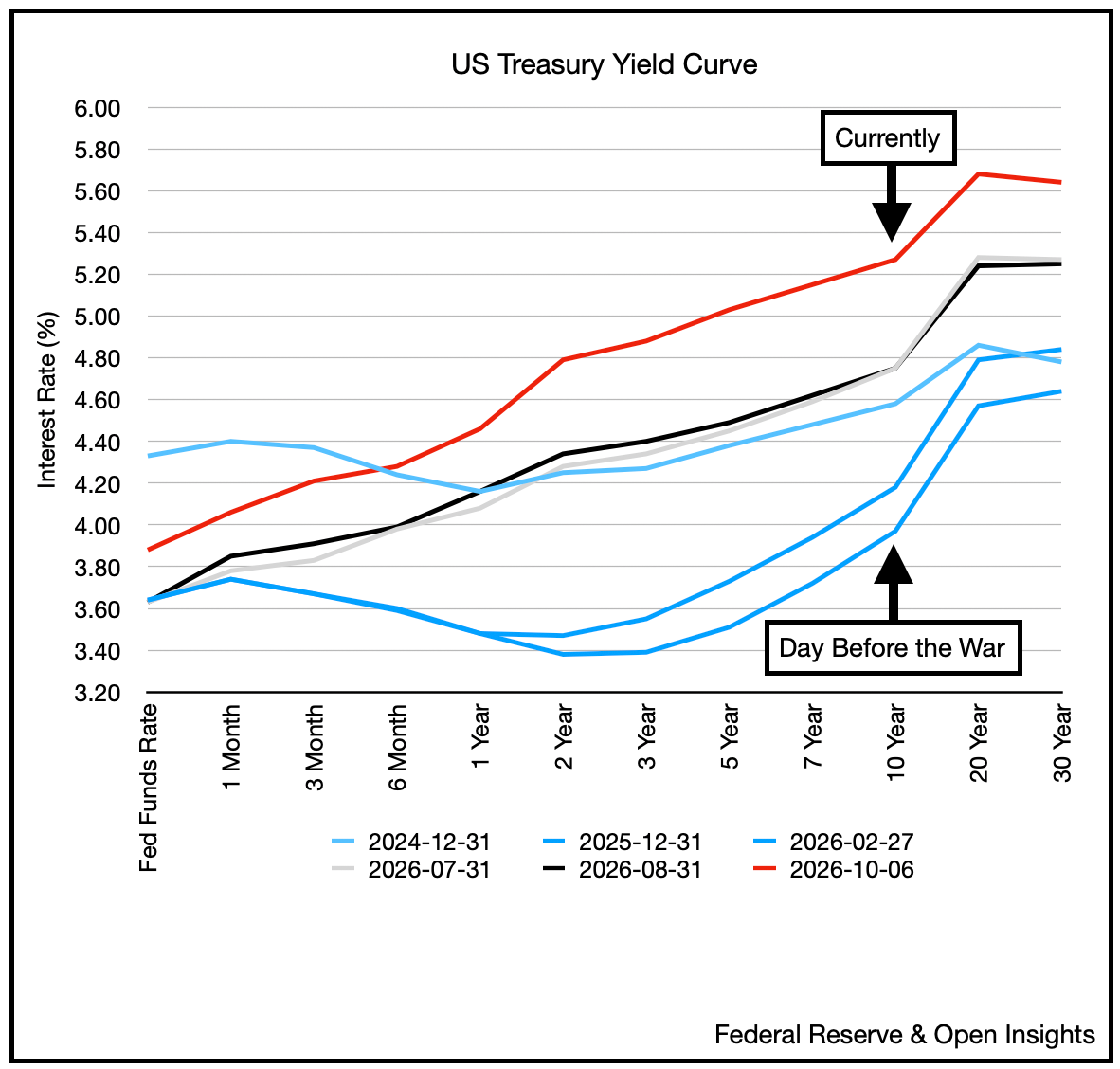
Moreover, how does a peace deal work if the US needs to control the SoH to insure “the grand bargain,” (i.e., the implicit/explicit agreement between the US and the Middle East that in exchange for security, oil shall be denominated in US dollars (i.e., the petrodollar)). The petrodollar serves as the global reserve currency, which allows the US to borrow at reduced rates, and for a country with $40T in national debt, the petrodollar must be protected lest inflation and interest rates leap uncontrollably. Nixon helped create it, and every president since has defended it. Until this one. Allowing Iran to control the SoH means abandoning partners in the Middle East, thereby weakening the incentive to support the petrodollar.
The Iranian regime also views the entire conflict as an existential matter. It’s only been a few months since the US and Israel eliminated the original leadership team, and after enduring that blow, Iran now finds itself holding a key chokepoint. The SoH finally gives the Iranians the nuclear weapon it’s long craved, albeit an economic one. Shutting the SoH was once unimaginable, but giving it up now is unthinkable. Their grip has since tightened with the intelligence and reconnaissance information provided by China and Russia. Both allies have also transferred materials to rearm and upgrade the ballistic missiles and drones used by the Iranians. In sum, the accuracy of Iran’s missile targeting has increased dramatically, as has their ability to evade the US’ air defense systems.
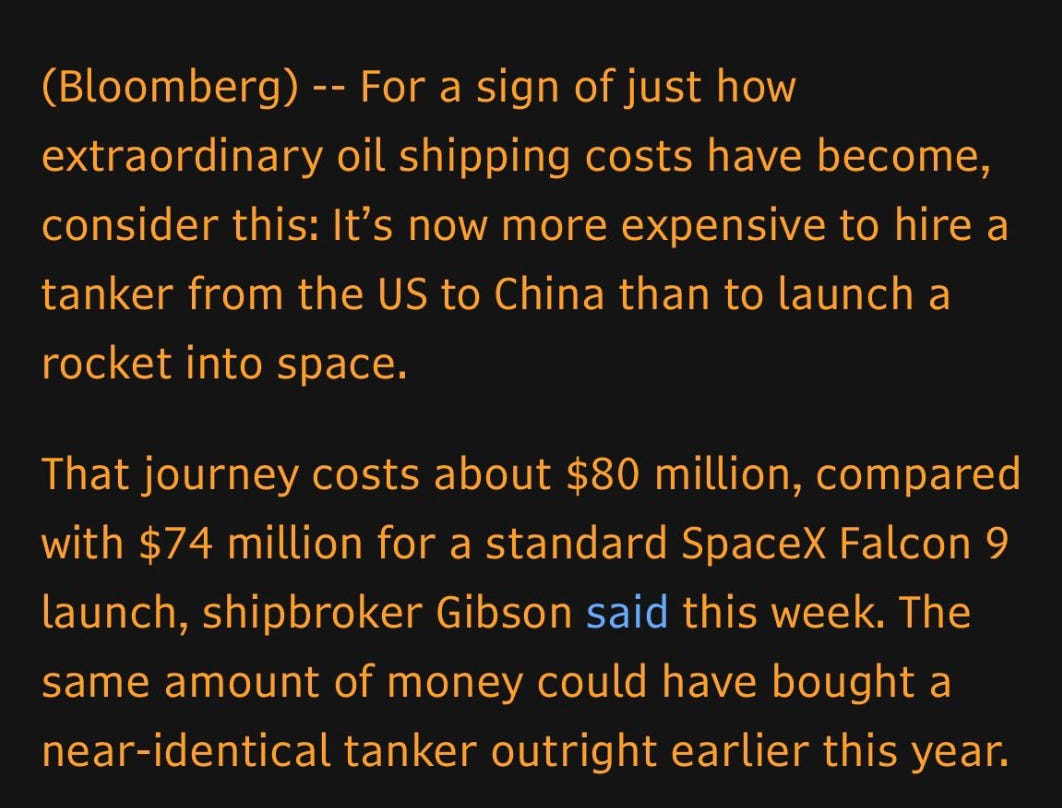
Iran’s battlefield successes have also empowered its proxies. The Houthis in Yemen attacked and quickly captured key territories along the west coast, ultimately reaching the Bab el-Mandeb Strait. It then closed the strait to the Saudis, and began to systematically attack key energy infrastructure in Saudi Arabia. The Houthis struck the pumping stations along the Yanbu pipeline, which the Saudis had been using to divert oil from the East (and away from the Strait of Hormuz) to the West. Though the Saudis have managed to restore shipments at lower flow rates, the pipeline continues to face threats. To compensate, the Saudis have increased Western exports through the Southern Oman lane by relying heavily on US military escorts and frankly luck. Medium-to-long term though this is unsustainable given the costs and resource intensity. So how unsustainable is this? Well here’s a blurb from Bloomberg that says it all.
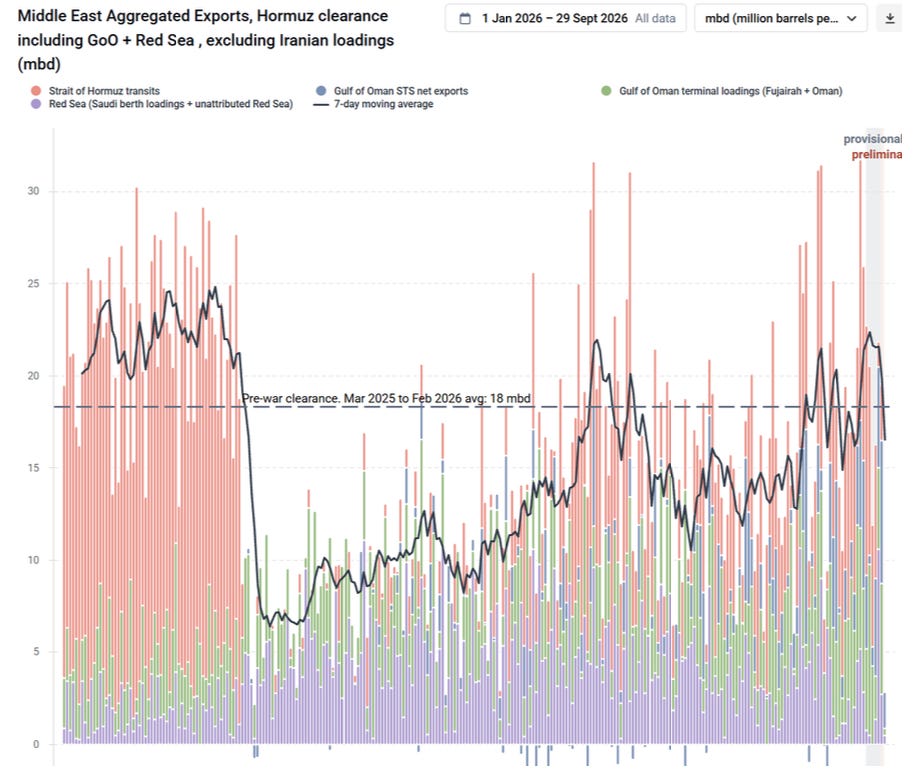
While oil is flowing through the SoH, it’s uneven and still below pre-war levels. Despite reports of higher exports, there’s still a gap, and that gap stands around 5-6M bpd.
Products are an Issue
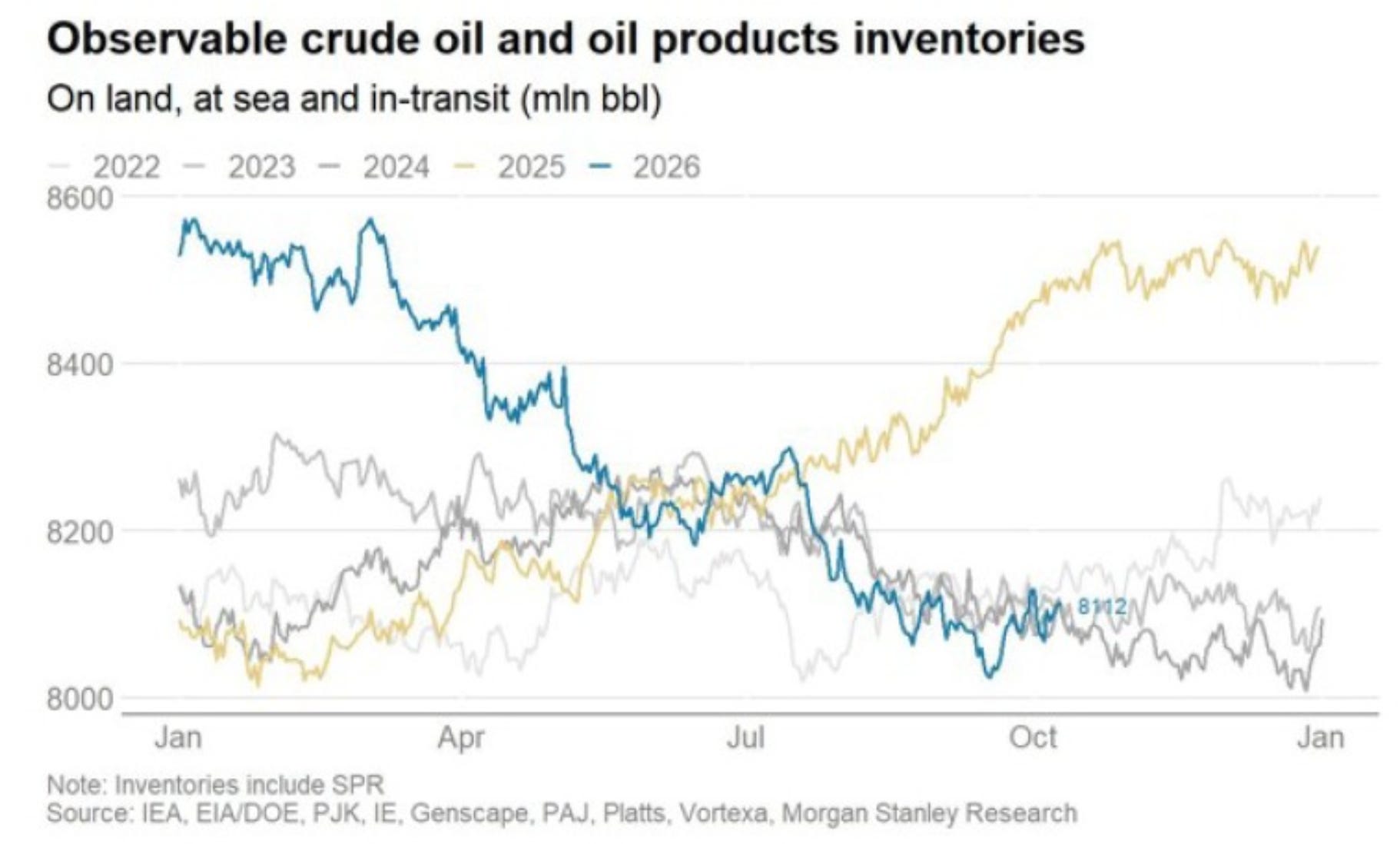
Most of the buffers that have subdued energy prices for the past 8 months are largely gone. Both crude and product stores have been drawn down sharply. Visible inventories have collapsed by over 550M barrels, and the invisible portion likely doubles that.
Products are arguably in danger of stock outs. We think secondary and tertiary stocks have largely been drawn, and we’re gnawing on bone. No need to take that on faith, look at product prices. While crude prices have remained the administration’s focus, product prices are roofing as the shortage plays out. We know this because product prices for diesel in the US, where it is arguably more plentiful than anywhere else (as our refineries sit unharmed unlike in Russia/Middle East), have vaulted.
Crack spreads (i.e., the price it costs to refine a barrel of crude to diesel typically averages ~$25/barrel, they are now over $100/barrel, which means a barrel of diesel is priced >$220/barrel). This doesn’t happen if there’s diesel left in inventories.
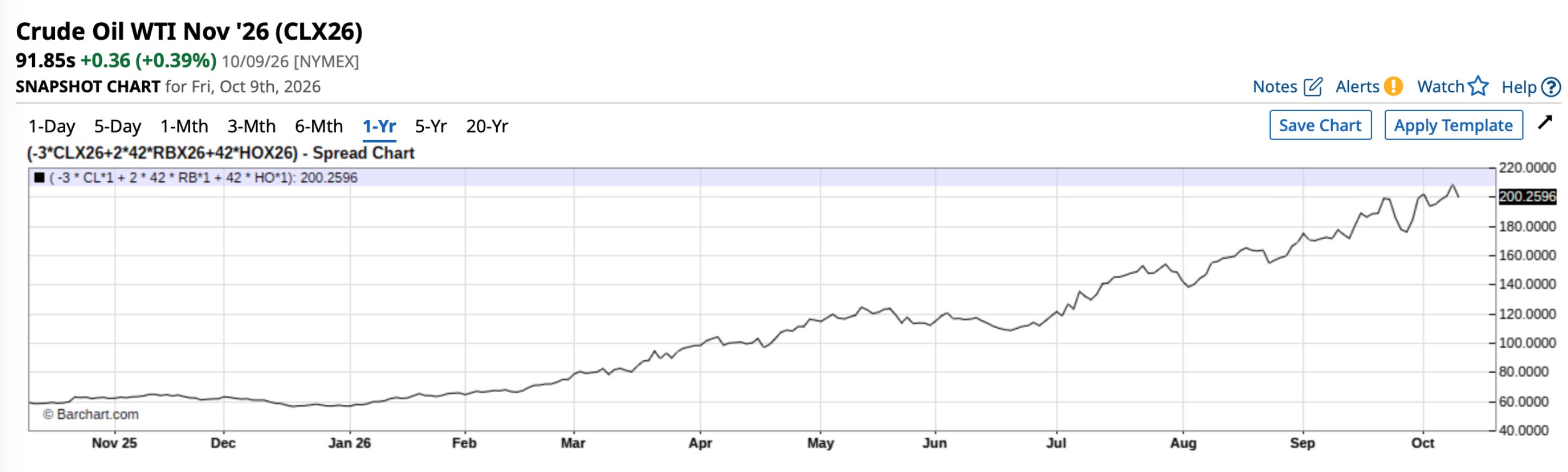
Crack spreads will stay high if Middle East and Russian production remains disrupted.
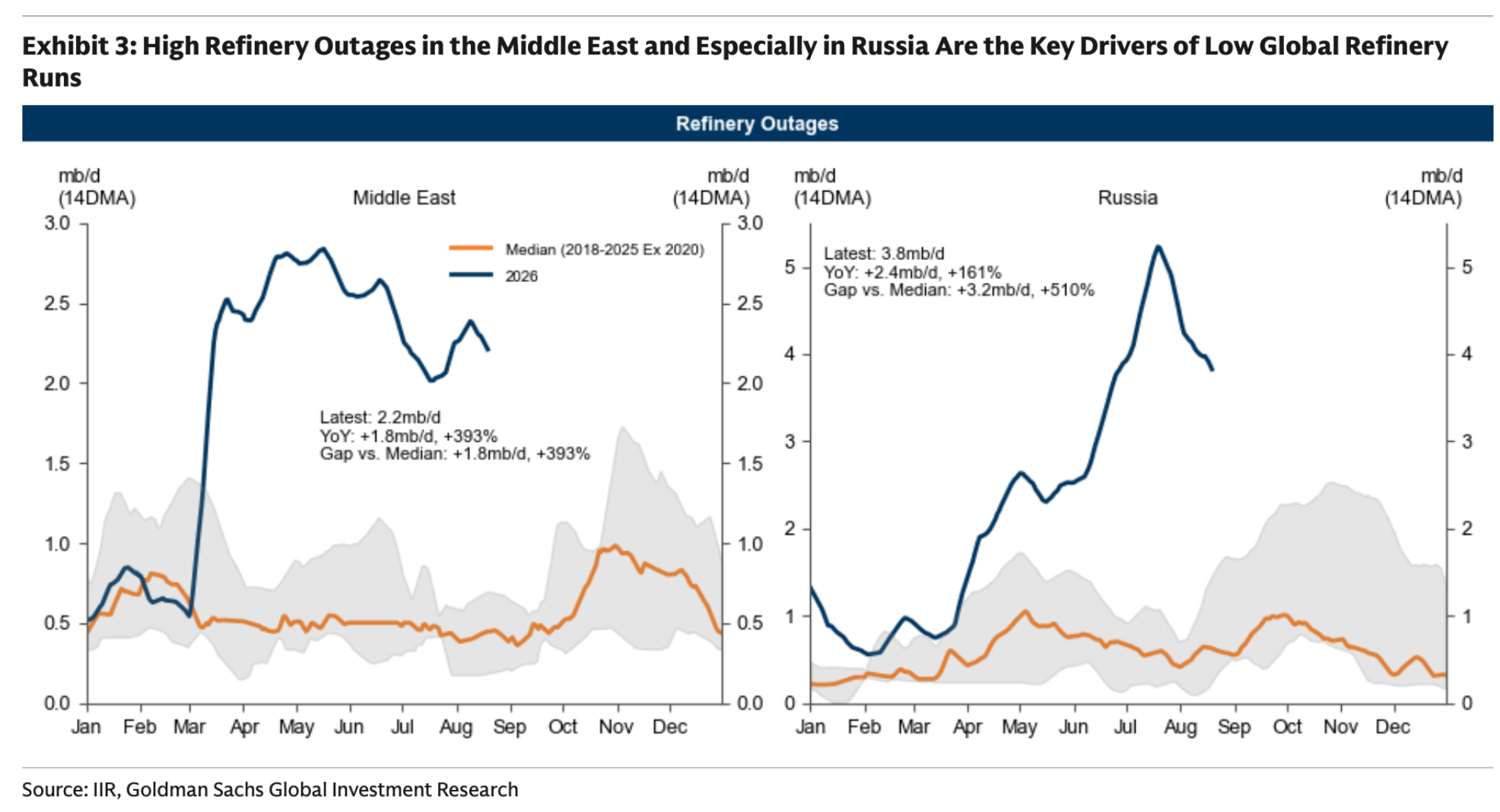
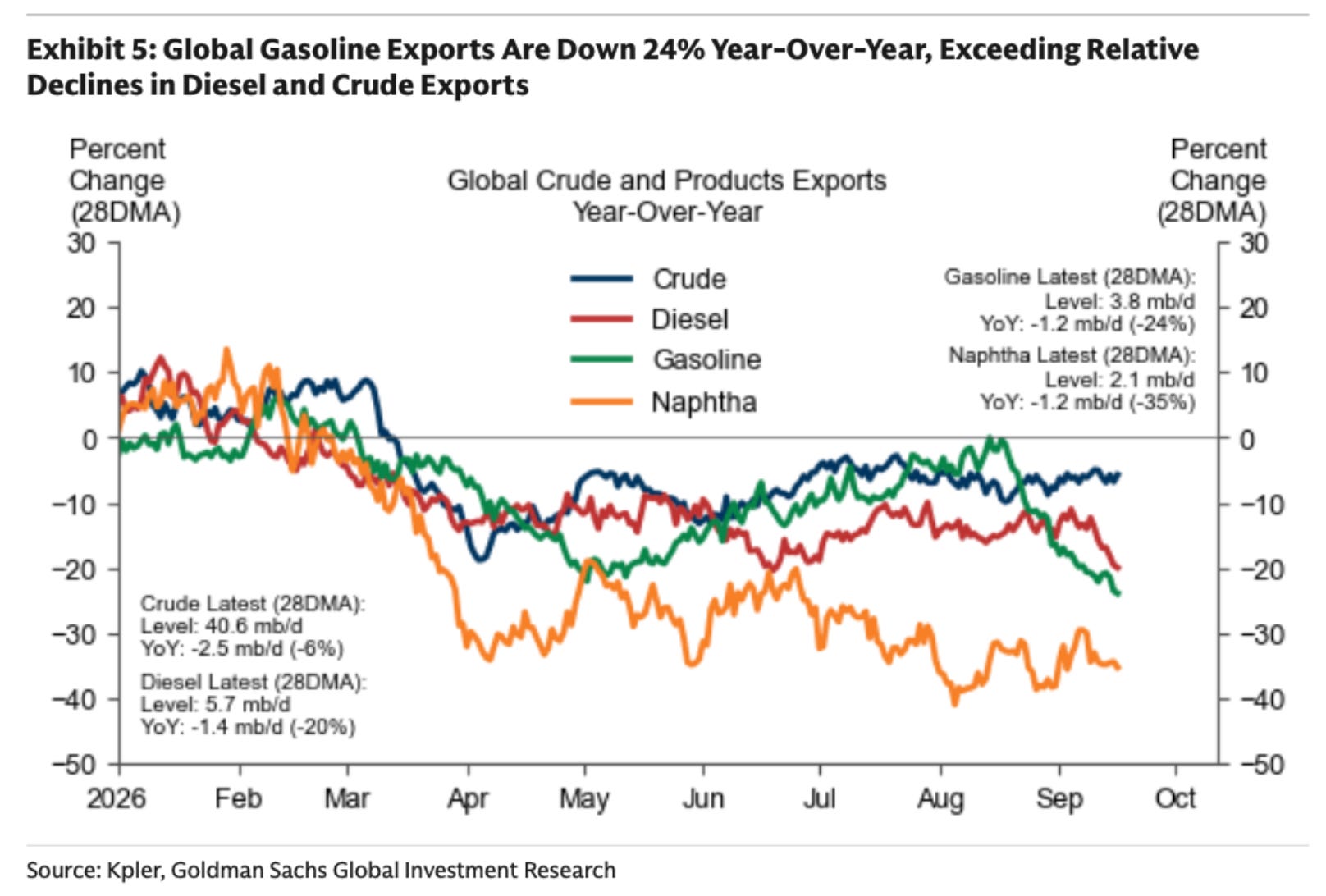
The damage caused by ongoing refinery attacks means ~7M bpd of refinery production is offline worldwide, and that’s translating to depressed global exports of petroleum products.
The remaining refineries though are running even harder as product crack spreads incentivize production. Here’s the US refiners maxing out, trying to capture the sky-high crack spreads. Here’s the US to illustrate . . .
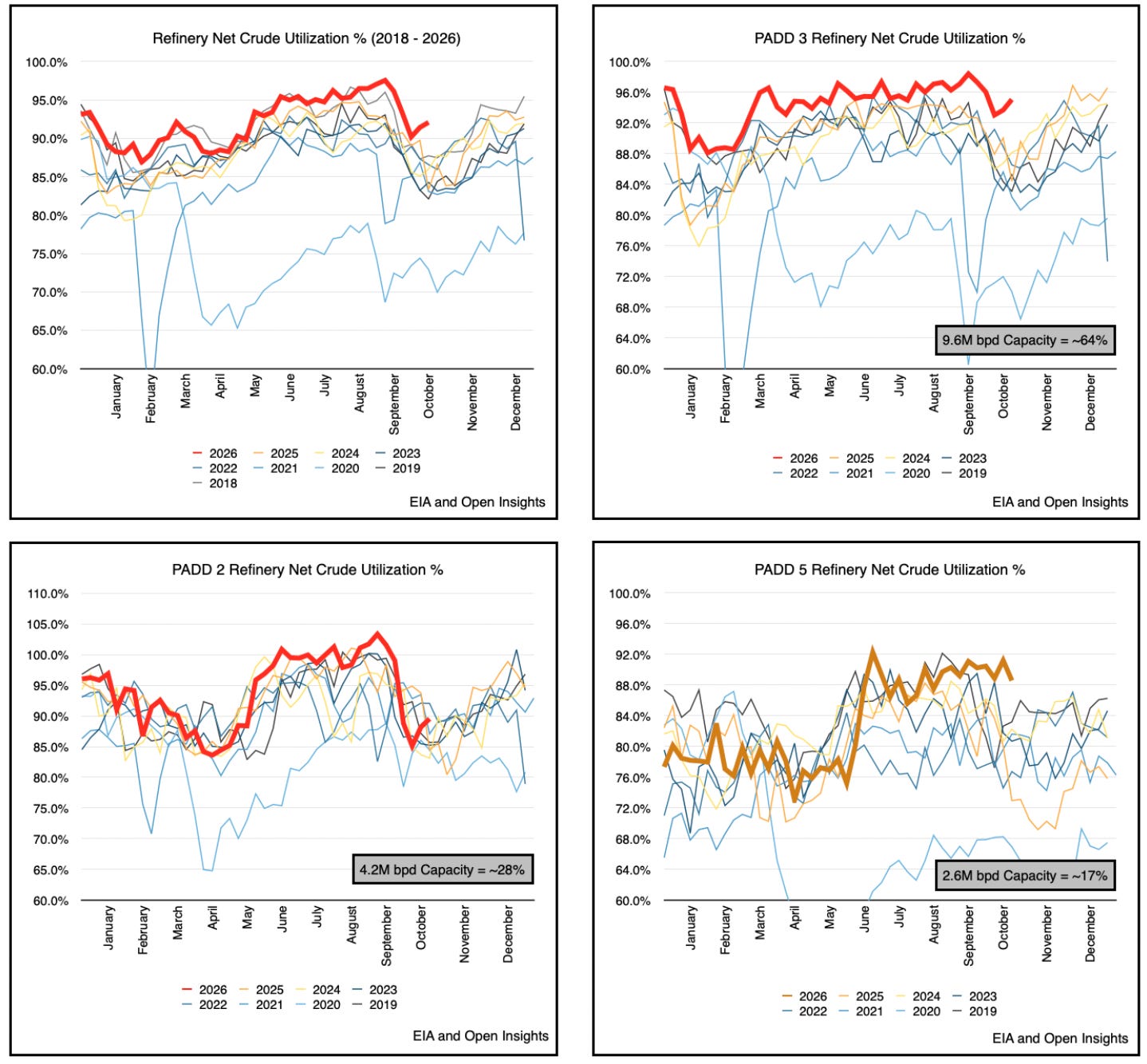
The world runs on products and eventually that crack spread will force crude higher when refineries return. Even if they don’t and we stay in this status-quo whereby Iran continuously harasses shipping and energy infrastructure in the Middle East and Ukraine presses its attacks on Russia, the remaining plants will run hotter and for longer. Higher utilization and China’s return to the crude market means crude prices need to climb. Otherwise we’d have to believe that product prices will stay permanently high, but crude low? Intuitively that makes little sense, as refiners will want to capture that historic spread.
Adding to this, China had throttled product exports to preserve inventories and prevent a price spike by running their refineries at ~66% of capacity, well below their typical utilization rates. Their restraint has propped-up the world, but it comes at the cost of their product inventories and refinery losses. Despite its vast reserves, China has a pain point, and we may be reaching it as they’ve since relaxed export restrictions. Chinese imports of crude are still down nearly 3M bpd year-over-year, but should begin to rise as refiners power on, putting pressure on crude prices.
Today, what’s flowing out of the Middle East collectively remains stymied. A ~5-6M bpd gap, smaller than the original 10M bpd gap this summer, is still huge. The reduced flow is coming into a vastly different landscape, one where commercial and SPR stocks have drawn dramatically. Think about it this way, pre-war, even a 1-2M bpd disruption would be concerning for market participants, and enough to spike oil prices higher if the disruptions held. We’re still talking about a 2.5-3x gap 8 months later, and what is coming out is entering a thirsty market with materially less buffers. With the cushions removed, we’ll feel everything.
So we muddle through. At this stage it’s best to assume that energy prices won’t necessarily rise on top, but on the bottom. What we mean is that the floor for oil prices appears to be moving higher. Because of the administration’s jawboning and attempts to introduce volatility (and we’re almost sure intervene directly in the market) to lower oil prices, price discovery has been abandoned on the financial side. The paper market is completely dislocated from the physical reality, as the physical prices are much higher. Normally, the oil you can get delivered 10-30 days out trades relatively closely to what’s available in the paper market. The spread though has blown out.

Backwardation is also steep in that Wall Street continues to harbor the assumption that this too shall pass quickly and oil prices will quickly sell down thereafter (similar to June post-MOU). What’s interesting is that recent sell-offs have become shallower. Each selloff is bouncing off a higher floor. When oil sold off in June prices fell to the low $70s, this time, various claims of negotiations have only resulted in oil retreating to the high-$80s. As the situation drags on, the investment community is starting to price in the long-term impacts of lower inventories and higher geopolitical uncertainty. So either the market is becoming inured to the numerous false claims of peace, or increasingly aware of lower inventories, the price floor is lava, and the lava is rising.
We’re a few weeks away from midterms, and the administration is releasing another batch of reserves while attempting to talk down oil prices. There’s a chance the administration can agree to a deal with Iran to reopen the SoH, and give the market a lift before November, but as the days past, that window of opportunity is shrinking. We don’t think it’s an immaterial risk, but even if it occurs, there’s still some big issues that’ll be left unsolved . . . like Iran’s control of the Middle East.
What happens after the midterms? Any détente proves unworkable if we start with the premise that Iran cannot have control over the SoH and develop nuclear weapons. More pointedly, the reality is that they “control” the straits. Even if they don’t physically control it, the continuing harassment means we don’t, and that’s the key. Throw in a cadre of proxies in Iraq, Yemen, and Lebanon employing the same weapons, and you have a toxic brew of instability going forward. Translation? Higher prices will be with us for awhile.
Parting Thoughts
We’re shifting from worrying about the midterms to wondering what happens after. In late-September, the energy community largely debated what type of deal the administration would agree to in order to quell rising energy prices ahead of the midterm elections on November 3. We’re about three weeks away, and even if an agreement were to be had post-haste, physical flows wouldn’t shift fast enough for it to matter. The election is what it’ll be.
After the election? It’s about legacy. This is a legacy defining event, and if Democrats rout in the midterms, which they’re currently forecasted to do, Trump will face the next two years dealing with a hostile Congress hellbent on political retribution. President Trump could fire Secretary of War Pete Hegseth, to take the blame for the war, but that’s merely window dressing. Iran would still “control” the SoH, and absent a ground campaign there’re few options left to dislodge the Iranian’s from pestering maritime traffic. All of that is before we even consider the Houthis. The Saudis have re-entered the war with the Yemeni government, but will they be victorious? Doubtful. They haven’t been in the past few years, and the Houthis have only gotten stronger after obtaining drones and missiles from their Iranian benefactors. In short? There goes the Bab el-Mandeb Strait.
We’ve very likely drawn inventories by >1B barrels. Tanker prices are through the roof, physical barrels are in short supply, and product prices are at all-time highs. Interest rates are rising as the inflationary impact of energy prices start to filter through. While President Trump is attempting to use the nuclear threat to catalyze political support for staying firm against Iran, the longer this unpopular war drags on, the costlier it becomes. If energy prices become unbearable, and the equity market finally cracks because the bond market breaks, the President will likely paint himself into a corner as one of history’s biggest losers of his own making.
The irony of it all. For want of self-glorification, for want of cheap oil . . . the kingdom could be lost. Talk about negative aura.
Addy: Our teacher announced that you’re presenting at career day.
Me: Oh yeah? Did anyone seem interested?
Addy: hmm . . . not really.
Me: Hedge fund manager?! Who wants to learn about shrubbery and bushes!
Mason: Daddy thinks “it’s my moment” haha
Addy: You better be good, I don’t want negative aura!
Me: That’s pressure! OMG, I better be good, what if I give my daughter negative aura?!
Mommy: You better not be buns.
Me: Don’t worry, I’ll make them laugh, I got jokes!
Addy: I give up . . .
Please hit the “like” button and subscribe below if you enjoyed reading the article, thank you.