

History sure does ryhme doesn’t it?
I wonder what they’ll call it? Operation Epic Fury 2?
Furiosa?
Heck even call it Operation Linebacker II, you know, it’s that Nixon 1972 bombing campaign that blasted the North Vietnamese back to the table when peace talks stalled.
Sound familiar?
Yeah because that’s likely what we’re planning to do again after the midterms. In case you were wondering, that’s coming next Tuesday.
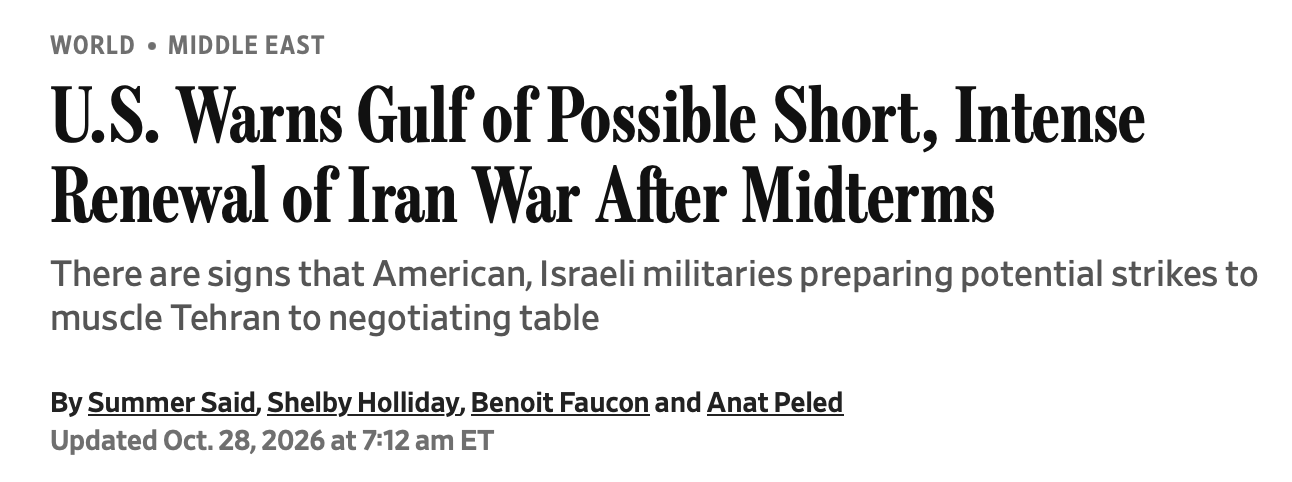
So the clock’s ticking here. The clock for diplomacy that is.
Though Qatar, Pakistan, Saudi Arabia and Turkey are enmeshed in regional talks, they’ve produced little so far. It’s not for lack of trying, but the Iranians are being “insistent” on their demands. They seem to insist that they want to keep control of the Strait of Hormuz. Something that we’ve said is completely untenable to the US.

Moreover, the US, and more importantly President Trump, wants the nuclear materials . . . he needs the nuclear material.

It’s precious because it’s the very premise he’s used to justify this entire venture to begin with. So that’s the legacy bit, and once you’ve climbed up on that stage to champion the dismantlement of Iran’s nuclear program, it’s hard to get down without injuring your reputation.
Like every major rapper though, there’s a hype man, and Trump’s favorite one in the region is Netanyahu. At the beginning of the week it looked like the hype man was about to exit stage left. Surprisingly to the Polymarket betters out there, that was hardly the case. Bibi not only escaped voter banishment, but the second best outcome for him actually happened. Prior to Israel’s election, it was widely predicted that Netanyahu’s party would lose majority control, and in turn, he’d lose his position as Prime Minister.
In a complete twist, the opposite happened. The opposition was unable to get the required 61 seats to gain control of the Knisset, and Netanyahu, though losing seats, still retained enough seats to deadlock the government.
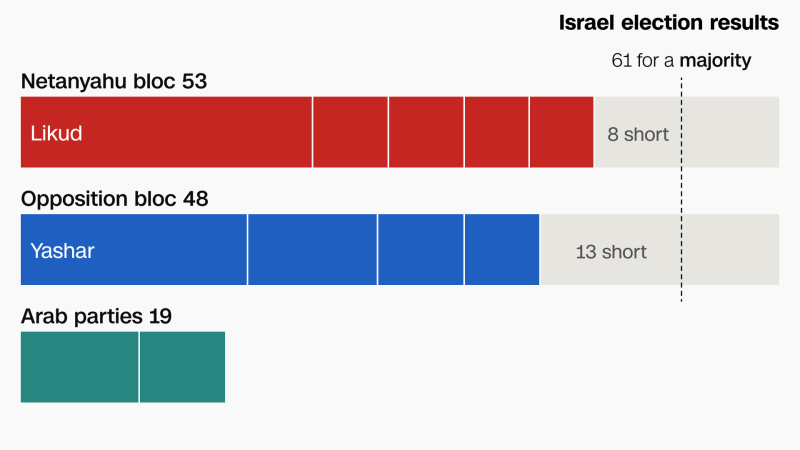
53 of them in fact. The Opposition Bloc had promised not to throw in with the Arab parties, so it’s unlikely they’ll partner-up to overthrow Netanyahu. It’s more likely Bibi can peel off some of the Opposition’s supporters and form a new government. At worst (for Bibi), the stalemate favors the incumbent as he’ll retain control as Prime Minister (i.e., as an interim caretaker). Regardless of whether the parties can agree to compromise and form a majority coalition to govern, or whether a new election will need to be called, any scenario will take time to evolve, and meanwhile Bibi is free to tap Iran.

As the week progressed, the Wall Street Journal reported that the US, specifically Vice President JD Vance had sent a letter to Mohsen Rezaei, the secretary of Iran’s Supreme National Security Council in an attempt to test a framework for negotiations. The letter was sent on Sunday, but the WSJ dropped its story at 3:59pm EST on Wednesday, about a minute before market close on a day when oil had bounced upwards by nearly $3/barrel.
Yet on Thursday, Mohammad Ghalibaf, Iran’s Speaker of the Parliament tweeted that Iran’s 7 conditions still remained in effect before negotiations can begin (i.e., ending all military actions, releasing frozen assets, withdrawing US forces from the Middle East, or removing the blockade).

If true, then this is likely already a non-starter as the US needs (or wants) Iran’s nuclear issue to be on the table. So despite the entreaties, Iran keeps tapping the sign on the wall. 7 conditions, no less and no more. What’s even more frustrating for the administration though is Iran’s intractability, its unwillingness to start negotiating the nuclear file without concessions landing first.
That intransigence means we’re at a stalemate, and as we noted before, time is the very thing the US doesn’t have much of. Flows through the Middle East are still down 5-6M bpd, despite the exorbitant costs of clustering and shuttling tankers under US military protections.
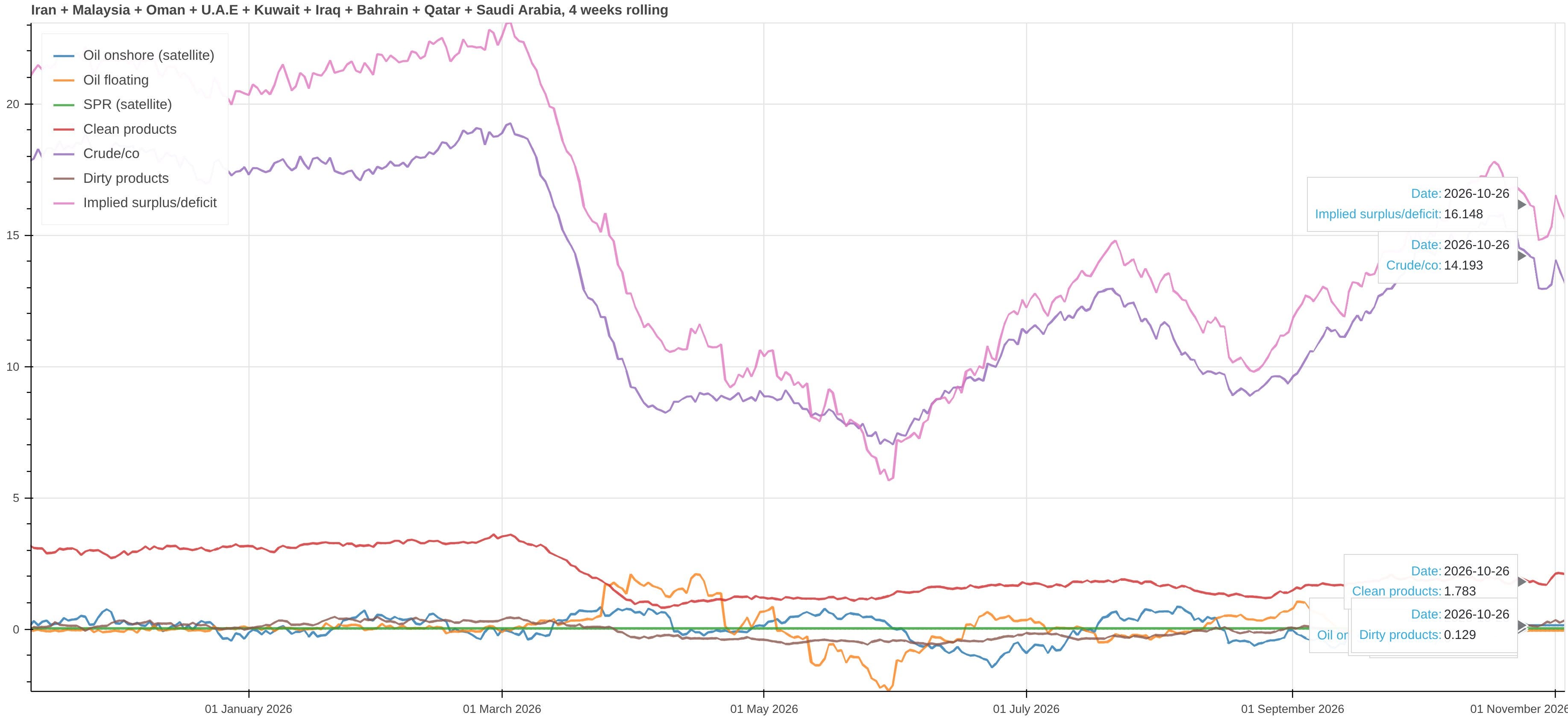
None of this is sustainable economically or militarily.
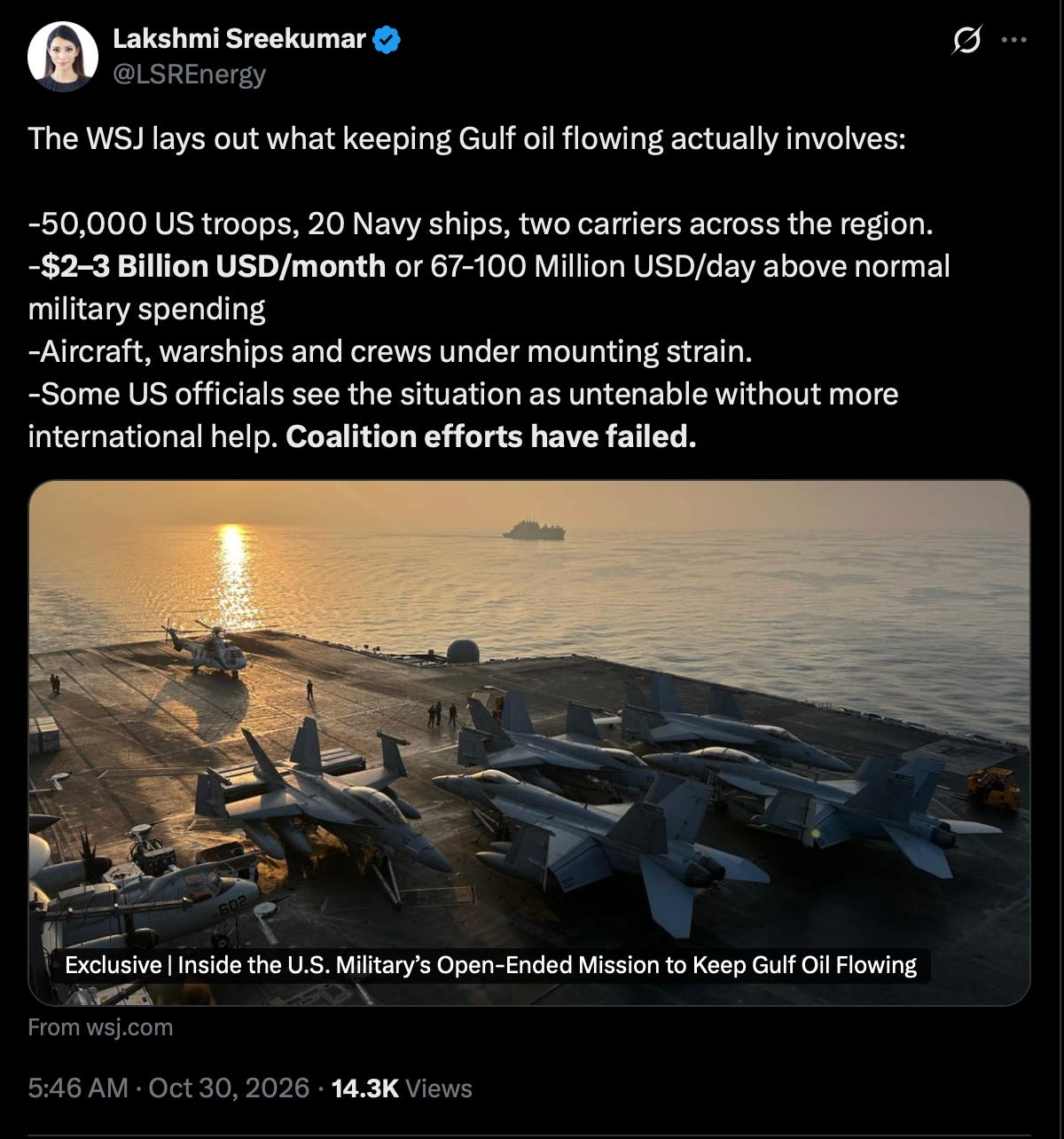
We persist though because what choice do we have?
So unless the diplomats can move Iran off of its maximalist positions, we’ll need to win concessions on the battlefield, and the only way to do that is “shock and awe.” The next phase of campaign will need to exact a toll such that the party sitting across from the US/Israel will be a conciliatory one.
For Iran, at this stage it just has to survive, and by surviving we mean literally and figuratively. Literally because the US is likely planning to target Iranian leadership in the next round of strikes. Figuratively because even if some members don’t survive, the remaining cadre can step into a new role as a regional superpower if it can run out the clock. WTI is at $105/barrel and Brent at $117/barrel, with physical prices nearly $17/barrel above that. The alarm bells are starting to ring.
Something has to give here, “neither peace nor war” works for nobody, and unless a diplomatic breakthrough is achieved, we need to climb the escalation ladder. Unfortunately, cheap and plentiful drones and ballistic missiles have shifted the balance of power, and we’re all just getting used to that idea 9 months later. So the US and Israel should be careful when advocating for regime change, because it could just be coming, perhaps just not quite the country you were expecting.
Please hit the “like” button and subscribe below if you enjoyed reading the article, thank you.